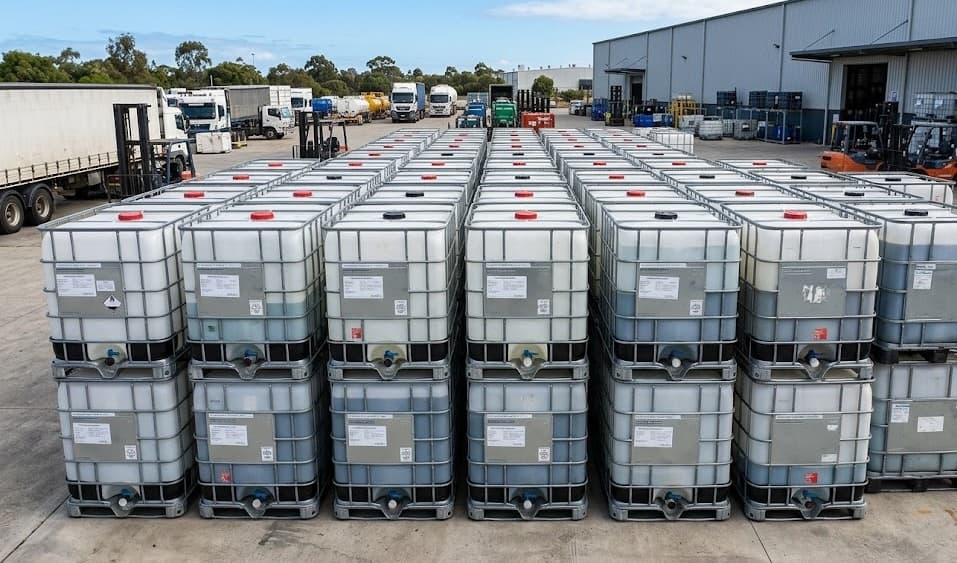
IBC Tote Resource Guide
Everything you need to know about intermediate bulk containers — from sizing and types to safety and regulations. Built by the West Coast's IBC specialists.
What Is an IBC Tote?
An Intermediate Bulk Container (IBC) is a reusable industrial container designed for the transport and storage of bulk liquids, powders, and granulated substances. IBCs sit between drums (typically 55 gallons) and full-size tanks (500+ gallons) in capacity, with the most common sizes holding 275 or 330 gallons.
The standard IBC tote consists of an HDPE (high-density polyethylene) inner bottle mounted inside a tubular steel cage, sitting on a pallet base — usually wood, steel, or composite. This design makes them forklift-accessible, stackable, and far more space-efficient than drum arrays.
The term "tote" is North American industry slang. In Europe and Australia, these containers are typically referred to simply as IBCs or "bulk containers." Other regional names include "IBC tanks," "pallet tanks," "tote tanks," and "intermediate bulk bins" (for dry-goods variants). Regardless of the name, the fundamental design — a container engineered for mechanized handling that holds between 119 and 793 gallons — is what defines an IBC under international standards.
IBCs are used across virtually every industry that handles liquids: food and beverage, chemicals, pharmaceuticals, agriculture, coatings, and more. Their popularity has surged over the past two decades because they dramatically reduce handling time, warehouse footprint, and packaging waste compared to 55-gallon drums.
The global IBC market was valued at approximately $3.2 billion in 2023 and is projected to exceed $4.5 billion by 2030, driven by growth in chemical manufacturing, food processing, and the push toward sustainable packaging solutions. Composite IBCs account for over 60% of the total market, with stainless steel and flexible IBCs sharing the remainder.
Whether you are buying your first IBC or managing thousands, understanding the differences between sizes, types, and regulatory requirements can save significant money and prevent compliance issues. That is exactly what this guide covers.
The History and Evolution of IBC Totes
The IBC as we know it today traces its origins to the late 1970s and early 1980s, when European packaging companies began experimenting with alternatives to the 55-gallon drum. The drum had dominated bulk liquid handling since the early 1900s, but rising labor costs and the need for greater efficiency drove innovation.
Schutz GmbH, a German packaging company, is widely credited with developing the first commercially successful composite IBC in 1980. Their design paired a blow-molded polyethylene bottle with a galvanized steel cage on a pallet base — the same basic architecture used by the vast majority of IBCs sold today, more than four decades later.
In 1985, the United Nations adopted performance standards for intermediate bulk containers under the UN Recommendations on the Transport of Dangerous Goods. This standardization created the classification system still in use (31HA1, 31A, 31H2, etc.) and gave shippers confidence that IBCs met consistent safety benchmarks worldwide.
Mauser Packaging Solutions (now part of MAUSER Group) entered the market in the late 1980s, introducing its own composite IBC design and the S60x6 thread standard that remains one of the two dominant valve fittings globally. The competition between Schutz and Mauser drove rapid improvements in bottle durability, cage design, and pallet integration.
By the 1990s, IBC adoption had spread from Europe to North America and Asia. The chemical industry was the earliest large-scale adopter, but the food and beverage sector quickly followed as FDA-compliant HDPE resins became available. The introduction of rebottling — replacing the inner bottle while reusing the cage and pallet — in the mid-1990s created an entire reconditioning industry and dramatically improved the economics of IBC ownership.
Today, the IBC market continues to evolve. Recent innovations include anti-static HDPE formulations for flammable liquid handling, aseptic flexible IBCs with multi-layer barrier liners, heated IBCs for viscous products, and IoT-enabled smart IBCs with GPS tracking and fill-level sensors. Despite these advances, the core composite IBC design has remained remarkably stable — a testament to the original engineering.
IBC Key Facts — Quick Reference
The table below summarizes the essential specifications, market data, and operational benchmarks for IBC totes. Use it as a quick-reference cheat sheet.
| Fact | Detail |
|---|---|
| Full name | Intermediate Bulk Container |
| UN classification | 31HA1 (composite), 31A (metal), 31H2 (flexible) |
| Most common size (North America) | 275 US gallons (1,041 liters) |
| Most common size (Europe) | 1,000 liters (264 US gallons) |
| Standard pallet footprint | 48" x 40" (GMA standard) |
| Typical empty weight | 115-140 lbs (52-64 kg) for composite |
| Maximum gross weight (water) | ~2,400-2,900 lbs depending on size |
| Stacking limit (loaded) | 2 high (SG 1.2 or less) |
| Typical lifespan (multi-trip) | 5-10 years / dozens of fill cycles |
| Rebottling capability | New HDPE bottle into existing cage — extends life indefinitely |
| Primary material | HDPE bottle + galvanized steel cage |
| Temperature range (HDPE) | -40F to 150F (-40C to 65C) |
| Temperature range (stainless) | -40F to 400F (-40C to 204C) |
| Bottom valve size | 2" (50 mm) butterfly or ball valve |
| Top fill opening | 6" (150 mm) screw cap |
| Global market size (2023) | ~$3.2 billion |
| Estimated IBCs in circulation (global) | ~50 million units |
| Top manufacturers | Schutz, Mauser, Greif, Werit, Hoover Ferguson |
Browse the Guide
Select a topic below to dive into detailed, expert-level information.
IBC Size Chart
Complete dimensions, weights, and capacities for every standard IBC size — 275, 330, and 550 gallon with metric equivalents.
Read articleDeep DiveTypes of IBC Totes
HDPE composite, stainless steel, carbon steel, flexible — learn the differences, materials, and best applications for each type.
Read articleBuyer GuideHow to Choose the Right IBC
Decision framework covering liquid type, volume, FDA requirements, temperature range, stacking needs, and budget considerations.
Read articleComparisonIBC Totes vs. Drums
Side-by-side cost, space, handling, and environmental comparison. Learn when to switch from drums to IBCs and how to migrate.
Read articleSafetyIBC Safety & Handling
Safe handling procedures, storage requirements, stacking limits, chemical compatibility, inspection checklists, and PPE guidelines.
Read articleComplianceIBC Regulations & Compliance
UN/DOT certification marks, OSHA storage requirements, EPA rules for used containers, FDA food-grade standards, and West Coast regulations.
Read articleRecommended Reading Order
If you are new to IBCs or evaluating them for the first time, we recommend reading the guide articles in this sequence. Each article builds on concepts introduced in the previous one.
Types of IBC Totes
Start here to understand the different IBC constructions and materials. This foundational knowledge informs every decision that follows.
IBC Size Chart
Once you know the types, explore the exact dimensions, weights, and capacities. This is critical for warehouse planning and logistics.
How to Choose the Right IBC
Apply your knowledge of types and sizes to your specific application. This decision framework prevents costly mistakes.
IBC Totes vs. Drums
If you are currently using drums, this comparison quantifies the ROI of switching. Even if you have already chosen IBCs, it is useful context.
IBC Safety & Handling
Before receiving your first IBCs, ensure your team knows safe handling procedures, stacking rules, and inspection requirements.
IBC Regulations & Compliance
Finally, understand the regulatory landscape — UN/DOT marks, OSHA rules, EPA requirements, and state-specific regulations for the West Coast.
Size Quick Reference
| Spec | 275 Gal | 330 Gal | 550 Gal |
|---|---|---|---|
| Liters | 1,040 L | 1,250 L | 2,082 L |
| Footprint | 48" x 40" | 48" x 40" | 48" x 48" |
| Height | 46" | 53" | 53" |
| Weight (empty) | ~118 lbs | ~135 lbs | ~185 lbs |
| Gross weight (water) | ~2,415 lbs | ~2,890 lbs | ~4,780 lbs |
| Drums replaced | 5 drums | 6 drums | 10 drums |
See the full IBC size chart for detailed dimensions, valve sizes, and stacking specifications.
Did You Know? 15 Interesting Facts About IBCs
A single 275-gallon IBC replaces five 55-gallon drums, but takes up 35% less floor space than those same five drums on pallets.
The steel cage of a composite IBC can be reused through 20+ rebottling cycles. Only the HDPE bottle is replaced, making it one of the most sustainable packaging formats in industrial use.
The two dominant valve thread standards — NPS (American) and S60x6 (Mauser/European) — are NOT interchangeable and differ by less than 2mm in diameter. This causes countless compatibility headaches.
IBC totes were invented in Germany in 1980 by Schutz GmbH. The original design is remarkably similar to modern IBCs, showing how well-engineered the concept was from the start.
A fully loaded 275-gallon IBC filled with water weighs approximately 2,415 lbs — more than most compact cars. This is why forklift handling is mandatory, not optional.
The bottom-discharge valve on an IBC allows gravity drainage that recovers 99.5% of the contents. Drums typically leave 2-5% as residual waste, costing businesses thousands per year.
HDPE — the plastic used for IBC bottles — is the same material used in milk jugs and detergent bottles, just much thicker. It is chemically resistant to most acids, bases, and aqueous solutions.
An empty composite IBC can be folded flat by removing the bottle from the cage, reducing return-freight volume by up to 75%. However, cages cannot themselves be folded.
In the wine industry, stainless steel IBCs have become popular for fermenting and transporting wine in bulk. A single 350-gallon stainless IBC replaces about 1,750 standard wine bottles.
The IBC reconditioning industry processes millions of containers annually. A properly reconditioned IBC with a new bottle performs identically to a new unit at 40-60% of the cost.
Five 275-gallon IBCs of oil (1,375 gallons total) triggers the EPA SPCC rule requirement for a Spill Prevention, Control, and Countermeasure plan. Many small facilities unknowingly exceed this threshold.
IBCs can be fitted with heating blankets or jackets to maintain viscous products (like chocolate, resins, or heavy oils) at dispensing temperature without separate heated storage.
The UN performance testing for IBCs includes a drop test (1.2m), stacking test (1.8x gross weight for 28 days), internal pressure test, and leakproofness test — all before a design earns certification.
In California, used IBC totes that contained certain chemicals may be classified as hazardous waste under state rules even when they qualify as RCRA-empty under federal standards.
Smart IBCs with IoT sensors are now available from several manufacturers. These track GPS location, fill level, temperature, and tilt angle in real time — ideal for fleet management of reusable containers.
IBC Industry Statistics
Understanding the scale and trends of the IBC market helps contextualize purchasing decisions. Here are key market data points from industry reports and trade associations.
| Metric | Value | Context |
|---|---|---|
| Global IBC market value (2023) | ~$3.2 billion | Growing at ~6% CAGR through 2030 |
| North American market share | ~28% | Second largest region after Europe (~35%) |
| Composite IBC market share | ~62% | HDPE + cage is the dominant format by volume |
| Stainless steel IBC market share | ~18% | Growing fastest in pharma and food sectors |
| Flexible IBC market share | ~12% | Driven by one-way export and aseptic applications |
| Estimated global units in circulation | ~50 million | Including new, reconditioned, and used |
| Average rebottling cycles per cage | 5-8 cycles | Some cages exceed 20 cycles with maintenance |
| Reconditioned IBC share of North American sales | ~45% | Cost savings drive strong secondary market |
| Average lifespan of a composite IBC cage | 10-15 years | When maintained and rebottled as needed |
| Chemical industry share of IBC usage | ~40% | Largest single end-use sector globally |
| Food and beverage share | ~22% | Fastest-growing application segment |
| Year-over-year growth in IBC reconditioning | ~8% | Sustainability mandates accelerating adoption |
Who Uses IBC Totes? 12 Industries That Depend on Them
IBCs serve virtually every sector that handles liquids, pastes, or granulated materials in bulk. Here is a breakdown of the primary industries and how they use IBC totes.
Chemical Manufacturing
The largest IBC user by volume. Chemicals are stored, transported, and dispensed from IBCs throughout the supply chain. HDPE composites handle most water-based and acid-based chemicals; stainless steel is used for solvents and flammables.
Food & Beverage
IBCs transport fruit juices, liquid sweeteners, edible oils, sauces, wine, beer, and dairy ingredients. FDA-compliant new or certified reconditioned IBCs are required. Stainless steel is common for hot-fill and high-purity applications.
Pharmaceuticals & Biotech
Stainless steel IBCs with CIP/SIP capability are standard for pharmaceutical ingredients, purified water, and process intermediates. Full traceability and FDA 21 CFR Part 211 compliance are mandatory.
Agriculture & Farming
Liquid fertilizers, pesticides, herbicides, animal nutrition supplements, and irrigation water are commonly stored in IBCs. Used and reconditioned IBCs are popular for non-food agricultural applications due to cost savings.
Paints, Coatings & Inks
Water-based and solvent-based paints, industrial coatings, printing inks, and pigment dispersions are handled in IBCs. The bottom-drain valve enables nearly complete product recovery, reducing waste.
Personal Care & Cosmetics
Shampoo bases, surfactants, fragrances, and raw ingredients for cosmetics are transported in food-grade or dedicated IBCs. Stainless steel is preferred for fragrance compounds due to solvent content.
Water Treatment
Treatment chemicals (sodium hypochlorite, coagulants, pH adjusters) are delivered and stored in IBCs at municipal and industrial water treatment facilities. The 550-gallon size is popular for high-volume treatment plants.
Oil & Petroleum
Lubricants, hydraulic fluids, cutting oils, and petroleum-based products are stored in IBCs. Carbon steel and stainless steel IBCs are preferred for petroleum products that may soften HDPE over time.
Construction & Concrete
Concrete admixtures, curing compounds, form release agents, and waterproofing chemicals are delivered to job sites in IBCs. The forklift-accessible design is ideal for construction site logistics.
Automotive & Manufacturing
Coolants, degreasers, cleaning solutions, and process chemicals are managed in IBCs across automotive plants and general manufacturing. The reduced changeover time compared to drums increases production uptime.
Laundry & Cleaning Products
Commercial laundry operations and janitorial supply companies use IBCs for bulk detergents, disinfectants, and cleaning concentrates. Gravity-fed dispensing from IBCs is common in large laundry facilities.
Cannabis & Hemp Processing
Extraction solvents (ethanol, CO2), terpenes, and liquid concentrates are handled in IBCs. This rapidly growing industry requires both HDPE (for water-based) and stainless steel (for solvents) IBCs with full regulatory compliance.
Who Should Read This Guide?
Procurement Managers
Compare IBC types, sizes, and new vs. reconditioned options to make cost-effective purchasing decisions. Understand total cost of ownership and vendor evaluation criteria.
Warehouse & Logistics Teams
Understand stacking limits, handling procedures, and space optimization when storing and moving IBCs. Learn how many IBCs fit per truck and per warehouse bay.
EHS & Compliance Officers
Navigate UN/DOT markings, OSHA storage rules, EPA disposal regulations, and FDA food-grade requirements. Access inspection checklists and training resources.
Operations & Plant Managers
Evaluate whether to switch from drums to IBCs, choose the right container for your process, and reduce waste. Quantify ROI with our cost comparison tools.
Sustainability Directors
Assess the environmental benefits of IBCs over drums, calculate packaging waste reduction, and support ESG reporting with concrete data on reuse cycles and recyclability.
Quality Assurance Teams
Verify IBC cleanliness standards, traceability requirements, and cross-contamination prevention protocols for food-grade and pharmaceutical applications.
Shipping & Receiving Staff
Learn incoming inspection procedures, how to read UN data plates, and proper receiving documentation. Understand when to accept or reject an IBC delivery.
Small Business Owners
Get a comprehensive introduction to IBCs without industry jargon. Understand whether IBCs make sense for your scale and how to get started with your first order.
Printable Resources & Reference Materials
Many of the tables, checklists, and comparison charts in this guide are designed to be useful as printed reference materials for your warehouse, procurement office, or safety station. Here are some suggestions for making the most of this content:
IBC Inspection Checklist
Print the checklist from our Safety & Handling page and post it at receiving docks and filling stations. A 30-second visual check prevents the majority of IBC incidents.
Size Chart Quick Reference
The complete size chart with dimensions, weights, and capacities is ideal as a laminated wall poster for warehouse teams who need quick specs during operations.
Chemical Compatibility Guide
The material compatibility table from our Types page helps operators quickly verify whether a chemical is safe for HDPE, stainless, or carbon steel containers.
Buyer's Checklist
Use the buyer's checklist from How to Choose as a standard procurement form. Having answers to all 15+ questions before ordering ensures the right IBC every time.
Getting Started: New to IBC Totes?
If you have never purchased, used, or managed IBC totes before, this section will walk you through the fundamentals. We cover the basics that every first-time IBC user needs to know before placing their first order.
Step 1: Determine Your Needs
Before you shop for IBCs, answer these fundamental questions:
- What product will the IBC contain? This determines material compatibility (HDPE vs. stainless steel), required certifications (food-grade, UN/DOT rated), and cleaning requirements.
- How many gallons do you need per container? The 275-gallon is the most common and most cost-effective. If you need maximum capacity in the same footprint, choose 330 gallons.
- How will you fill and dispense? Top-fill through the 6-inch opening, bottom-drain via the 2-inch valve. Make sure your pumping equipment is compatible with the valve thread standard (NPS or S60x6).
- Where will you store the IBC? Indoors or outdoors? On a flat surface or in pallet racking? Verify your floor load capacity, ceiling height for stacking, and any secondary containment requirements.
- How will you move the IBC? You need a forklift with at least 2,500 lbs capacity and 36-inch forks. Hand-moving a filled IBC is not practical or safe.
Step 2: Choose New, Reconditioned, or Rebottled
There are three main categories of IBC tote you can purchase. Understanding the differences helps you make the most cost-effective choice for your application:
- New: Manufactured from virgin materials. Highest cost ($250-$400+). Required for certain pharmaceutical and high-purity applications. UN certification is always current.
- Reconditioned: Used tote that has been cleaned, inspected, and certified for reuse. Costs 40-60% less than new. Performance is equivalent to new for the vast majority of applications. This is what IBC West Coast specializes in.
- Rebottled: Existing cage and pallet fitted with a brand-new HDPE bottle. Combines the economics of reuse with the cleanliness of new. Ideal for food-grade and chemical applications where bottle condition is critical but cage reuse is acceptable.
For most agricultural, chemical, industrial, and water-handling applications, reconditioned Grade A totes deliver the best combination of quality, cost, and environmental responsibility.
Step 3: Place Your First Order
Contact IBC West Coast by phone, email, or our online quote form. Tell us your product, quantity, preferred grade, delivery location, and timeline. We will provide a detailed quote within one business day. For first-time buyers, we often recommend starting with a small test order (5-10 totes) to verify that our quality meets your standards before committing to larger volumes.
Step 4: Prepare for Delivery
Before your totes arrive, ensure you have adequate forklift capacity (minimum 2,500 lbs), a flat and level storage area, and any required secondary containment in place. If you plan to stack loaded IBCs, verify that your ceiling height accommodates two-high stacking (approximately 92 inches for 275-gallon totes). Brief your receiving team on the delivery schedule and any special handling instructions.
Step 5: Inspect Upon Receipt
When your totes arrive, perform a basic receiving inspection: verify the correct quantity and grade, check each tote for visible damage that may have occurred in transit, confirm the valve opens and closes smoothly, and verify the cap seal is intact. Compare the delivered totes against the certification documents included with the shipment. If anything is not right, call your account manager immediately.
Advanced Topics for Experienced IBC Users
Already familiar with the basics? These advanced topics go deeper into specialized areas of IBC management, optimization, and compliance.
Chemical Compatibility Deep Dive
Not all chemicals are safe for HDPE containers. Strong solvents, concentrated oxidizers, and certain hydrocarbons can degrade the bottle over time. Our types guide includes a comprehensive compatibility chart, but for edge cases, consult our team for a science-based recommendation on the right container material for your specific product.
ExploreUN/DOT Certification Decoding
The UN data plate on every certified IBC contains a wealth of information: packaging type, performance level, packing group rating, date of manufacture, and testing authority. Understanding how to read and interpret these markings is essential for regulatory compliance when shipping hazardous materials. Our regulations guide breaks down every code.
ExploreTotal Cost of Ownership Analysis
The purchase price of an IBC is just one component of its true cost. A complete TCO analysis includes procurement, freight, filling labor, storage costs, disposal or recycling costs, and the opportunity cost of capital tied up in container inventory. Our buyer guide includes a TCO framework that helps you compare new, reconditioned, and rebottled options on a true lifecycle basis.
ExploreMulti-Trip vs. Single-Trip Economics
Single-trip IBCs are thinner-walled and cheaper upfront, but they are designed for one fill cycle. Multi-trip IBCs cost more initially but can be reconditioned and reused multiple times. For businesses that consume totes regularly, multi-trip containers almost always deliver better economics over a three-year horizon, even accounting for cleaning and reconditioning costs.
ExploreStacking Optimization for Warehouse Density
Proper stacking can double your storage density, but getting it wrong can cause structural failures, spills, and safety incidents. Our size chart guide covers stacking limits by container type, specific gravity, and condition, plus guidance on floor load calculations and clearance requirements for fire sprinkler systems.
ExploreIBC Fleet Management Strategies
For businesses that manage dozens or hundreds of IBCs, fleet management strategies become critical: tracking container locations, monitoring fill cycles, scheduling reconditioning, managing deposits and returns, and optimizing reorder points. While we do not yet offer a full fleet management platform, our account team can help you develop a container management plan tailored to your operation.
ExploreVideo Resources and Tutorial Descriptions
Visual learners benefit from seeing IBC handling, inspection, and maintenance procedures demonstrated step by step. Below are descriptions of the tutorial topics we cover and recommend for anyone working with IBC totes.
How to Inspect an IBC Tote at Receiving
8-10 minutes
This tutorial walks through the complete receiving inspection process: verifying the delivery documents against the physical shipment, checking each tote for transit damage, testing the bottom valve for smooth operation, verifying the cap seal integrity, reading the UN data plate, and documenting your inspection results. This procedure takes 2-3 minutes per tote and catches the vast majority of issues before they become problems.
How to Safely Stack IBC Totes
6-8 minutes
Demonstrates proper two-high stacking technique: verifying that the lower tote is on a flat, level surface with no cage damage, centering the upper tote within the cage frame of the lower unit, checking that specific gravity does not exceed the data plate stacking limit, and securing outdoor stacks with strapping. Also covers common mistakes that cause stack failures.
How to Replace an IBC Valve
10-12 minutes
Step-by-step walkthrough of removing an old butterfly or ball valve and installing a replacement. Covers the two thread standards (NPS and S60x6), proper use of thread sealant tape, torque specifications for hand-tightening, and leak testing after installation. Also covers when to use adapters for cross-thread compatibility.
How to Read a UN Data Plate
5-7 minutes
Decodes every element on a UN certification marking: the packaging symbol, type code (31HA1), performance level (X, Y, or Z), specific gravity rating, hydrostatic test pressure, year and month of manufacture, authorizing country code, and manufacturer identification. Essential knowledge for compliance with DOT hazardous material shipping regulations.
How to Maximize Drainage from an IBC
7-9 minutes
Techniques for extracting the maximum product from an IBC tote, including proper valve positioning, the use of commercial tilting stands to angle the container toward the drain, compressed-air blowdown methods for residual product, and the economics of residual product loss (even 1% residual in a 275-gallon tote is 2.75 gallons of lost product per fill cycle).
How to Choose Between HDPE and Stainless Steel IBCs
12-15 minutes
A side-by-side comparison of composite HDPE and stainless steel IBCs covering material compatibility, temperature limits, weight differences, cost comparison (purchase and total lifecycle), cleaning and sanitization ease, regulatory considerations, and common applications for each type. Includes decision tree flowchart for making the right choice.
Ask an Expert
IBC totes seem simple, but the details matter. The wrong valve thread, the wrong grade, the wrong material compatibility, or the wrong stacking configuration can cause leaks, contamination, regulatory violations, or safety incidents. When you are not sure about something, ask us.
Our team includes specialists with deep expertise in HDPE chemistry and polymer degradation, chemical compatibility across thousands of substances, DOT and UN hazardous material shipping regulations, FDA food-grade compliance requirements, logistics optimization for bulk container shipping, and environmental compliance for container handling and disposal. We answer questions every day -- from simple sizing inquiries to complex regulatory scenarios.
There is no charge for technical consultations. We believe that helping you make the right decision upfront prevents problems downstream and builds the kind of trust that turns into a long-term business relationship.
Common questions we help with:
- Is my chemical compatible with HDPE, or do I need stainless steel?
- Can I legally ship this substance in a reconditioned IBC?
- What UN packing group do I need for my product?
- How many IBCs will fit in a 40-foot container to my export destination?
- What is the right valve type and thread standard for my existing equipment?
- How should I store IBCs containing flammable liquids to meet fire code?
- What documentation do I need for a food-grade audit?
Contact Our Technical Team
Phone, email, or our online form -- whichever is most convenient for you.
Phone: Available Mon-Fri 7am-5pm Pacific
Email: info@ibcwestcoast.com
Response time: Same business day
Typical Response Includes:
- Direct answer to your question with supporting details
- Relevant regulatory references or standards cited
- Product recommendations if applicable
- Links to relevant guide articles for deeper reading
- Follow-up offer for more complex scenarios
Need IBC Totes? We Can Help.
IBC West Coast buys, sells, reconditions, and transports used IBC totes across the entire West Coast. Whether you need a single tote or a full truckload, our team is ready to help.
Get a Free Quote