Frequently Asked Questions
Find answers to the most common questions about IBC totes, our products, services, ordering process, and more.
Ordering & Pricing
How do I place an order for IBC totes?
You can request a quote through our website contact form or by emailing info@ibcwestcoast.com. Provide the quantity you need, the grade preference, and your delivery location. Our team will respond with a detailed quote within one business day.
Is there a minimum order quantity?
No. We sell individual totes as well as full truckloads. Whether you need one container for a small project or hundreds for an industrial operation, we can accommodate your order.
How is pricing determined?
Pricing depends on the tote grade (A, B, or C), size, quantity ordered, and delivery location. Bulk orders receive automatic volume discounts. We provide transparent, itemized quotes with no hidden fees.
Do you offer bulk discounts?
Yes. Volume discounts are built into our pricing structure. The more totes you order, the lower the per-unit cost. Contact us with your quantity requirements for an exact quote.
Quality & Grades
What do the IBC tote grades (A, B, C) mean?
Grade A totes are in excellent condition with minimal cosmetic wear, clean interiors, and fully functional valves. Grade B totes show moderate cosmetic wear but are structurally sound and pressure-tested. Grade C totes have visible wear and are best suited for non-critical applications or storage.
Are reconditioned totes as good as new?
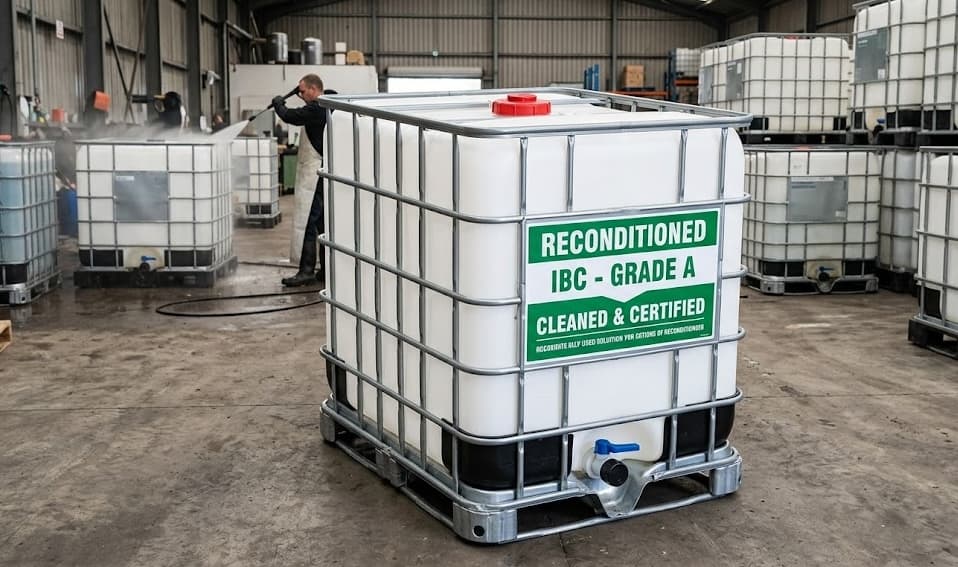
Reconditioned totes are cleaned, pressure-tested, and fitted with new components as needed. While they may show some cosmetic signs of previous use, they are functionally equivalent to new containers and meet the same safety and performance standards.
What quality checks do you perform?
Every tote goes through a five-step quality assurance process: visual inspection, triple-wash cleaning, pressure testing, component replacement (valves, gaskets, caps), and final certification with a tracking label.
Can I see photos of totes before purchasing?
Yes. Upon request, we can provide photos of the specific totes or a representative sample of the grade you are ordering. Email info@ibcwestcoast.com with your request.
Shipping & Delivery
Where do you deliver?
We deliver throughout the entire West Coast, including California, Oregon, Washington, Nevada, and Arizona. We also ship nationally for larger orders. Contact us for specific delivery availability to your area.
How long does delivery take?
Standard delivery within the West Coast takes 3 to 7 business days from order confirmation. Expedited shipping is available for urgent needs. Delivery timelines vary based on your location and order size.
Do you offer pickup options?
Yes. You are welcome to pick up your order directly from our facility. Coordinate your pickup time with our team by emailing info@ibcwestcoast.com so we can have your order staged and ready.
How are totes shipped?
Totes are shipped on pallets via flatbed or enclosed trailer depending on the quantity. They are stacked and secured to prevent damage during transit. A standard 53-foot trailer can hold approximately 56 totes.
Recycling & Buyback
Do you buy used IBC totes?
Yes. We purchase used IBC totes in all conditions. Whether you have a few empties or thousands of end-of-life containers, we will pick them up and pay you a fair price based on condition and quantity.
What happens to totes that cannot be reconditioned?
Totes that fail our quality inspection are disassembled and recycled. The HDPE bottle is shredded and sent to plastic recyclers, the steel cage is scrapped, and wooden pallets are repaired or chipped for mulch. Nothing goes to landfill.
How does the recycling pickup process work?
Contact us with the approximate number of totes and your location. We will schedule a pickup, load the totes onto our trucks, and provide payment based on the agreed rate. There is no cost to you for the pickup service on qualifying quantities.
Usage & Safety
What is the shelf life of an IBC tote?
The shelf life of an IBC tote depends on its storage conditions and the material stored in it. An empty tote stored indoors, out of direct sunlight, can remain in serviceable condition for many years. When filled, the HDPE bottle is generally rated for a useful life of five years from the date of manufacture if the tote is used within its rated temperature and chemical compatibility range. UV exposure, extreme heat, and incompatible chemicals can accelerate degradation. We recommend inspecting stored totes annually and replacing bottles that show signs of crazing, discoloration, or brittleness.
Can IBC totes be used for storing drinking water?
IBC totes can be used for non-potable water storage such as rainwater collection, irrigation, and industrial wash water. For potable (drinking) water, you must use a brand-new, food-grade IBC tote that has never held any chemical or non-food substance. The HDPE bottle must be manufactured from FDA 21 CFR 177.1520-compliant resin. We do not recommend using reconditioned totes for drinking water, as residual traces of previous contents may be present even after thorough cleaning. If you need containers specifically for potable water, contact us and we can source new food-grade units.
How should I dispose of an IBC tote?
IBC totes should never be sent to a landfill. The preferred disposal method is recycling. Contact us and we will pick up your end-of-life totes at no charge (minimum quantities apply). We disassemble each tote: the HDPE bottle is shredded and sold to plastics recyclers, the steel cage is sent to a scrap metal processor, and wooden pallets are either repaired or chipped for mulch. If the tote previously held hazardous materials, it must be triple-rinsed per EPA guidelines (40 CFR 261.7) before it can be recycled. We handle the entire process so you stay in compliance.
What is the difference between a rebottled and a reconditioned tote?
A reconditioned tote retains its original HDPE bottle, which is professionally cleaned, pressure-tested, and fitted with new gaskets, valves, and caps as needed. A rebottled tote goes further: the old HDPE bottle is completely removed and replaced with a brand-new blow-molded bottle, while the existing steel cage and pallet are retained after inspection and repair. Rebottled totes offer the cleanliness and integrity of a new container at a fraction of the cost. They are the preferred option for food-grade, pharmaceutical, or sensitive chemical applications where residual contamination must be eliminated entirely.
Can IBC totes be used for hazardous materials?
Yes, but only if the tote carries a valid UN certification for the specific hazard class and packing group of the material being transported. The UN marking code (e.g., UN 31HA1/Y/date) must be legible and current. UN certification expires based on the bottle manufacture date -- typically five years for composite IBCs. Reconditioned or rebottled totes can be re-certified if they pass hydrostatic testing and meet all performance requirements. Always consult the Safety Data Sheet (SDS) for your product and verify that the tote's UN rating matches the required packing group before filling.
Cleaning & Maintenance
How do you clean reconditioned totes?
Our reconditioning process uses a triple-wash system. First, the tote is pre-rinsed with high-pressure hot water to remove bulk residues. Second, it is washed with a food-grade alkaline detergent solution circulated at high temperature to dissolve organic compounds, oils, and films. Third, a final rinse with clean water ensures no detergent residue remains. For totes that previously held stubborn materials, we may use additional solvent rinses or steam cleaning. Every cleaned tote is visually inspected under bright light and, for food-grade certification, swab-tested to verify cleanliness before release.
How should I clean an IBC tote myself?
For basic cleaning between loads of the same product, a hot-water pressure rinse through the fill port is usually sufficient. For switching between different products, we recommend a three-step process: rinse with hot water, wash with an appropriate detergent (alkaline for organic residues, acidic for mineral scale), and rinse again until the water runs clear. Always remove the valve assembly and clean it separately. Allow the tote to drain completely and air-dry with the lid removed. For totes that held hazardous materials, EPA triple-rinse procedures (40 CFR 261.7) must be followed, and rinse water must be disposed of according to local regulations.
How do I prepare totes for pickup or buyback?
To prepare totes for our buyback program, drain all remaining contents and triple-rinse each tote if it held any chemical substance. Replace the valve cap and lid to prevent contamination during transport. Stack totes no more than two high on a level surface accessible by our truck. Remove any labels or placards that do not apply to the empty container. Have a count ready and, if possible, a list of what each tote previously held. Our driver will inspect the totes on-site and provide a receipt documenting quantity, condition, and agreed buyback value.
Customization & Services
Can you custom-label IBC totes?
Yes. We offer custom labeling services for bulk orders. We can apply your company logo, product name, GHS-compliant hazard labels, batch numbers, and barcodes to the tote cage using durable, weather-resistant adhesive labels or stenciled markings. Custom labeling is available on both reconditioned and rebottled totes. Provide your label artwork in PDF or vector format and we will produce and apply them before shipment. Lead time for custom-labeled orders is typically 3 to 5 additional business days.
Do you offer heating blankets or accessories for IBC totes?
We carry a range of IBC accessories including insulated heating blankets (120V and 240V), thermostat controllers, dust covers, UV protection covers, spill containment pallets, and dispensing stands. Heating blankets wrap around the tote and maintain contents at a set temperature, which is essential for products like oils, resins, and food ingredients that become too viscous to dispense in cold weather. Contact us for pricing and compatibility with your specific tote model.
Do you offer delivery, and what does it cost?
Yes, we deliver throughout California, Oregon, Washington, Nevada, and Arizona using our own fleet and trusted freight partners. Delivery cost depends on the quantity ordered, your location, and whether a liftgate or special equipment is required at the delivery site. For orders of 20 or more totes within the greater Bay Area, delivery is often included at no additional charge. We provide a firm delivery quote as part of every order proposal so there are no surprises. Expedited delivery within 24 to 48 hours is available for an additional fee.
What is your minimum order quantity?
There is no minimum order quantity. We sell individual totes for homeowners, small farms, and small businesses, as well as full truckloads for industrial operations. A standard 53-foot flatbed trailer holds approximately 56 totes, which is our most economical shipping configuration for large orders. Even if you only need one or two totes, you are welcome to pick them up from our Hayward facility or request delivery.
Do you supply new IBC totes, or only used and reconditioned?
Our core business is reconditioned and rebottled IBC totes, which offer significant cost savings and environmental benefits compared to new containers. However, we can source brand-new IBC totes for customers who require them -- for example, for first-use food-grade or pharmaceutical applications where a new bottle is mandatory. New totes are available in 275-gallon and 330-gallon capacities with your choice of valve type and pallet material. Contact us for new-tote pricing and lead times.
IBC Tote Specifications
What sizes of IBC totes do you carry?
We primarily stock 275-gallon and 330-gallon IBC totes, which are the most common sizes in industrial use. We occasionally have 110-gallon and 550-gallon units available. Contact us for current inventory.
What materials are IBC totes made from?
Standard composite IBC totes feature an HDPE (High-Density Polyethylene) inner bottle housed in a galvanized steel cage, mounted on a wooden or plastic pallet. The HDPE bottle is UV-stabilized and chemical-resistant.
What valve types are available?
The most common valve is the 2-inch buttress thread with a butterfly valve. We also carry cam-lock fittings, ball valves, and various adapter options. See our parts page for the full range of valve options.
Are your totes food-grade?
Many of our reconditioned totes are cleaned to food-grade standards and are suitable for FDA-regulated applications. Be sure to specify food-grade requirements when requesting a quote so we can match you with appropriately cleaned and certified containers.
What is the typical lifespan of an IBC tote?
A well-maintained IBC tote can be reconditioned and reused multiple times over a span of 5 to 10 years. The HDPE bottle can typically be refurbished 2 to 3 times before it needs to be replaced, while the steel cage and pallet last significantly longer.
What are the standard dimensions of a 275-gallon IBC tote?
A standard 275-gallon composite IBC tote measures approximately 48 inches long by 40 inches wide by 46 inches tall (including pallet). The pallet footprint is designed to match standard U.S. pallet dimensions of 48 by 40 inches. The overall height may vary by 1 to 2 inches depending on the manufacturer and pallet type. The fill port opening is 150mm (approximately 6 inches) in diameter, and the standard outlet is a 2-inch (DN50) buttress thread connection located at the bottom front of the tote.
How much does an IBC tote weigh when full?
The weight depends on the size of the tote and the specific gravity of the contents. A standard 275-gallon IBC tote has a tare weight (empty weight) of approximately 100 to 145 pounds depending on the pallet material and cage construction. When filled with water (specific gravity 1.0), the gross weight is approximately 2,400 to 2,450 pounds. When filled with a heavier liquid such as sulfuric acid (specific gravity 1.84), the gross weight can exceed 4,300 pounds. Always check the maximum gross weight rating stamped on the UN marking before filling -- exceeding this weight can cause structural failure.
What forklift requirements exist for handling IBC totes?
A standard forklift with a lifting capacity of at least 5,000 pounds is required to safely handle a fully loaded 275-gallon IBC tote. The forklift must have forks that are at least 42 inches long to fully engage the pallet entry channels. Shorter forks risk tipping the tote during transport. The forklift operator should insert forks fully into the pallet, lift the tote squarely, keep the load tilted slightly back during transport, and travel at a controlled speed. IBC totes should never be lifted by the cage, clamped by the bottle, or carried with the forks at an angle. Forklift operators should be trained and certified per OSHA 29 CFR 1910.178.
International Shipping & Regulations
Do you ship IBC totes internationally?
Our standard delivery area covers the five West Coast states, and we ship domestically across the United States for bulk orders. For international shipments, we can coordinate with freight forwarders to arrange container loading and export documentation. International shipping of IBC totes requires compliance with IMDG (International Maritime Dangerous Goods) Code if the totes contain or previously contained hazardous materials. Wooden pallets shipped internationally must carry the ISPM-15 heat treatment mark to meet phytosanitary requirements. Contact us with your destination country and we will help you navigate the logistics and compliance requirements.
What California-specific regulations apply to IBC totes?
California has several regulations that go beyond federal requirements. The California Department of Toxic Substances Control (DTSC) regulates hazardous waste containers under Title 22 of the California Code of Regulations, which has stricter definitions of hazardous waste than federal RCRA standards. California Proposition 65 requires warnings for products containing chemicals known to cause cancer or reproductive harm, which can apply to labels on IBC totes containing certain substances. Senate Bill 54 (the Plastic Pollution Prevention and Packaging Producer Responsibility Act) is reshaping packaging producer responsibility, and while IBC totes are currently categorized differently from consumer packaging, the regulatory landscape is evolving. The South Coast Air Quality Management District (SCAQMD) and Bay Area Air Quality Management District (BAAQMD) also regulate volatile organic compound emissions from container cleaning operations.
How do I read the UN markings on an IBC tote?
The UN marking on a composite IBC tote follows a standardized format. A typical marking reads: UN 31HA1/Y/date/country/manufacturer/test pressure/gross mass. Breaking this down: 'UN' indicates compliance with UN transport standards. '31' identifies the container as a rigid IBC for liquids. 'H' indicates a plastic inner receptacle. 'A' indicates a steel outer packaging. '1' means the container is designed for stacking. 'Y' indicates the performance level (X for Packing Group I, Y for Packing Groups II and III, Z for Packing Group III only). The date is the month and year of manufacture. The country code identifies where it was made. Additional markings include the maximum stacking test load in kilograms, the maximum gross mass in kilograms, and the hydrostatic test pressure in kilopascals. A valid UN certification typically expires five years from the manufacture date for composite IBCs.
Storage & Environmental Conditions
What are the best practices for outdoor storage of IBC totes?
If outdoor storage is unavoidable, follow these guidelines to protect your totes and their contents. Position totes on a level, well-drained surface such as concrete or compacted gravel -- never directly on bare soil, which can cause pallet rot and regulatory issues. Use UV-protective covers or store under a shade structure to reduce UV degradation of the HDPE bottle. Place totes inside secondary containment (spill pallets or containment berms) sized to hold at least 110 percent of the largest tote volume. Secure totes against wind with strapping or positioning against a wall or barrier. Check totes weekly for signs of UV damage, temperature-related stress, pest intrusion, and standing water on top of the fill cap. In areas with freezing temperatures, drain water-based products or use insulated blankets to prevent freeze damage.
How do I protect IBC totes from UV damage?
HDPE bottles in IBC totes are manufactured with UV stabilizers, but prolonged exposure to direct sunlight will still degrade the plastic over time. UV damage manifests as a chalky white surface, yellowing, crazing (fine surface cracks), and eventually brittleness that can lead to catastrophic failure. The most effective UV protection is to store totes indoors, under a roof, or inside a warehouse. If indoor storage is not possible, use commercial IBC tote UV covers made from UV-resistant fabric. These covers are designed to fit over the cage and block sunlight while still allowing access to the fill port and outlet valve. Alternatively, position totes in the shadow of a building or use a tarp. As a general rule, IBC totes stored in full sun in a hot climate like the Central Valley or Arizona should be rotated out of outdoor storage within 6 to 12 months to prevent significant UV degradation.
How should I winterize IBC totes?
In regions where temperatures drop below 32 degrees Fahrenheit (0 degrees Celsius), water-based products stored in IBC totes can freeze, expanding by approximately 9 percent and potentially cracking the HDPE bottle or bursting valve seals. To winterize your totes: drain all water-based products from totes that will be stored in unheated areas. For totes that must remain full, use insulated heating blankets (available in 120V and 240V configurations) with thermostat controllers set to maintain the contents above freezing. Alternatively, move totes into a heated building for the winter months. For empty totes stored over winter, leave the fill port cap slightly loose to allow moisture to escape and prevent condensation buildup inside the bottle. Inspect all totes for freeze damage in early spring before returning them to service.
Are there age limits for IBC totes?
For UN-certified totes used to transport hazardous materials, the service life is typically limited to five years from the date of manufacture stamped in the UN marking. After five years, the tote must pass a hydrostatic retest and re-inspection to be recertified for continued hazmat transport. For non-regulated applications (storing non-hazardous products), there is no hard regulatory age limit. The practical service life depends on storage conditions, UV exposure, chemical exposure history, and physical wear. A well-maintained tote stored indoors can remain serviceable for 10 years or more. The HDPE bottle is generally the component that determines end of life -- when it shows crazing, brittleness, or permanent deformation, the bottle should be replaced (rebottled) or the tote should be recycled. The steel cage and pallet can last 15 or more years with periodic maintenance.
Business & Purchasing
What is your bulk pricing structure?
Our pricing is tiered based on order quantity, tote grade, and delivery location. Volume discounts begin at orders of 10 or more totes and increase at 25, 50, 100, and full-truckload (56 tote) quantities. For example, a customer ordering 50 Grade B 275-gallon totes will pay a meaningfully lower per-unit price than someone ordering 5 of the same. We also offer annual contract pricing for customers with recurring monthly or quarterly needs, which locks in a favorable rate and guarantees priority inventory access. Contact us with your expected volume and we will provide a custom pricing proposal tailored to your requirements.
What is your return and exchange policy?
We stand behind the quality of every tote we sell. If a tote arrives with a defect that was not disclosed in the grade description -- such as a leak that was not caught during pressure testing, a valve that malfunctions, or a bottle condition that does not match the grade you ordered -- we will replace it at no charge or issue a full refund for the affected unit. Claims must be submitted within 7 business days of delivery with photos documenting the issue. For orders where the customer simply needs a different grade or quantity, we will work with you to arrange an exchange or credit toward a future order. Our goal is to make every transaction right, and our team has the authority to resolve issues quickly without bureaucratic delays.
Do you offer rush orders?
Yes. We understand that operational needs do not always follow a predictable timeline. For customers who need totes urgently, we offer rush processing and expedited delivery. If the totes you need are in stock at our Hayward facility, we can have them ready for same-day or next-day pickup. For delivered rush orders, we can arrange expedited freight with 24 to 48 hour delivery within California and 2 to 3 day delivery to other West Coast states. Rush orders are subject to a modest expediting fee that covers the cost of priority handling and premium freight. Call us directly to discuss your timeline and we will confirm availability and pricing on the spot.
Can I get custom colors or branded IBC totes?
Standard IBC totes come with natural (translucent white) HDPE bottles, which is the most common configuration in industrial use. For customers who need custom colors for branding, product identification, or safety coding, we can source totes with colored bottles (black, blue, and green are the most commonly available) from our manufacturing partners. Custom color totes require a minimum order quantity, typically 50 or more, and have a lead time of 4 to 6 weeks. We also offer custom labeling and stenciling services for applying your company logo, product name, GHS labels, barcodes, and any other required markings directly onto the tote cage.
Do I need insurance to store IBC totes?
While there is no universal legal requirement to carry insurance specifically for IBC tote storage, most commercial property insurance policies cover stored inventory including containers and their contents. If you store hazardous materials in IBC totes, your insurance carrier may require specific coverage endorsements for pollution liability, environmental cleanup, and third-party bodily injury. We strongly recommend consulting with your insurance broker to ensure your policy adequately covers the value of your tote inventory and contents, as well as any potential liability from spills, leaks, or container failures. For businesses storing flammable liquids, your insurer may also require compliance with NFPA 30 (Flammable and Combustible Liquids Code) as a condition of coverage.
Still Have Questions?
Our team is here to help. Reach out and we will get back to you within one business day with the answers you need.