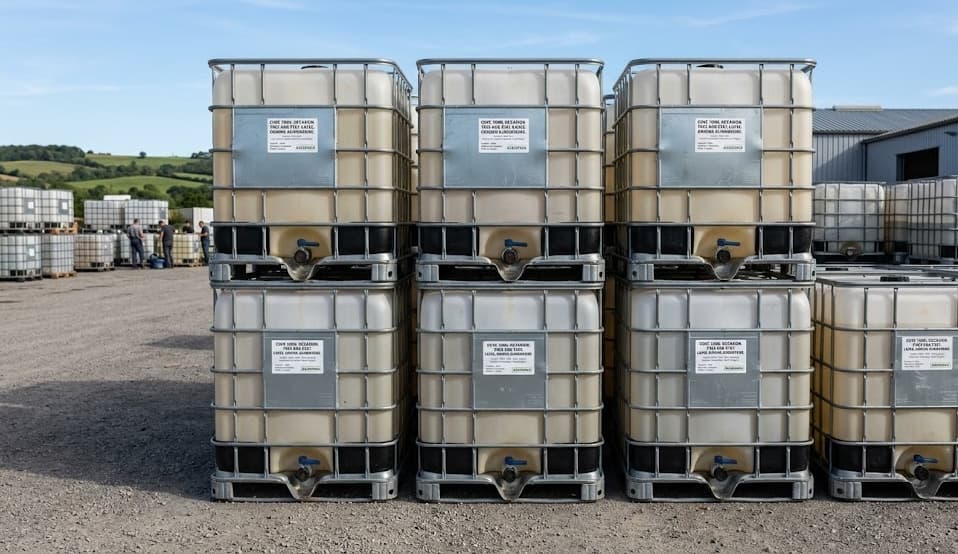
Transportation & Logistics
Dependable IBC tote pickup and delivery across the West Coast. Our fleet moves single pallets and full truckloads with equal precision.
Delivery & Pickup Services
Whether you are buying clean totes, selling surplus, or sending containers for recycling, we handle the transport end-to-end. No need to coordinate third-party carriers — our in-house fleet is purpose-built for IBC logistics.
Every load is secured with proper blocking and bracing to prevent shifting in transit. GPS-tracked trucks give you real-time visibility from pickup to drop-off.
For Buyers
We deliver purchased totes directly to your dock or yard. Standard delivery within 3-5 business days across our primary coverage area. Expedited options available for time-sensitive operations.
For Sellers & Recyclers
Schedule a pickup at your facility. Our crew loads the totes — you do not need a forklift or loading dock, though both speed up the process. Free pickup on recycling loads of 10+ totes.
Coverage Area
Our primary service area spans the entire West Coast, with extended routes reaching into the Mountain West.
California
Full coverage — Los Angeles, San Francisco, San Diego, Sacramento, Central Valley, and all points between.
Oregon
Portland metro, Salem, Eugene, Medford, Bend, and statewide industrial corridors.
Washington
Seattle, Tacoma, Spokane, Tri-Cities, and the greater Puget Sound region.
Nevada & Arizona
Las Vegas, Reno, Phoenix, Tucson — extended service with scheduled routes.
Idaho & Utah
Boise, Salt Lake City, and surrounding areas on a weekly route basis.
Fleet Capabilities
The right vehicle for every job. Our fleet is maintained to DOT standards and purpose-configured for safe IBC transport.
Flatbed Trucks
Open-deck flatbeds carry up to 56 totes per load. Ideal for standard and caged IBC totes.
Enclosed Trailers
Climate-protected transport for food-grade and chemical-sensitive containers.
Dedicated Pickups
Smaller box trucks for loads under 20 totes. Same-day and next-day available in metro areas.
Multi-Stop Routes
Consolidated loads across multiple facilities to reduce cost per unit on smaller orders.
Safety Protocols During Transport
IBC totes are bulky, heavy, and sometimes contain residual chemicals. Safe transport requires more than just loading them on a truck. Our drivers follow documented safety procedures on every run.
Load Securement
Every tote is secured per FMCSA cargo securement rules (49 CFR Part 393). Flatbed loads use ratchet straps rated to 5,000 pounds, edge protectors to prevent strap damage to HDPE bottles, and dunnage between rows to prevent shifting. We calculate aggregate working load limit for every shipment to confirm it exceeds the cargo weight.
Stacking Limits
Empty totes can be stacked up to four high on a flatbed with proper interlocking. Totes containing residual liquid are never stacked. Drivers verify stacking stability before departing, and loads are re-checked at each stop. Overheight loads are flagged and routed to avoid low-clearance bridges and overpasses.
Hazmat Residue Protocol
Totes with hazardous residue are placarded per DOT regulations. Drivers carry current HAZMAT endorsements on their CDL and have completed DOT-mandated hazardous materials training. Emergency response information, including Safety Data Sheets for the previous contents, is kept in the cab for every load that may contain residual chemicals.
Pre-Trip Inspection
Before every dispatch, drivers perform a full pre-trip inspection covering tires, brakes, lights, securement equipment, and load condition. Deficiencies are corrected before departure. Post-trip inspections are conducted upon return and documented in the vehicle maintenance log.
Driver Training
All drivers hold valid Class A CDLs and complete annual training on load securement, defensive driving, and spill response. Drivers handling totes with chemical residue hold HAZMAT endorsements and receive additional training on DOT hazardous materials transportation regulations.
Spill Response Readiness
Every truck carries a spill response kit containing absorbent pads, containment booms, nitrile gloves, and disposal bags. Drivers are trained on initial spill containment procedures and carry emergency contact numbers for our dispatch team and regional hazmat response coordinators.
Insurance & Liability Coverage
When your totes are on our trucks, they are our responsibility. We carry comprehensive insurance coverage that protects you against loss, damage, and third-party claims during transit.
Our commercial auto policy covers vehicle liability up to $1,000,000 per occurrence. Motor truck cargo insurance provides coverage for the value of goods in transit -- including both the totes themselves and any residual product. General liability insurance covers third-party bodily injury and property damage arising from our operations at your facility during pickup and delivery.
For shipments involving totes with hazardous residues, we carry pollution liability coverage that responds to spills or releases during transport. Certificates of insurance are available upon request and can be issued with your company named as additional insured if required by your risk management team.
Coverage Summary
Certificates of insurance available upon request. Additional insured endorsements issued within one business day.
Scheduling Flexibility
We understand that your production schedule dictates when totes need to arrive or be picked up. Our dispatch team works with you to find windows that minimize disruption to your operations.
Standard pickups and deliveries are scheduled Monday through Friday, 7:00 AM to 5:00 PM. For facilities with restricted receiving hours, early-morning, late-afternoon, and weekend appointments are available by arrangement. Recurring customers can set up standing weekly or biweekly routes, ensuring a consistent supply of clean totes or regular collection of empties without having to call each time.
Need to change a scheduled pickup? Adjustments made 24 hours or more in advance are free of charge. Same-day changes may be possible depending on route availability, though a rescheduling fee may apply. Our dispatch team confirms every appointment with a phone call or email the day before, so there are no surprises at the dock.
Seasonal Considerations
IBC tote logistics are affected by seasonal patterns that experienced shippers plan for in advance. Understanding these cycles helps you avoid delays and secure capacity when you need it most.
Spring and early summer see peak demand in the agricultural sector as growers stock up on liquid fertilizers, crop protection chemicals, and irrigation additives. Transport capacity tightens across the Central Valley and Pacific Northwest during these months. We recommend scheduling recurring agricultural deliveries by February to lock in route availability.
Winter brings freeze risk for totes containing water-based products. We use insulated blankets on enclosed trailers during cold-weather runs to Oregon, Washington, Idaho, and mountain routes. If your product is freeze-sensitive, let us know during scheduling so we can assign the right equipment.
Year-end inventory pushes in November and December often generate large volumes of surplus or end-of-life totes. Early scheduling for recycling pickups during this period ensures your yard is cleared before the new year without competing for limited truck availability.
Transparent Pricing
Transport costs depend on several factors. We quote every load individually so you only pay for what you need — no blanket surcharges.
- ✓Number of totes (volume discounts start at 20+)
- ✓Pickup and delivery distance
- ✓Single-stop vs. multi-stop route
- ✓Container type and stacking requirements
- ✓Urgency — standard, expedited, or same-day
Scheduling & Tracking
Book pickups and deliveries by phone, email, or through our online form. Once scheduled, you receive a confirmation with your estimated window and a tracking link so you can monitor progress in real time.
Need to reschedule? No problem — adjust your window up to 24 hours before the appointment at no extra charge.
Schedule a Pickup or DeliveryRoute Optimization
Moving IBC totes efficiently is not just about having trucks -- it is about putting the right totes on the right truck on the right route. Our dispatch team uses route optimization to minimize miles driven, reduce fuel costs, and get your totes to their destination faster. The savings from efficient routing are passed directly to our customers in the form of lower per-tote transportation costs.
Route optimization becomes especially powerful for customers who ship or receive totes on a recurring basis. By building your stops into our scheduled route network, we eliminate dead-head miles and consolidate loads, driving per-unit costs down significantly.
How Route Optimization Works
Scheduled Route Network
We maintain scheduled routes that run on fixed days each week across our coverage area. Major corridors include the I-5 corridor from San Diego to Seattle, the I-80 corridor from the Bay Area to Salt Lake City, the Central Valley agricultural belt, and the Pacific Northwest industrial corridor from Portland to Spokane. Orders placed on a scheduled route day ship at the lowest per-unit cost because they share the truck with other deliveries on the same corridor.
Multi-Stop Consolidation
When multiple pickups or deliveries fall within the same geographic area on the same day, our dispatch system consolidates them into a single truck route. This reduces the number of trucks on the road, lowers fuel consumption, and passes savings to every customer on that route. You benefit from shared transportation costs without compromising on delivery timing.
Return Load Matching
Every truck that delivers totes to a customer returns to our facility -- and an empty truck is a wasted trip. Our dispatch team actively matches return loads with pickup requests. If we are delivering totes to a customer 200 miles away and another customer within 30 miles of that delivery point needs a pickup, we combine both trips on one truck. This can reduce or eliminate transportation costs for the pickup customer.
Dynamic Rerouting
Real-world conditions change constantly -- traffic, weather, road closures, customer schedule changes. Our GPS-tracked fleet provides real-time position data that allows our dispatch team to reroute trucks mid-trip when conditions warrant. If a delivery destination reports a receiving delay, we can rearrange the stop sequence to keep the driver productive rather than idling at a dock.
Route Efficiency by Region
Multiple daily departures covering Silicon Valley, East Bay, Peninsula, North Bay, and San Francisco. Most deliveries and pickups completed within 4-6 hours of dispatch. Our Hayward facility is centrally located for maximum coverage efficiency.
Scheduled runs covering LA Metro, Inland Empire, Orange County, and the Port of Long Beach corridor. Overnight routes from Hayward arrive by early morning for dock-ready delivery.
Agricultural and food processing corridor from Bakersfield to Sacramento. Heavy during spring and summer growing seasons, with additional runs added to meet demand. Key stops include Fresno, Modesto, Stockton, and Sacramento.
I-5 corridor from Medford through Portland to Seattle/Tacoma. Portland stops served same-day. Seattle deliveries typically next-day from Portland. Spokane and Tri-Cities served on the eastern Washington extension route.
Extended routes to Las Vegas, Reno, Phoenix, Boise, and Salt Lake City. These routes run on fixed weekly schedules. Orders placed by Wednesday typically ship on the following Monday's route. Dedicated truck available for time-sensitive loads.
Hazmat Transport Capabilities
Transporting IBC totes that contain or previously contained hazardous materials requires specialized training, equipment, documentation, and insurance coverage. IBC West Coast maintains full hazmat transport capability across our fleet, so you do not need to coordinate with a separate hazmat carrier for totes with chemical residues.
Our hazmat capability covers the transport of empty totes with residual hazardous materials -- the most common scenario in IBC tote logistics. For totes containing full or partial loads of hazardous materials, additional requirements apply and we work with you on a case-by-case basis to ensure full DOT compliance.
Driver Qualifications
Documentation and Compliance
Common Hazmat Residue Categories We Transport
Corrosive Liquids (Class 8)
Acids (sulfuric, phosphoric, hydrochloric), caustic solutions (sodium hydroxide, potassium hydroxide)
Most common hazmat residue in IBC totes. Requires placarding when residue exceeds reportable quantity.
Flammable Liquids (Class 3)
Solvents (acetone, toluene, MEK), fuels, petroleum products, alcohol-based products
Fire risk requires no-smoking protocol and proper ventilation. Enclosed trailers equipped with ventilation.
Oxidizers (Class 5.1)
Sodium hypochlorite (bleach), hydrogen peroxide, potassium permanganate
Must be segregated from flammable materials during transport. Special loading procedures apply.
Toxic Substances (Class 6.1)
Pesticide concentrates, certain industrial chemicals, biocides
PPE required during loading/unloading. Spill response kit with appropriate absorbents on board.
Environmentally Hazardous (Class 9)
Various industrial chemicals classified as marine pollutants or environmental hazards
Requires Class 9 placard. Environmental cleanup protocols for any release during transport.
Empty Residue Containers
Any IBC tote that previously held a listed hazardous material and has not been cleaned to non-regulated status
Subject to 49 CFR 173.29 requirements for residue containers. Most common category in our operations.
Return Logistics Program
The return trip is just as important as the delivery. Empty IBC totes sitting in your yard take up space, create clutter, and represent idle capital. Our Return Logistics Program makes it easy to get empty, used, or surplus totes off your property and back into the supply chain -- whether they are headed for cleaning, resale, or recycling.
For customers who buy totes from us on a recurring basis, return logistics can be built directly into your delivery schedule. We drop off clean totes and pick up empties on the same trip, eliminating the need for separate scheduling and reducing transportation costs for both legs.
Coordinated Drop-and-Pick
The most efficient return logistics model. When our truck delivers a load of clean or purchased totes to your facility, the same truck picks up your empty or used totes on the same trip. This eliminates a separate pickup appointment and reduces transportation costs by 40-60% compared to scheduling delivery and pickup as independent jobs. Available for any customer on a recurring delivery schedule.
Scheduled Empty Pickup
For facilities that accumulate empties over time and want them picked up on a regular basis, we set up a standing pickup schedule -- weekly, bi-weekly, or monthly. Your empties are collected on the same day each cycle without requiring you to call and schedule. If you generate empties faster than expected, adding an extra pickup is a simple phone call to dispatch.
On-Call Pickup
For facilities with irregular or unpredictable empty accumulation, our on-call pickup service dispatches a truck within 3 business days of your request. This is ideal for project-based operations, seasonal businesses, or facilities that only generate surplus totes occasionally. No standing schedule required -- just call when you need a pickup.
Customer-Initiated Drop-Off
If you have your own trucks or prefer to handle transportation yourself, you can drop off empty totes at our Hayward facility during business hours at no charge. We accept any quantity, any condition, no appointment necessary. Drive in, unload, and drive out. Buyback payment or recycling credit is processed within 3-5 business days.
Cross-Customer Return Matching
In some cases, your empty totes do not need to come back to our facility at all. If another customer near your location needs totes and your empties are suitable for their application, we can coordinate a direct transfer. You receive buyback credit, the receiving customer gets totes with minimal transportation, and we eliminate unnecessary miles.
Pallet and Cage-Only Returns
If you have IBC tote cages, pallets, or other components without bottles -- perhaps from totes that were damaged or from bottles that were removed for other purposes -- we accept component returns as well. Steel cages and wood pallets have recycling value and are accepted for processing at our standard component buyback rates.
Cross-Docking Services
Cross-docking is a logistics strategy where inbound totes are received at our facility and immediately sorted and redirected to outbound trucks for delivery to their final destination, without entering long-term storage. This eliminates warehousing time and cost, and accelerates the movement of totes through the supply chain.
Our Hayward facility is strategically positioned in the San Francisco Bay Area with direct access to I-880, I-580, and I-238, making it an ideal cross-docking hub for IBC tote logistics across the West Coast. From Hayward, we can reach any point in California within a day and any point in the Pacific Northwest or Mountain West within two days.
How Cross-Docking Works for IBC Totes
Inbound Receiving
Totes arrive at our facility from suppliers, sellers, or your own operations. They are received, counted, inspected, and assigned to outbound destinations based on your instructions. Receiving happens within hours of arrival, not days.
Sort and Stage
Totes are sorted by destination, grade, or customer order and staged in our outbound loading area. If any totes require quick services -- valve checks, label replacement, or minor cleaning -- this is done during the staging window without adding significant time.
Outbound Dispatch
Sorted totes are loaded onto outbound trucks and dispatched to their final destinations. Outbound loads are scheduled to depart within 24-48 hours of inbound receipt. For time-critical shipments, same-day cross-docking is available when coordinated in advance.
Documentation and Tracking
You receive confirmation at each stage -- inbound receipt, sort completion, and outbound dispatch -- with tracking numbers for every outbound shipment. This gives you full visibility into the movement of your totes without requiring you to manage the logistics yourself.
Cross-Docking Use Cases
Multi-Destination Distribution
You have 200 totes that need to go to 8 different customer sites across the West Coast. Ship them all to our facility in one truckload, and we sort, stage, and dispatch individual deliveries to each destination on optimized routes. Far more cost-effective than shipping 8 separate partial loads from your facility.
Consolidation from Multiple Suppliers
You are purchasing totes from three different sellers across the state. Have all three sellers ship to our facility, where we receive, inspect, and consolidate the totes into a single delivery to your operation. One truck, one delivery appointment, one set of paperwork.
Service Integration
Totes arrive at our facility, receive cleaning or modifications, and are dispatched directly to their end destination without being returned to your location in between. This eliminates a round-trip and accelerates the total turnaround from pickup to final delivery.
Seasonal Surge Management
During peak seasons, your facility may not have space to stage large tote shipments. We receive and hold totes at our facility, releasing them to you in smaller batches on a schedule that matches your consumption rate. This effectively uses our yard as overflow storage without long-term warehousing fees.
Freight Cost Calculator Guide
Understanding what drives IBC tote transportation costs helps you budget accurately and identify opportunities to reduce your freight spend. While we quote every load individually based on its specific parameters, the factors below are what our dispatch team evaluates when building your quote. Knowing these factors puts you in a position to optimize your shipping decisions.
We do not publish a fixed rate card because IBC tote freight is too variable for flat-rate pricing to be fair to every customer. Instead, we provide transparent, line-item quotes that show exactly how your rate was calculated.
Primary Cost Factors
Distance
The single biggest factor. Freight cost increases with distance, but not linearly. Loads on our scheduled routes benefit from shared costs with other customers. Loads that require a dedicated truck to a one-off destination cost more per mile because the full round-trip cost falls on a single customer. Moving from a one-off delivery to a scheduled route can reduce your per-tote freight cost by 30-50%.
Volume (Number of Totes)
More totes per load means a lower per-unit cost. A full truckload of 56 totes costs the same to move as a half-load of 28 totes on the same route, so the per-unit cost is essentially halved. Volume discounts on transportation begin at 20 totes and increase at 40, 56 (full load), and multi-truck volumes.
Vehicle Type
Flatbed trucks are the most cost-effective for standard IBC totes. Enclosed trailers cost 10-20% more but provide weather protection for food-grade and temperature-sensitive loads. Dedicated box trucks for small orders (under 20 totes) have a higher per-unit cost due to the smaller payload but offer same-day service and tight delivery windows.
Urgency
Standard delivery (3-5 business days) is priced at our base rate. Expedited delivery (1-2 days) carries a 25% surcharge. Same-day delivery carries a 50% surcharge. These surcharges reflect the cost of interrupting scheduled routes and dispatching dedicated trucks on short notice.
Secondary Cost Factors
Tote Condition (Empty vs. Residue)
Clean, empty totes are the simplest and cheapest to transport. Totes with residual product add weight and may require specific handling (e.g., hazmat placarding for chemical residues). Full totes weigh approximately 2,400 lbs each, which limits the number per truckload and increases the per-unit transportation cost.
Loading and Unloading Conditions
Facilities with a dock and forklift allow fastest loading and unloading. If our driver must use a liftgate or hand-load totes (rare but possible for small orders), loading time increases and may be reflected in pricing. Rural locations without paved access may incur additional time charges.
Multi-Stop vs. Direct
A direct route from our facility to your facility is priced as a single point-to-point move. If your load requires multiple stops (e.g., delivering to two of your facilities on the same trip), each additional stop adds time and mileage. However, multi-stop routing within the same geographic area is often cheaper than scheduling separate deliveries.
Fuel Surcharge
Diesel fuel prices fluctuate. Our base rates are calculated at a benchmark fuel price. When diesel exceeds that benchmark, a fuel surcharge is applied as a percentage of the base freight rate. This surcharge adjusts monthly and is published transparently on every invoice. When fuel prices are below the benchmark, no surcharge is applied.
Seasonal Demand
During peak agricultural season (March through June), truck capacity tightens across the West Coast. Loads that can be scheduled in advance or placed on weekly routes are not affected. Spot loads on short notice during peak periods may see higher rates due to limited truck availability.
Tips to Reduce Your Freight Costs
Consolidate Orders
Combine multiple smaller orders into one larger shipment. Moving 50 totes on one truck costs far less per unit than moving 25 totes on two trucks.
Use Scheduled Routes
Place orders on our fixed route days instead of requesting dedicated trucks. Route-based shipping can save 30-50% versus dedicated service.
Plan Ahead
Standard 3-5 day delivery costs significantly less than expedited or same-day. If you can forecast your needs 1-2 weeks out, you avoid rush surcharges entirely.
Combine Delivery and Pickup
If you are buying totes and have empties to return, schedule both on the same truck. The return load ships at a steep discount because the truck is already making the trip.
Let Us Handle the Logistics
Stop worrying about how to move IBC totes. Our dedicated fleet and experienced drivers make it effortless.