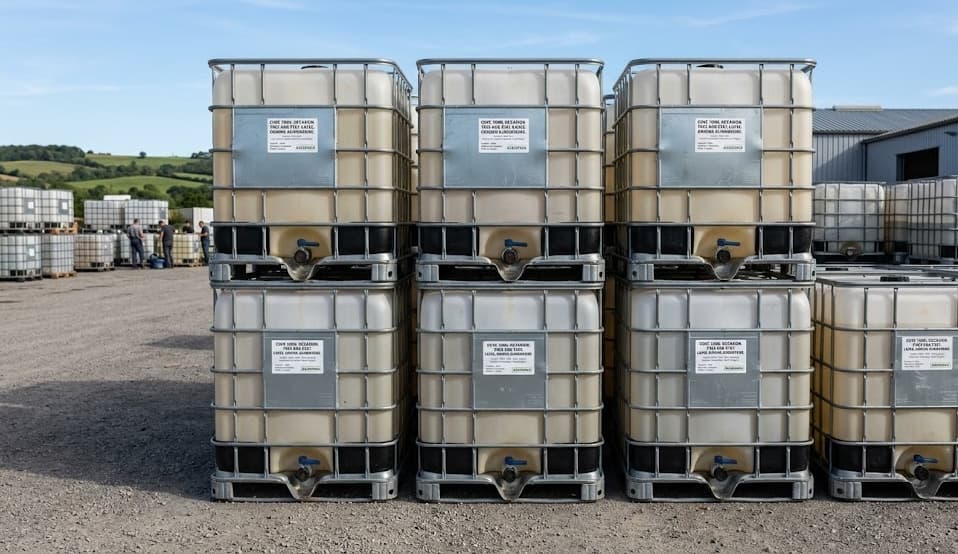
How to Choose the Right IBC Tote
Six critical factors to evaluate before you buy. This decision framework will save you money and prevent costly compatibility mistakes.
What Liquid Are You Storing?
This is the single most important factor. Your liquid's chemical properties determine which IBC material is safe to use. Consult the Safety Data Sheet (SDS) for your product and check the manufacturer's chemical compatibility chart.
- •Water-based solutions, mild acids, and caustics — HDPE composite is the standard choice and the most cost-effective.
- •Organic solvents (acetone, toluene, MEK, xylene) — Require stainless steel. HDPE will soften, swell, or permeate.
- •Flammable liquids with a flash point below 100°F — Stainless steel or carbon steel is strongly recommended. HDPE creates a static discharge risk that demands additional grounding/bonding measures.
- •Food ingredients (oils, syrups, juices) — FDA-compliant HDPE or food-grade stainless steel (304 or 316L). The IBC must be new or properly reconditioned with documented cleaning.
- •Concentrated acids (sulfuric >50%, hydrofluoric) — HDPE handles most strong acids well, but verify concentration limits. Stainless 316L for nitric acid applications.
How Much Volume Do You Need?
IBCs come in several sizes, but three dominate the market. Choosing the right size avoids paying for unused capacity or running short mid-batch.
- •275 gallons (1,040L) — The North American standard. Best for pallet racking, standard trailers, and replacing five 55-gallon drums.
- •330 gallons (1,250L) — Same floor space as a 275, just taller. Gives you 20% more capacity at a modest price increase. Ideal when ceiling height allows.
- •550 gallons (2,000L) — Wider footprint (48" x 48"). Best for high-volume static storage, water treatment, and agricultural applications.
- •Rule of thumb: if you currently use 4–6 drums of the same liquid, one 275-gallon IBC replaces them. For 6–8 drums, consider the 330.
Do You Need FDA or Food-Grade Compliance?
If your product is a food ingredient, beverage component, pharmaceutical, or cosmetic, the IBC must meet FDA 21 CFR requirements for food-contact surfaces.
- •New food-grade HDPE IBCs are manufactured with virgin resin and documented cleaning — they come with a certificate of conformance.
- •Reconditioned food-grade IBCs are available but must have been previously used only for food-grade products and properly cleaned/inspected.
- •Stainless steel IBCs are inherently food-grade when cleaned and sanitized. 304 is standard; 316L is used for acidic foods.
- •Never use a previously chemical-laden IBC for food products, even after cleaning. Cross-contamination risk is too high.
- •Keep documentation: lot numbers, cleaning certificates, and previous-content records for food-safety audits.
What Temperature Range?
Temperature limits vary dramatically by IBC material. Exceeding them can cause warping, seal failure, or structural collapse.
- •HDPE composite: safe from -40°F to 150°F (-40°C to 65°C). Above 150°F, the bottle softens and can deform under load.
- •Stainless steel: -40°F to 400°F (-40°C to 204°C). Suitable for hot-fill operations and steam cleaning.
- •Carbon steel (lined): typically -20°F to 250°F, depending on the lining material.
- •If you need to fill above 140°F, HDPE is borderline — stainless is the safe choice.
- •For cold storage and freezing, HDPE performs well. Stainless excels here too but is more expensive.
Will You Stack Them?
Stacking is a major space-saver but imposes strict requirements on IBC condition and load limits.
- •Standard HDPE composite IBCs are rated for 2-high stacking when loaded (UN stacking test).
- •The cage — not the bottle — bears the stacking load. Damaged cages, bent corner posts, or warped pallets make stacking unsafe.
- •Specific gravity matters: liquids heavier than water (SG > 1.2) may reduce allowable stacking. Check the data plate.
- •Empty IBCs can be stacked 3–4 high, but must be secured against tipping in wind or seismic zones.
- •If stacking is critical to your layout, buy multi-trip rated IBCs with heavier-gauge cages.
New, Reconditioned, or Used?
Budget is always a consideration. The used IBC market offers significant savings, but the right choice depends on your application.
- •New: full manufacturer warranty, UN certification intact, required for pharma and first-use food-grade.
- •Reconditioned (rebottled): new HDPE bottle installed in a cleaned and inspected cage with a new pallet if needed. 40–60% of new price. Carries a new manufacture date and UN rating.
- •Used (as-is): lowest cost, 20–40% of new price. Inspected for leaks and structural integrity but no rebottling. Suitable for non-critical water, agriculture, and non-food chemicals.
- •IBC West Coast offers all three tiers. Our reconditioned totes are the best value for most West Coast operations.
Common Mistakes to Avoid
Ignoring chemical compatibility
Always cross-reference the SDS with the IBC material. A wrong match can cause leaks, contamination, or dangerous reactions.
Buying on price alone
A cheap used IBC that fails in your process costs far more than the savings. Factor in downtime, cleanup, and disposal costs.
Overlooking valve thread standards
NPS and S60x6 (Mauser) threads look similar but are not interchangeable. Verify your pump and hose connections before ordering.
Assuming all used IBCs are food-safe
A cleaned IBC that previously held chemicals is never food-grade. Require documented previous-content history for food applications.
Stacking damaged IBCs
A single bent cage corner post or cracked pallet can cause a stack collapse — 2,400+ lbs of liquid crashing down. Inspect before stacking.
Storing HDPE IBCs in direct sunlight for years
UV exposure degrades HDPE over time, making the bottle brittle. Use UV-protective covers or store indoors for long-term storage.
IBC Buyer's Checklist
Use this checklist before placing your order. Having clear answers to these questions ensures you get the right IBC the first time.
- Product name and SDS available?
- Chemical compatibility verified with IBC material?
- Required capacity determined (gallons/liters)?
- Fill temperature range known?
- Storage temperature range known?
- FDA / food-grade required? (If yes, new or certified reconditioned only.)
- UN/DOT rating required for transport?
- Stacking requirements defined (how high, loaded or empty)?
- Valve type and thread standard confirmed (NPS vs. S60x6)?
- Pallet type preference (wood, steel, composite)?
- Budget per unit and quantity needed?
- Delivery location and timeline confirmed?
Quick Decision Matrix
Answer these four questions to narrow your IBC selection down to one or two options. Start at the top and follow the path that matches your situation.
| Your Situation | Recommended IBC Type | Condition | Typical Size |
|---|---|---|---|
| Water-based chemical, non-food, moderate volume | HDPE Composite (31HA1) | Reconditioned or used | 275 gal |
| Water-based chemical, non-food, high volume or tall storage | HDPE Composite (31HA1) | Reconditioned or new | 330 gal |
| Food ingredient, beverage, or cosmetic (first use) | HDPE Composite, food-grade | New only | 275 or 330 gal |
| Food ingredient (refill program, closed loop) | HDPE Composite, food-grade | Certified reconditioned | 275 gal |
| Organic solvent (acetone, toluene, MEK, xylene) | Stainless Steel 304 | New or used | 350 gal |
| Flammable liquid, flash point below 100 F | Stainless Steel 304 or Carbon Steel | New or used | 350 gal |
| Corrosive acid (nitric, phosphoric, concentrated) | Stainless Steel 316L | New or used | 350 gal |
| Hot-fill above 150 F | Stainless Steel 304 or 316L | New or used | 350 gal |
| Pharmaceutical or high-purity | Stainless Steel 316L | New | 350 gal |
| One-way export, return logistics too costly | Flexible / Collapsible (31H2) | New | 275 gal |
| Agricultural irrigation, rainwater, non-critical | HDPE Composite (31HA1) | Used (as-is) | 275 or 330 gal |
| Large static storage (water treatment, ag tanks) | HDPE Composite (31HA1) | New or reconditioned | 550 gal |
This matrix covers the most common scenarios. For edge cases -- mixed chemicals, extreme temperatures, or unusual volumes -- contact our team for a custom recommendation.
Industry-Specific Recommendations
Different industries have different priorities. Here is what we typically recommend for the most common sectors we serve on the West Coast.
Agriculture and Irrigation
Used or reconditioned HDPE 275-gallon IBCs are the standard. For fertilizer concentrates, verify HDPE compatibility with the specific formulation. Drip-irrigation operations benefit from the bottom-drain valve for gravity feed. For large-volume water storage, 550-gallon IBCs reduce the number of units needed.
Food and Beverage
New food-grade HDPE IBCs for first use. Certified reconditioned units work for closed-loop refill programs where previous contents are documented. Stainless steel 304 or 316L for acidic juices, hot sauces, or any product filled above 140 F. Always require a Certificate of Conformance and maintain chain-of-custody documentation.
Chemical Manufacturing
Material selection is entirely driven by chemical compatibility. HDPE handles most acids and bases. Stainless 316L is required for nitric acid, high-chloride solutions, or any application requiring CIP (clean-in-place). Carbon steel with epoxy lining is a cost-effective middle ground for industrial solvents where stainless is overkill.
Cleaning Products and Detergents
Reconditioned HDPE 275-gallon IBCs are the workhorses of this industry. Surfactants, degreasers, and dilute acid/base cleaners are fully compatible with HDPE. Ensure the valve type matches your filling line -- NPS 2-inch butterfly is most common. For concentrated bleach (sodium hypochlorite), HDPE is the only practical choice as it corrodes stainless steel.
Cannabis and Hemp Processing
Ethanol extraction requires stainless steel IBCs for solvent storage and transport -- HDPE is not compatible with ethanol at high concentrations. For water, nutrients, and non-solvent liquids, reconditioned HDPE is fine. California and Oregon have additional state-level permitting requirements for cannabis processing facilities.
Construction and Concrete
Admixtures, curing compounds, and form-release agents typically go in reconditioned HDPE IBCs. Concrete admixtures can be highly alkaline -- verify compatibility. For job-site water storage, used IBCs are the most economical option. Ensure IBCs on construction sites are secured against tipping and clearly labeled.
Budget Planning: What to Expect
IBC pricing varies significantly based on material, condition, and quantity. Use the ranges below to budget your purchase. These are approximate 2025-2026 West Coast market prices.
| IBC Type | New Price Range | Reconditioned | Used (As-Is) | Cost per Gallon (New) |
|---|---|---|---|---|
| HDPE 275 gal (standard) | $280 - $400 | $90 - $180 | $40 - $90 | $1.02 - $1.45 |
| HDPE 275 gal (food-grade) | $320 - $450 | $150 - $250 | N/A | $1.16 - $1.64 |
| HDPE 330 gal | $320 - $450 | $110 - $200 | $50 - $100 | $0.97 - $1.36 |
| HDPE 550 gal | $500 - $700 | $200 - $350 | $80 - $150 | $0.91 - $1.27 |
| Stainless Steel 304 (350 gal) | $2,500 - $4,000 | $1,200 - $2,000 | $800 - $1,500 | $7.14 - $11.43 |
| Stainless Steel 316L (350 gal) | $3,500 - $5,500 | $1,800 - $3,000 | $1,200 - $2,200 | $10.00 - $15.71 |
| Carbon Steel (lined, 350 gal) | $1,500 - $2,500 | $700 - $1,200 | $400 - $800 | $4.29 - $7.14 |
| Flexible / Collapsible (275 gal) | $150 - $300 | N/A | N/A | $0.55 - $1.09 |
Hidden Costs to Factor In
- Freight: IBC delivery costs vary by distance and quantity. Full truckloads (20 units) are significantly cheaper per unit than LTL (less-than-truckload) shipments of 1-4 IBCs. For Bay Area and Central Valley deliveries from Hayward, local delivery is often included or nominal.
- Valve adapters: If your fill or discharge equipment uses a different thread standard (NPS vs S60x6), budget $15-$40 per adapter.
- Secondary containment: If you are storing hazardous materials, containment pallets run $200-$600 each and hold one to four IBCs.
- Disposal or return: End-of-life IBCs need to be recycled, reconditioned, or disposed of. IBC West Coast picks up empties across California, Oregon, and Washington -- often at no charge if the IBC has resale value.
- Downtime from wrong selection: An incompatible IBC that fails in service costs far more than the price difference between the right and wrong container. Factor in cleanup, lost product, potential fines, and operational delay.
Still Not Sure? We Will Help You Choose.
Our team has decades of experience matching IBC types and sizes to real-world applications across the West Coast. Tell us what you are storing and we will recommend the best option.
Get Expert Advice