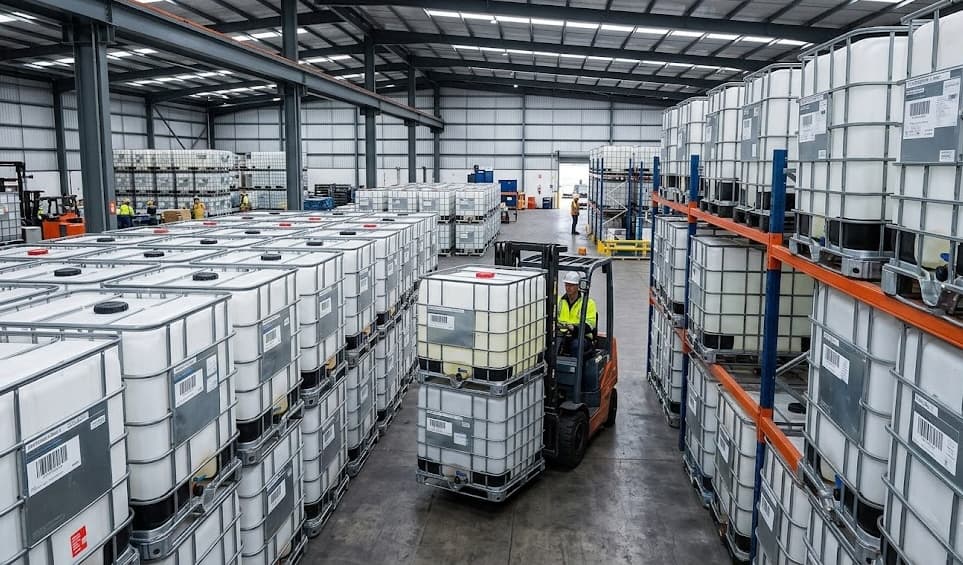
IBC Tote Size Chart
Every dimension, weight, and capacity spec you need — for 275, 330, and 550 gallon IBCs in both imperial and metric units.
Standard IBC Sizes at a Glance
The three most common IBC tote sizes in North America are the 275-gallon, 330-gallon, and 550-gallon. The 275 and 330 share the same 48" x 40" pallet footprint (standard GMA pallet), while the 550 uses a wider 48" x 48" base. Below is the complete dimensional breakdown.
| Specification | 275 Gallon | 330 Gallon | 550 Gallon |
|---|---|---|---|
| Capacity (US gal) | 275 gal | 330 gal | 550 gal |
| Capacity (liters) | 1,041 L | 1,249 L | 2,082 L |
| Capacity (Imperial gallons) | 229 Imp gal | 275 Imp gal | 458 Imp gal |
| Capacity (cubic feet) | 36.8 ft³ | 44.1 ft³ | 73.5 ft³ |
| Length | 48" (1,219 mm) | 48" (1,219 mm) | 48" (1,219 mm) |
| Width | 40" (1,016 mm) | 40" (1,016 mm) | 48" (1,219 mm) |
| Overall Height | 46" (1,168 mm) | 53" (1,346 mm) | 53" (1,346 mm) |
| Bottle Height (no pallet) | 38" (965 mm) | 45" (1,143 mm) | 45" (1,143 mm) |
| Pallet Height | ~6" (150 mm) | ~6" (150 mm) | ~6" (150 mm) |
| Cage tube diameter | 1" (25 mm) square tube | 1" (25 mm) square tube | 1.25" (32 mm) square tube |
| Tare Weight (empty) | ~118 lbs (54 kg) | ~135 lbs (61 kg) | ~185 lbs (84 kg) |
| Gross Weight (water-filled) | ~2,415 lbs (1,095 kg) | ~2,890 lbs (1,311 kg) | ~4,780 lbs (2,168 kg) |
| HDPE bottle wall thickness | ~2.5 mm (multi-trip) / ~1.8 mm (single-trip) | ~2.5 mm (multi-trip) / ~1.8 mm (single-trip) | ~3.0 mm (multi-trip) |
| Pallet Size | 48" x 40" | 48" x 40" | 48" x 48" |
| Pallet Material | Wood, steel, or composite (varies by manufacturer) | ||
| Top Fill Opening | 6" (150 mm) | 6" (150 mm) | 6" (150 mm) |
| Bottom Valve | 2" (50 mm) butterfly | 2" (50 mm) butterfly | 2" (50 mm) butterfly |
| Valve Thread | NPS 2" or S60x6 (Mauser) | NPS 2" or S60x6 (Mauser) | NPS 2" or S60x6 (Mauser) |
| Stacking (max loaded) | 2 high | 2 high | 2 high (manufacturer dependent) |
| Stacking (empty) | 4 high | 4 high | 3 high |
| UN Designation | 31HA1 (composite) | 31HA1 (composite) | 31HA1 (composite) |
| Floor area (footprint) | 13.33 ft² (1.24 m²) | 13.33 ft² (1.24 m²) | 16.0 ft² (1.49 m²) |
| Gallons per sq ft | 20.6 gal/ft² | 24.8 gal/ft² | 34.4 gal/ft² |
Weight Capacity by Liquid Density (Specific Gravity)
Not all liquids weigh the same. Water has a specific gravity (SG) of 1.0, but many chemicals and products are heavier. This table shows approximate gross weights for different liquid densities. Use it to verify your forklift capacity, racking load limits, and stacking safety.
| Liquid (Example) | SG | 275 Gal Gross Wt | 330 Gal Gross Wt | 550 Gal Gross Wt | Stack OK? |
|---|---|---|---|---|---|
| Water | 1.00 | 2,415 lbs | 2,890 lbs | 4,780 lbs | Yes (2H) |
| Vegetable oil | 0.92 | 2,230 lbs | 2,670 lbs | 4,415 lbs | Yes (2H) |
| Ethanol (denatured) | 0.79 | 1,930 lbs | 2,310 lbs | 3,810 lbs | Yes (2H) |
| Acetic acid (glacial) | 1.05 | 2,530 lbs | 3,030 lbs | 5,010 lbs | Yes (2H) |
| Sodium hydroxide 50% | 1.52 | 3,610 lbs | 4,325 lbs | 7,145 lbs | Check plate* |
| Sulfuric acid 50% | 1.40 | 3,340 lbs | 4,000 lbs | 6,610 lbs | Check plate* |
| Phosphoric acid 85% | 1.69 | 3,990 lbs | 4,780 lbs | 7,900 lbs | 1H only |
| Glycerin | 1.26 | 2,990 lbs | 3,580 lbs | 5,920 lbs | Check plate* |
| Liquid sugar (67 Brix) | 1.33 | 3,170 lbs | 3,800 lbs | 6,280 lbs | Check plate* |
| Diesel fuel | 0.85 | 2,080 lbs | 2,490 lbs | 4,110 lbs | Yes (2H) |
*SG above 1.2 may reduce stacking from 2-high to 1-high depending on the specific IBC model and its UN stacking test results. Always check the data plate. Gross weights include estimated tare weight of the container.
Imperial to Metric Conversion
Many IBC manufacturers, especially European brands like Schutz and Mauser, spec containers in metric. Here is a quick conversion table for common IBC measurements.
| Measurement | Imperial | Metric | Notes |
|---|---|---|---|
| 275 gallon capacity | 275 US gal | 1,041 liters | Often listed as "1,000L IBC" |
| 330 gallon capacity | 330 US gal | 1,249 liters | Often listed as "1,250L IBC" |
| 550 gallon capacity | 550 US gal | 2,082 liters | Sometimes called "2,000L IBC" |
| Standard pallet | 48" x 40" | 1,219 mm x 1,016 mm | GMA pallet standard |
| Wide pallet | 48" x 48" | 1,219 mm x 1,219 mm | Used for 550-gal IBCs |
| EUR pallet equivalent | 47.2" x 31.5" | 1,200 mm x 800 mm | European standard — IBCs typically use 1200x1000 |
| Fill opening | 6" diameter | 150 mm (DN150) | Standard screw cap |
| Discharge valve | 2" diameter | 50 mm (DN50) | Butterfly or ball valve |
| 1 US gallon | 128 fl oz | 3.785 liters | Conversion factor: multiply gal x 3.785 |
| 1 Imperial gallon | 160 fl oz (UK) | 4.546 liters | ~20% larger than US gallon |
Volume Conversion Quick Formulas
When sourcing IBCs internationally or converting between measurement systems, these formulas are indispensable. Bookmark this section for quick reference.
US Gallons to Liters
Gallons x 3.785 = Liters
275 gal x 3.785 = 1,041 L
Liters to US Gallons
Liters / 3.785 = Gallons
1,000 L / 3.785 = 264.2 gal
US Gallons to Cubic Feet
Gallons / 7.481 = ft3
275 gal / 7.481 = 36.8 ft3
Liters to Cubic Meters
Liters / 1,000 = m3
1,041 L / 1,000 = 1.041 m3
Pounds to Kilograms
Lbs / 2.205 = kg
2,415 lbs / 2.205 = 1,095 kg
Inches to Millimeters
Inches x 25.4 = mm
48" x 25.4 = 1,219 mm
Which Size for Which Application?
275 Gallon (1,000L)
The most common IBC size in North America. Its 48" x 40" footprint matches the standard GMA pallet, making it ideal for companies already using pallet racking and standard 53′ trailers.
Best For:
- Food and beverage ingredients
- Cleaning chemicals and solvents
- Agricultural products and fertilizers
- Operations using standard pallet racking
- Companies transitioning from 55-gallon drums
- Multi-product facilities needing manageable batch sizes
Truck Fit:
20 per 53′ trailer (single layer) or 40 double-stacked. Equivalent to 5,500 gallons single-layer or 11,000 double-stacked.
330 Gallon (1,250L)
Same pallet footprint as the 275 but roughly 7 inches taller. The extra height adds 55 gallons of capacity with zero additional floor space, making it the best value when ceiling height allows.
Best For:
- Chemical manufacturing and distribution
- Paint, coatings, and ink production
- High-volume operations needing max capacity
- Facilities with tall ceilings / no racking
- Export shipments where per-unit cost matters
- Maximizing truckload efficiency on long hauls
Truck Fit:
20 per 53′ trailer (single layer); stacking depends on weight. Equivalent to 6,600 gallons single-layer.
550 Gallon (2,000L)
A wide-body IBC sitting on a 48" x 48" pallet. Less common in the US but popular in specific industries. The increased footprint means fewer units per truckload but much higher per-container capacity.
Best For:
- Water and wastewater treatment
- Bulk oils and lubricants
- Agricultural irrigation supply
- On-site storage where floor space is ample
- Situations requiring fewer connections
- Static storage applications (not frequently moved)
Truck Fit:
18 per 53′ trailer (single layer). Stacking possible when empty. Equivalent to 9,900 gallons single-layer.
Shipping Container & Truck Fit Calculations
Maximizing container utilization reduces per-unit shipping costs. Below are detailed fit calculations for standard intermodal containers and domestic trailers.
| Container / Trailer | Internal Dimensions | 275 Gal (48x40) | 330 Gal (48x40) | 550 Gal (48x48) |
|---|---|---|---|---|
| 20ft ISO container | 19'4" x 7'8" x 7'10" | 8 single / 16 stacked | 8 single / 16 stacked* | 6 single / 12 stacked* |
| 40ft ISO container | 39'5" x 7'8" x 7'10" | 16 single / 32 stacked | 16 single / 32 stacked* | 12 single / 24 stacked* |
| 40ft HC container | 39'5" x 7'8" x 8'10" | 16 single / 32 stacked | 16 single / 32 stacked | 12 single / 24 stacked* |
| 53ft domestic trailer | 52'6" x 8'2" x 9'0" | 20 single / 40 stacked | 20 single / 40 stacked | 18 single / 36 stacked* |
| 48ft domestic trailer | 47'6" x 8'2" x 9'0" | 18 single / 36 stacked | 18 single / 36 stacked | 16 single / 32 stacked* |
Important Shipping Notes
- *Stacking may be weight-limited before count-limited. Check container/trailer max payload (typically 44,000 lbs for domestic, 47,900 lbs for 20ft ISO).
- 330-gal IBCs in standard 20ft containers may not fit double-stacked due to 7'10" ceiling vs. 106" stacked height. Use High Cube containers for stacking.
- Always verify door opening width accommodates IBC width (40" for 275/330, 48" for 550). Standard ISO container doors are 7'6" wide.
- International shipments must secure IBCs per IMDG Code or carrier requirements. Use blocking, bracing, and strapping.
- Weight distribution matters: place heavier IBCs toward the front/center of the container for trailer stability.
Forklift Compatibility Chart
Not every forklift can safely handle every IBC. Weight capacity, fork length, and lift height all matter. Use this chart to verify your equipment can handle the IBCs you plan to use.
| Forklift Spec | 275 Gal (water) | 330 Gal (water) | 550 Gal (water) | Notes |
|---|---|---|---|---|
| Min. lift capacity needed | 2,500 lbs | 3,000 lbs | 5,000 lbs | At 24" load center |
| Min. fork length | 36" (40" preferred) | 36" (40" preferred) | 42" (48" preferred) | Forks must fully enter pallet |
| Min. fork spread | 22" (for 40" wide pallet) | 22" (for 40" wide pallet) | 22" (for 48" wide pallet) | Adjustable spread recommended |
| Min. lift height for 2-high stack | 110" (275 size) | 120" (330 size) | 120" (550 size) | With mast fully extended |
| Aisle width needed | 10-12 ft (standard) | 10-12 ft (standard) | 12-14 ft (wide body) | For 90-degree turn with load |
| Recommended forklift class | Class I, IV, or V | Class I, IV, or V | Class I, IV, or V | Electric, IC cushion, or IC pneumatic |
Pallet Dimensions: US vs. International Standards
IBC pallet size directly affects compatibility with your racking, trailers, and international shipping. Here are the global pallet standards and how IBC sizes map to them.
| Pallet Standard | Dimensions | Region | IBC Compatibility |
|---|---|---|---|
| GMA (North America) | 48" x 40" (1219x1016 mm) | US, Canada, Mexico | 275 & 330 gal standard fit |
| EUR / EPAL | 47.2" x 31.5" (1200x800 mm) | Europe | Not standard for IBCs — too narrow |
| EUR 1200x1000 | 47.2" x 39.4" (1200x1000 mm) | Europe (IBC standard) | European 1000L IBC standard base |
| 48" x 48" (square) | 48" x 48" (1219x1219 mm) | US (specialty) | 550-gal IBC standard base |
| Australian Standard | 45.9" x 45.9" (1165x1165 mm) | Australia | Compatible with most IBC designs |
| ISO 1100x1100 | 43.3" x 43.3" (1100x1100 mm) | Asia-Pacific | Used for some Asian-market IBCs |
Stacking Guidelines & Weight Limits
One of the biggest advantages of caged IBCs over drums is stackability. However, stacking limits depend on the container condition, fill level, and contents. Always check the UN stacking test certification on the data plate.
| Condition | 275 Gal | 330 Gal | 550 Gal | Notes |
|---|---|---|---|---|
| Full (loaded), SG ≤ 1.2 | 2 high | 2 high | 2 high* | *Check data plate for 550 models |
| Full (loaded), SG > 1.2 | 1 high | 1 high | 1 high | Some premium models rated for 2H at higher SG |
| Empty (with cage) | 4 high | 4 high | 3 high | Cage must be undamaged |
| Reconditioned (loaded) | 2 high | 2 high | 1 high | Cage integrity must be verified |
| In transit (loaded) | 2 high | 2 high | 1 high | Must be secured/strapped |
| Stacked height (2H loaded, 275) | ~92 inches (7 ft 8 in) — verify fits under ceiling/sprinklers | NFPA 3-ft sprinkler clearance | ||
| Stacked height (2H loaded, 330) | ~106 inches (8 ft 10 in) — requires higher ceilings | Will not fit standard 20ft ISO container | ||
Critical Stacking Rules
- Never stack IBCs with damaged cages, bent corner posts, or warped pallets.
- The top IBC must sit squarely within the cage frame of the lower unit — the cage corners are the load-bearing members, not the bottle.
- Specific gravity above 1.2 may reduce allowable stacking from 2-high to 1-high. Check the data plate.
- Outdoor stacked IBCs must be secured with strapping or racking to prevent wind uplift when empty.
- OSHA recommends limiting stack heights to 2 totes when workers access the area on foot.
- UN stacking test standard: 1.8x the gross weight of the IBC must be sustained for 28 days without failure.
- In seismic zones (California, Oregon, Washington), local fire codes may impose lower stacking limits.
Fill Rate Optimization Tips
Maximizing the fill rate of each IBC reduces the number of containers needed, cuts shipping costs, and improves operational efficiency. Here are expert tips for optimizing fill rates.
Maximizing Fill Volume
- Always leave a minimum 2-inch (50 mm) headspace for thermal expansion — but no more than necessary for your product
- For hot-fill products, calculate expansion: most aqueous liquids expand ~0.02% per degree F. A 50F temperature increase on 275 gal = ~2.75 gal expansion
- Use level sensors or sight gauges to fill consistently to the optimal point
- If filling by weight rather than volume, use the formula: target weight = (capacity in gallons x 8.34 x SG) - headspace allowance
- Automated filling systems with flow meters reduce underfilling and overfilling
- For viscous products, allow extra settling time before capping to let air escape
Minimizing Residual Product
- The bottom-drain valve recovers 99.5%+ of contents vs. top-pump methods
- For viscous products, tilt the IBC slightly toward the drain valve (1-2 degrees) using a commercial IBC tilting stand
- Warm viscous products before draining — every 10F increase typically doubles flow rate for thick liquids
- Use a compressed-air blowdown for the last 1-2% of product in the bottle
- Install a siphon tube through the top cap for products that do not flow well by gravity
- Track residual volume per IBC over time — increasing residual indicates valve degradation or bottle deformation
Non-Standard & Specialty Sizes
While the 275, 330, and 550 gallon models cover the vast majority of applications, several specialty sizes exist for niche use cases.
| Size | Liters | Typical Type | Common Use | Availability |
|---|---|---|---|---|
| 110 gal | 416 L | Stainless steel | Pharma, small-batch chemical | Special order |
| 160 gal | 600 L | HDPE composite | European import, hazmat | Limited — EU sourced |
| 200 gal | 757 L | Stainless steel | Food processing, dairy | Special order |
| 264 gal | 1,000 L | HDPE composite | European standard IBC | Common (EU imports) |
| 350 gal | 1,325 L | Flexible / foldable | One-way shipments, export | Available |
| 400 gal | 1,514 L | Stainless steel | Wine/spirits, brewing | Special order |
| 450 gal | 1,703 L | HDPE composite | Specialty chemical, large batch | Rare — custom order |
| 793 gal | 3,000 L | Metal (max UN size) | Maximum IBC per UN definition | Very rare |
Non-standard sizes can be harder to source on the secondary market. If you are buying used IBCs, the 275 and 330 gallon HDPE composite totes are by far the most available. Contact us for current inventory and pricing.
International Standards: EU vs. US Sizing
If you import or export products in IBCs, understanding the differences between European and North American sizing conventions is essential for logistics planning.
| Specification | North American Standard | European Standard | Key Difference |
|---|---|---|---|
| Primary capacity | 275 US gal (1,041 L) | 1,000 L (264 US gal) | US is ~4% larger |
| Large capacity | 330 US gal (1,249 L) | 1,250 L (330 US gal) | Identical |
| Pallet footprint | 48" x 40" (1219x1016 mm) | 1200 x 1000 mm (47.2" x 39.4") | US is slightly wider |
| Pallet entry | 2-way or 4-way | Typically 4-way | EU emphasizes 4-way access |
| Valve thread dominant | NPS 2" (US standard) | S60x6 / DIN61 (Mauser) | NOT interchangeable |
| Fill opening | 6" / DN150 (both) | 6" / DN150 (both) | Same standard |
| UN marking authority | DOT (USA) | BAM (Germany) or national authority | Different approval codes |
| Bottle color | Typically natural/translucent | Often white or natural | No functional difference |
| Cage coating | Galvanized or powder-coated | Hot-dip galvanized standard | EU galvanization often heavier |
| ISPM-15 wood pallet | Required for export | Required for export | Both require heat-treated wood |
Valve & Fitting Reference
Valve compatibility is one of the most overlooked details when sourcing IBCs. The two dominant thread standards — NPS and S60x6 (Mauser/DIN) — are not interchangeable. Verify your system before ordering.
| Fitting | Thread | OD | Common On |
|---|---|---|---|
| Bottom valve (butterfly) | 2" NPS or S60x6 | 2.375" / 60 mm | All HDPE composites |
| Bottom valve (ball) | 2" NPS | 2.375" | Chemical / heavy-duty |
| Top fill cap | 6" / DN150 | 6.625" / 163 mm | Universal |
| Vented cap | 6" / DN150 | Same as standard cap | Fermentation, off-gassing liquids |
| Camlock adapter | 2" Type A/D | Varies | Quick-connect pumping systems |
| 3" butterfly valve | 3" NPS / S80x6 | 3.5" / 80 mm | High-viscosity products, food-grade |
| Tri-clamp sanitary fitting | 2" or 3" tri-clamp | Varies by size | Stainless steel food/pharma IBCs |
Custom Size & Configuration Options
Major IBC manufacturers offer custom configurations for operations with specific requirements that standard sizes do not meet. Here are the most common customization options and their typical lead times.
Custom Capacity
Non-standard volumes between 119 and 793 gallons. Requires custom mold for HDPE bottle — minimum order quantities typically apply (50-100 units).
Typical lead time: 8-16 weeks
Custom Pallet Size
Non-standard pallet footprints to fit specific racking or container configurations. Steel and composite pallets are more easily customized than wood.
Typical lead time: 4-8 weeks
Alternative Valve Size
3-inch bottom valves for high-viscosity products, or smaller 1-inch valves for controlled-flow applications. Custom valve locations also available.
Typical lead time: 2-4 weeks
Heated / Insulated
Factory-installed heating elements or insulation jackets for products that must be maintained at temperature. Available for both HDPE and stainless steel.
Typical lead time: 4-8 weeks
Color-Coded Bottles
Custom HDPE bottle colors for product identification, contamination prevention, or branding. Common colors: black (UV protection), blue (non-food), white (food-grade).
Typical lead time: 4-6 weeks
Anti-Static / Conductive
Carbon-loaded HDPE bottles that dissipate static charge for flammable liquid handling. Tested to surface resistivity standards per IEC 61340.
Typical lead time: 4-8 weeks
Dimensional Tolerances
IBC totes are manufactured through blow-molding (for the HDPE bottle) and welded fabrication (for the steel cage). Both processes introduce dimensional variation. Understanding these tolerances is critical for planning racking systems, automated handling, and tight-clearance installations.
| Dimension | Nominal Value (275 gal) | Typical Tolerance | Variation Source |
|---|---|---|---|
| Overall Length | 48" (1,219 mm) | +/- 0.25" (6 mm) | Cage fabrication, pallet fit |
| Overall Width | 40" (1,016 mm) | +/- 0.25" (6 mm) | Cage fabrication, pallet fit |
| Overall Height | 46" (1,168 mm) | +/- 0.5" (13 mm) | Bottle height + pallet thickness variation |
| Bottle Diameter | ~38" (965 mm) | +/- 0.375" (10 mm) | Blow-molding process variation |
| Bottle Wall Thickness | 2.5 mm (multi-trip) | +/- 0.3 mm | Resin distribution during blow-molding |
| Pallet Height | ~6" (150 mm) | +/- 0.25" (6 mm) | Wood plank thickness, assembly variation |
| Cage Tube Diameter | 1" (25 mm) square | +/- 0.02" (0.5 mm) | Steel tubing mill tolerance |
| Fill Opening Diameter | 6" (150 mm) | +/- 0.1" (2.5 mm) | Molding precision (tighter tolerance) |
| Valve Port Diameter | 2" (50 mm) | +/- 0.05" (1.3 mm) | Thread precision (very tight tolerance) |
| Capacity (volumetric) | 275 US gallons | +/- 2% (5.5 gal) | Bottle shape variation from molding |
Practical Implications of Tolerances
- When designing pallet racking for IBCs, add at least 1 inch of clearance on each side beyond the nominal dimensions. A 48-inch-wide IBC in a rack bay needs a minimum 50-inch clear opening.
- For automated handling systems (conveyors, guided vehicles), program dimensional ranges rather than exact values. The height variation of up to 0.5 inches can cause sensor misreads on tight-tolerance systems.
- Capacity tolerance of +/- 2% means a nominally 275-gallon IBC may actually hold between 269.5 and 280.5 gallons. For fill-to-weight applications, always calibrate using the actual volume of the specific containers in your batch.
- Wall thickness variation is highest at the corners and edges of the bottle, where material distribution during blow-molding is least uniform. Inspect these areas most carefully during quality checks, as they are the most likely failure points.
- Reconditioned totes may have slightly wider dimensional variation than new totes due to accumulated wear on cage components. IBC West Coast verifies that all reconditioned totes fall within acceptable dimensional ranges during our inspection process.
- For international shipments in ISO containers, the cumulative effect of tolerance stacking (multiple IBCs with dimensions at the upper end of tolerance) can reduce the number of units that physically fit. Plan for one fewer unit than the theoretical maximum when loading is tight.
Weight Calculator: Formulas for Any Liquid
Knowing the exact weight of a filled IBC is critical for forklift selection, racking load calculations, truck weight compliance, and stacking safety. These formulas allow you to calculate the gross weight for any liquid.
Core Weight Formula
Gross Weight (lbs) = Tare Weight + (Capacity in gallons x 8.34 x Specific Gravity)
Where:
- Tare Weight = empty IBC weight (see size chart: 118 lbs for 275 gal, 135 lbs for 330 gal, 185 lbs for 550 gal)
- Capacity = volume in US gallons (subtract headspace if not filling to capacity)
- 8.34 = weight of one gallon of water in pounds
- Specific Gravity (SG) = ratio of liquid density to water density (water = 1.00)
Worked Examples
Example 1: 275-gal IBC filled with water (SG 1.0)
118 + (275 x 8.34 x 1.0) = 118 + 2,293.5 = 2,412 lbs
Example 2: 275-gal IBC filled with 50% sodium hydroxide (SG 1.52)
118 + (275 x 8.34 x 1.52) = 118 + 3,486 = 3,604 lbs
Example 3: 330-gal IBC filled with vegetable oil (SG 0.92)
135 + (330 x 8.34 x 0.92) = 135 + 2,531 = 2,666 lbs
Example 4: 550-gal IBC with 85% phosphoric acid (SG 1.69)
185 + (550 x 8.34 x 1.69) = 185 + 7,749 = 7,934 lbs
Metric Weight Formula
Gross Weight (kg) = Tare (kg) + (Liters x SG)
Since 1 liter of water weighs exactly 1 kg, the metric formula is simpler. For a 1,000L IBC (tare 54 kg) filled with a liquid of SG 1.3: 54 + (1,000 x 1.3) = 1,354 kg.
Finding Specific Gravity
Your product's Safety Data Sheet (SDS), Section 9 (Physical and Chemical Properties), will list the specific gravity or relative density. If only density in g/mL or kg/L is given, that number IS the specific gravity (since water = 1.0 g/mL). For solutions, SG varies with concentration. Check SDS for the specific concentration you are handling.
Weight Safety Margins
Always add a 10% safety margin when specifying forklift capacity and racking load limits. A forklift rated at 5,000 lbs should only handle IBCs weighing up to 4,500 lbs at the specified load center. Account for dynamic loads during lifting and transit, which can temporarily exceed static weight by 20-30%.
Truck Loading Configurations: Totes Per Trailer by Size
Optimizing how many IBCs you load per trailer directly impacts your per-unit freight cost. The number of totes that fit depends on the trailer type, IBC size, whether they are loaded empty or full, and whether stacking is permitted for the contents.
| Trailer Type | 275 Gal (48x40) Single | 275 Gal Stacked 2H | 330 Gal (48x40) Single | 330 Gal Stacked 2H | 550 Gal (48x48) Single |
|---|---|---|---|---|---|
| 53' Enclosed Van | 20 | 40 | 20 | 40* | 18 |
| 53' Flatbed | 20 | 40 | 20 | 40 | 18 |
| 48' Enclosed Van | 18 | 36 | 18 | 36* | 16 |
| 48' Flatbed | 18 | 36 | 18 | 36 | 16 |
| 26' Box Truck | 8 | 16 | 8 | 16* | 6 |
| Sprinter Van (cargo) | 2 | N/A | 2 | N/A | N/A |
| 20' ISO Container | 8 | 16 | 8 | 16* | 6 |
| 40' ISO Container | 16 | 32 | 16 | 32* | 12 |
| 40' HC ISO Container | 16 | 32 | 16 | 32 | 12 |
Weight-Limited vs. Space-Limited
The table above shows space-limited counts (how many physically fit). However, you may hit the truck's weight limit before filling all available positions:
- 53' trailer max payload: ~44,000 lbs. At 2,415 lbs per 275-gal tote (water), you can load 18 filled totes before hitting weight limit, even though 20 fit physically.
- Stacked filled 275-gal totes (water): 40 x 2,415 = 96,600 lbs -- far exceeds payload. Max stacked filled load: 18 totes.
- Stacked empty 275-gal totes: 40 x 118 = 4,720 lbs -- well within payload. Always stack empties to maximize return-trip efficiency.
- High-SG liquids: For liquids with SG above 1.2, the weight limit is reached even sooner. A 275-gal tote of 50% sodium hydroxide (SG 1.52) weighs 3,610 lbs -- only 12 per trailer.
Loading Best Practices
- Load IBCs with the valve facing the trailer wall (not toward the door) to prevent accidental valve contact during loading and unloading.
- Place the heaviest IBCs toward the front of the trailer (over the axles) for optimal weight distribution and trailer stability.
- Use ratchet straps or load bars to secure IBCs against lateral movement. Minimum two straps per row of totes.
- For mixed loads (different IBC sizes), load larger/heavier units first and fill remaining space with smaller units.
- When stacking in enclosed trailers, verify ceiling clearance: two 275-gal totes stacked = 92 inches; two 330-gal totes = 106 inches. Standard van trailers have ~108-110 inches of interior height.
- For international shipments, secure IBCs per IMDG Code requirements and ensure ISPM-15 compliant wood pallets for customs clearance.
Per-Unit Freight Cost Optimization
Single Layer (20 totes)
If freight cost is $2,000 for a full 53-foot trailer from Hayward to Portland, the per-unit cost is $100. This is acceptable for high-value contents but expensive for commodity products.
Double Stacked Empty (40 totes)
Same $2,000 freight, but 40 empty totes = $50 per unit. This is why we always recommend stacking empty returns: it halves the logistics cost per tote.
LTL vs. FTL Breakpoint
For orders under 8 totes, LTL (less-than-truckload) is typically more cost-effective. Above 8 totes, FTL (full truckload) rates per unit drop significantly. Above 15 totes, FTL is almost always the better choice.
International Size Standards: US, EU, and Asian Specifications
IBC totes manufactured in different regions follow different dimensional conventions. If you import, export, or source containers internationally, understanding these differences prevents compatibility issues with your existing infrastructure.
| Specification | North America (US/CA) | Europe (EU/UK) | Asia-Pacific (CN/JP/KR/AU) |
|---|---|---|---|
| Standard capacity | 275 US gal (1,041 L) | 1,000 L (264 US gal) | 1,000 L (264 US gal) |
| Large capacity | 330 US gal (1,249 L) | 1,250 L (330 US gal) | 1,250 L (330 US gal) |
| Pallet footprint | 48" x 40" (1219x1016 mm) | 1200 x 1000 mm (47.2"x39.4") | 1100 x 1100 mm (43.3"x43.3") |
| Pallet type | GMA 4-way wood/composite | EPAL or custom 4-way | ISO 1100x1100 wood or plastic |
| Dominant valve thread | NPS 2" (American Std) | S60x6 / DIN 61 (Mauser Std) | S60x6 (European heritage) or JIS |
| Fill opening | 6" / DN150 screw cap | DN150 screw cap (identical) | DN150 screw cap (identical) |
| Bottle color | Natural/translucent | White or natural | Natural, white, or blue |
| Cage galvanization | Hot-dip or electro-galv | Hot-dip (heavier coat standard) | Varies by manufacturer |
| UN certification authority | DOT (USA) / TC (Canada) | BAM (Germany) or national auth | National authority (varies) |
| Common manufacturers | Schutz, Mauser, Greif | Schutz, Mauser, Werit, Boehl | Schutz, Sotralentz, local brands |
| Reconditioning/rebottling | Widespread industry | Well-established industry | Growing, less standardized |
| ISPM-15 wood treatment | Required for export | Required for export | Required for export |
Key Compatibility Issues
- Valve thread mismatch: NPS 2-inch (American) and S60x6 (European/Mauser) valve threads differ by less than 2mm in outer diameter. They look almost identical but are NOT interchangeable. Cross-threading will damage the valve port. Always verify thread type before connecting fittings.
- Pallet size mismatch: European 1200x1000mm pallets are approximately 0.6 inches narrower than US 48x40 pallets. European IBCs will fit in US racking with slight extra clearance, but US IBCs may not fit in racking designed for European pallet dimensions.
- Asian 1100x1100mm pallets: These are 2.6 inches shorter in both dimensions than the US standard. IBCs on these pallets will have excess clearance in US racking, which can cause stability issues if not blocked properly.
- Capacity confusion: A US 275-gallon IBC holds 1,041 liters, while a European 1,000-liter IBC holds 264 gallons. They are close but NOT identical. For fill-to-volume applications, always verify the actual capacity of the specific containers you receive.
Import and Export Considerations
- Wood pallet treatment: All wood pallets used for international shipments must comply with ISPM-15 (heat treated to 56C core temperature for 30 minutes). Non-compliant pallets will be rejected at customs. Look for the ISPM-15 stamp (wheat sheaf logo + treatment code HT or MB).
- UN certification portability: UN/DOT certification from one country is generally recognized internationally under the UN Recommendations on Transport of Dangerous Goods. However, some countries require local re-registration. Verify with your destination country's regulatory authority.
- Return logistics: If you import products in European-spec IBCs, returning the empty containers to a European reconditioning facility is usually not economical. Plan to recondition or recycle them domestically. IBC West Coast accepts European-spec IBCs for processing.
- Valve adapter availability: If you receive IBCs with S60x6 valves but your plant uses NPS fittings (or vice versa), adapter fittings are available. However, adapters add a potential leak point and increase the height of the valve assembly. For recurring imports, consider standardizing on the thread type that matches your incoming containers.