Types of IBC Totes
HDPE composite, stainless steel, carbon steel, and flexible — each type serves different industries and applications. Here is what sets them apart.
HDPE Composite (Rigid)
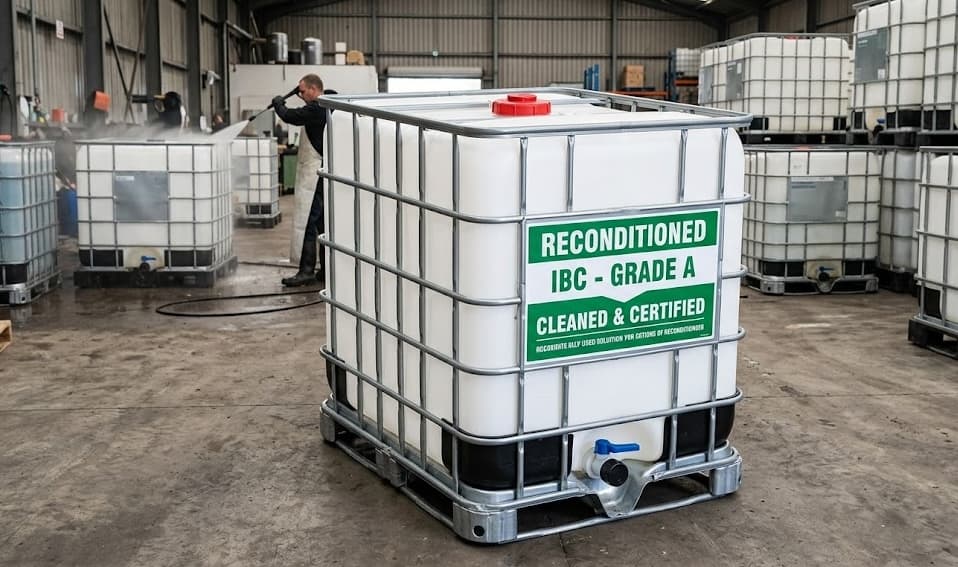
UN 31HA1By far the most common IBC in use today. A blow-molded high-density polyethylene (HDPE) bottle is housed inside a welded tubular steel cage, all sitting on a pallet base. The bottle is translucent or white, allowing visual fill-level checks. Standard sizes are 275 and 330 gallons.
Advantages
- +Lowest cost per unit
- +Lightweight — easy to handle and transport
- +Chemically resistant to most acids, bases, and solvents
- +Recyclable and rebottlable (new bottle into existing cage)
- +Available in food-grade (FDA) and UN/DOT rated versions
- +Translucent bottle allows visual fill monitoring
Limitations
- –Not suitable for temperatures above 150°F (65°C)
- –UV degradation when stored outdoors long-term
- –Permeation risk with certain solvents (aromatics, ketones)
- –Limited reuse life — typically 5 years from manufacture date
- –Not spark-proof (static buildup possible)
Best For:
General chemicals, food ingredients, cleaning products, agricultural inputs, water, and most non-extreme liquids.
Stainless Steel (304 / 316L)
UN 31AConstructed entirely from welded stainless steel — typically 304 for general use or 316L for corrosive environments. Stainless IBCs are far more durable than HDPE, can handle extreme temperatures, and are easily cleaned and sanitized. They cost 5–10x more than plastic but last decades with proper care.
Advantages
- +Extreme temperature range: -40°F to 400°F (-40°C to 204°C)
- +No permeation or UV degradation
- +Easy to clean, sanitize, and sterilize (CIP/SIP capable)
- +Indefinite reuse life with proper maintenance
- +Grounding is straightforward — eliminates static risk
- +FDA and pharma compliant
Limitations
- –5–10x the cost of HDPE composite
- –Significantly heavier (300+ lbs empty for 350 gal)
- –Not compatible with hydrochloric acid, bleach, or high-chloride solutions
- –Dents and damage are expensive to repair
- –Harder to source on the used market
Best For:
Pharmaceuticals, food/beverage, high-purity chemicals, hot-fill applications, flammable solvents, and long-term reuse operations.
Carbon Steel
UN 31A (carbon)Similar construction to stainless but made from mild carbon steel, usually with an interior coating or lining (epoxy, phenolic, or polyethylene). Carbon steel IBCs are less expensive than stainless while still offering rigidity and temperature resistance. The interior lining determines chemical compatibility.
Advantages
- +Lower cost than stainless steel
- +Good structural rigidity and stackability
- +Higher temperature tolerance than HDPE
- +Interior linings can be matched to specific chemicals
- +Easily repaired by welding
Limitations
- –Susceptible to corrosion if lining is damaged
- –Heavier than HDPE composite
- –Interior lining limits chemical versatility
- –Less common — harder to find replacement parts
- –Not suitable for food-grade without specialized lining
Best For:
Industrial solvents, petroleum products, non-food chemicals where stainless is overkill but HDPE is insufficient.
Flexible (Foldable / Collapsible)
UN 31H2A flexible inner bag (usually multi-layer PE or foil laminate) supported by a collapsible outer frame — either a foldable steel cage or corrugated walls. These IBCs fold flat when empty, reducing return-shipping costs to as little as 20% of the outbound freight.
Advantages
- +Folds flat — 75–80% reduction in return transport volume
- +Lightweight, typically under 60 lbs
- +Lower per-trip cost for one-way shipments
- +Aseptic liner options for food and pharma
- +Reduced warehousing space when empty
Limitations
- –Not stackable when loaded (most models)
- –Lower overall durability — fewer reuse cycles
- –Limited to gravity or low-pressure discharge
- –Not suitable for viscous products without heated systems
- –Liner replacement adds per-cycle cost
Best For:
One-way export shipments, seasonal products, aseptic food ingredients, and operations where return logistics are expensive.
Caged vs. Uncaged IBCs
Caged (Standard)
The tubular steel cage is the defining feature of a composite IBC. It provides structural support for stacking, forklift handling, and protection during transit. Cage IBCs are required for UN/DOT rated transport of hazardous materials.
- Stackable up to 2 high when loaded
- Forklift accessible from 2 or 4 sides
- Required for hazmat shipments
- Cage is rebottlable — new bottle fits existing cage
Uncaged (Tank-Only)
Some HDPE tanks are sold without the external cage — essentially a large plastic tank on a pallet. These are cheaper but sacrifice stackability and protection. They are common for single-use water storage or non-transport applications.
- Not stackable when loaded
- Lower purchase cost
- Not UN/DOT rated — no hazmat transport
- Suitable for static storage only
Single-Use vs. Multi-Trip
| Factor | Single-Use (One-Way) | Multi-Trip (Reusable) |
|---|---|---|
| Unit cost | Lower initial price | Higher initial price, lower per-trip cost |
| Build quality | Lighter gauge cage, thinner bottle | Heavier gauge, thicker bottle walls |
| Rebottlable? | Sometimes — depends on cage condition | Yes — designed for multiple rebottlings |
| Typical lifespan | 1–3 trips | 5–10 years / dozens of trips |
| Best for | Export, one-way distribution | Closed-loop supply chains, refill programs |
| Environmental impact | Higher waste per trip | Significantly lower — ideal for sustainability goals |
Material Compatibility Quick Guide
The table below is a general guide. Always verify compatibility with the IBC manufacturer and your chemical supplier's SDS (Safety Data Sheet) before filling.
| Substance | HDPE | SS 304 | SS 316L | Carbon Steel |
|---|---|---|---|---|
| Water / aqueous solutions | Yes | Yes | Yes | Yes (lined) |
| Mild acids (acetic, citric) | Yes | Yes | Yes | No |
| Strong acids (sulfuric, nitric) | Yes* | Limited | Yes | No |
| Caustic / NaOH | Yes | Yes | Yes | Yes (lined) |
| Solvents (acetone, MEK, toluene) | No | Yes | Yes | Yes (check lining) |
| Food oils / vegetable oils | Yes | Yes | Yes | No |
| Petroleum products | Limited | Yes | Yes | Yes |
| Bleach / sodium hypochlorite | Yes | No | Limited | No |
| Flammable liquids (flash <100°F) | Risk** | Yes | Yes | Yes |
*Concentration-dependent. Check with manufacturer for concentrations above 50%. **HDPE is non-conductive — static discharge risk. Use grounding and bonding for flammables.
Rigid vs. Flexible IBCs: Detailed Comparison
The choice between rigid and flexible IBCs affects your entire logistics chain. Here is a detailed breakdown of how they compare across every operational dimension.
| Dimension | Rigid IBC (HDPE / Metal) | Flexible IBC (Collapsible) |
|---|---|---|
| Structural integrity | Self-supporting. Cage and bottle maintain shape under load. Can be stacked 2-high when full. | Relies on external frame or pallet structure. Most models cannot be stacked when loaded. Shape changes as contents are dispensed. |
| Discharge method | Bottom butterfly valve allows gravity feed or pump connection. Precise flow control. Bottom drain minimizes residual waste. | Top-fill, bottom-drain through fitment. Flow rate is limited. Bag collapses during discharge, which can restrict flow if not properly supported. |
| Return logistics | Full-size return. Empty 275-gal IBC occupies the same trailer space as a full one. Return freight is a significant cost. | Folds flat to 15-20% of loaded volume. Return freight cost drops by 75-80%. This is the primary reason to choose flexible. |
| Durability | Cage protects against impact during transit. HDPE bottle lasts 5+ years. Stainless steel lasts decades. Can survive rough handling. | Liner is vulnerable to puncture. Outer frame is lighter gauge and less protective. Typical life is 1-5 trips depending on model and handling. |
| Cleaning | HDPE can be pressure-washed and rebottled. Stainless steel supports CIP and SIP. Reuse with different products is common after proper cleaning. | Liner is usually single-use. Outer frame can be reused with a new liner. Multi-product use requires liner replacement each time. |
| Temperature range | HDPE: -40 F to 150 F. Stainless: -40 F to 400 F. Suitable for hot-fill and cold storage. | Typically limited to 32 F to 130 F depending on liner material. Not suitable for hot-fill. Freezing can damage the liner seams. |
| Viscous products | Handles thick liquids well. Bottom valve allows pump-assisted discharge. Heating jackets available for stainless IBCs. | Poorly suited for viscous products. Bag collapse pinches off flow. Heated discharge is impractical. |
| Cost per trip (one-way) | Higher due to container value and return freight. | Lower. Container cost is less, and return freight is minimal when folded. |
| Cost per trip (round-trip) | Lower when amortized over many reuse cycles. | Higher if liner must be replaced each trip. |
Bottom line: rigid IBCs are the standard for domestic operations, closed-loop supply chains, and any application requiring stacking, temperature resistance, or chemical durability. Flexible IBCs are optimal for one-way international shipments where return logistics would otherwise be prohibitively expensive.
Specialty IBC Types
Beyond the four main categories, several specialized IBC configurations serve niche applications. These are less common but critical when standard options fall short.
Stainless Steel 316L (Pharma-Grade)
316L adds molybdenum to the alloy for superior resistance to chlorides and acidic environments. Interior surfaces are electropolished to a mirror finish (typically Ra 0.5 micrometers or better) for pharmaceutical and biotech applications. These IBCs support full CIP (clean-in-place) and SIP (sterilize-in-place) protocols. They carry 3A Sanitary Standards certification and meet ASME BPE (Bioprocessing Equipment) requirements. Pricing starts around $3,500 for a 350-gallon unit.
Carbon Steel with Epoxy Lining
The most common lined carbon steel configuration. Epoxy phenolic lining provides excellent resistance to aromatic solvents, petroleum products, and mild acids. The lining must be inspected regularly -- any chips, cracks, or peeling expose the bare steel to corrosion. Relining is possible but must be done by a certified facility. These are the workhorse containers for petroleum distribution and industrial solvent operations where HDPE fails and stainless is overkill.
Carbon Steel with Polyethylene Lining
A rotationally molded polyethylene liner bonded inside a carbon steel shell. This hybrid gives you the chemical resistance of HDPE with the structural strength and temperature tolerance of steel. Common for caustic soda (NaOH), bleach, and water treatment chemicals. The PE liner handles chemicals that would corrode bare steel, while the steel shell provides impact protection and stackability that standalone HDPE tanks lack.
Heated / Jacketed IBCs
Stainless steel IBCs fitted with an external heating jacket -- either electric heating blankets, steam coils, or hot-water jackets. Essential for products that solidify at ambient temperatures (waxes, coconut oil, chocolate, certain resins). Temperature is thermostatically controlled to maintain the product within the required viscosity range for pumping. These IBCs cost $4,000 to $8,000 depending on the heating system and insulation level.
ATEX / EX-Rated IBCs
Composite HDPE IBCs with integrated conductive layers in the bottle wall and built-in grounding connections. Designed for use in ATEX Zone 1 and Zone 2 explosive atmospheres. The conductive bottle dissipates static charge that would otherwise accumulate during filling -- eliminating the ignition risk that makes standard HDPE dangerous with flammable liquids. These cost 20-40% more than standard HDPE composites.
Aseptic IBCs
Flexible or rigid IBCs with a sterile, sealed inner bag designed for aseptic food and beverage applications. The inner bag is pre-sterilized (gamma irradiation or steam) and sealed in a clean-room environment. The product is filled through a sterile connection without exposing the interior to ambient air. Common for fruit juice concentrates, dairy ingredients, and wine. The bag is single-use; the outer container is reusable.
Application-to-Type Matching Guide
Not sure which IBC type fits your specific application? This reference table maps common product categories to the recommended IBC type, with notes on the critical factors driving the selection.
| Application / Product | Recommended Type | Key Selection Factor |
|---|---|---|
| Potable water storage | HDPE Composite (new, food-grade) | FDA compliance; virgin resin required |
| Irrigation water, non-potable | HDPE Composite (used, as-is) | Lowest cost; no regulatory requirements |
| Liquid fertilizer (urea, UAN) | HDPE Composite (reconditioned) | Chemical compatibility; corrosion-resistant |
| Sodium hypochlorite (bleach) | HDPE Composite | Bleach corrodes all metals including stainless |
| Concentrated sulfuric acid | HDPE Composite | HDPE excellent up to 93% concentration |
| Nitric acid (any concentration) | Stainless Steel 316L | Nitric attacks HDPE at high concentrations; 304 is insufficient |
| Acetone, MEK, toluene, xylene | Stainless Steel 304 | Solvents permeate and soften HDPE |
| Ethanol (fuel or extraction grade) | Stainless Steel 304 | Flammable; HDPE permeation risk |
| Vegetable oil (soy, canola, palm) | HDPE food-grade or Stainless 304 | FDA compliance; temperature at fill |
| Fruit juice concentrate | Stainless 304 or Aseptic Flexible | Acidity; sanitation; temperature |
| Hot-fill product above 160 F | Stainless Steel 304 or 316L | HDPE deforms above 150 F |
| Latex paint, coatings | HDPE Composite (reconditioned) | Water-based formulations are HDPE-compatible |
| Petroleum-based lubricants | Carbon Steel (epoxy-lined) | Petroleum compatibility; cost-effective |
| Diesel fuel, biodiesel | Carbon Steel or Stainless 304 | Flash point and SPCC containment requirements |
| Pharmaceutical intermediates | Stainless Steel 316L (electropolished) | GMP compliance; CIP/SIP capability |
| Export shipment (one-way) | Flexible / Collapsible | Return freight savings are the deciding factor |
This table covers common scenarios. Always verify chemical compatibility with the IBC manufacturer and your product's Safety Data Sheet before committing to a container type.
Lifespan and Total Cost of Ownership
The purchase price of an IBC is only part of the story. The total cost of ownership over the container's usable life varies dramatically by type.
HDPE Composite
5 years / 1-3 rebottlings
Lowest overall. Purchase cost is low; rebottling extends cage life by years. End-of-life value: the HDPE bottle is recyclable (ground into pellets) and the steel cage is scrap metal -- so disposal cost is near zero or even revenue-positive.
Stainless Steel
20+ years / indefinite with maintenance
Highest upfront cost but lowest per-year cost over a long service life. Cleaning costs are moderate (CIP systems). No bottle replacement needed. Dent repair is the main maintenance expense. Resale value remains high even after decades.
Carbon Steel
10-15 years / lining replacement every 5-8 years
Middle ground. Purchase cost is moderate. Lining inspection and replacement add periodic maintenance cost. If the lining fails and the shell corrodes, repair is expensive. Scrap value at end of life is good.
Flexible
1-5 trips / liner replaced each cycle
Lowest per-trip cost for one-way shipments. Liner replacement adds $30-$80 per cycle. Outer frame lasts 3-5 years with care. Not economical for round-trip domestic use.