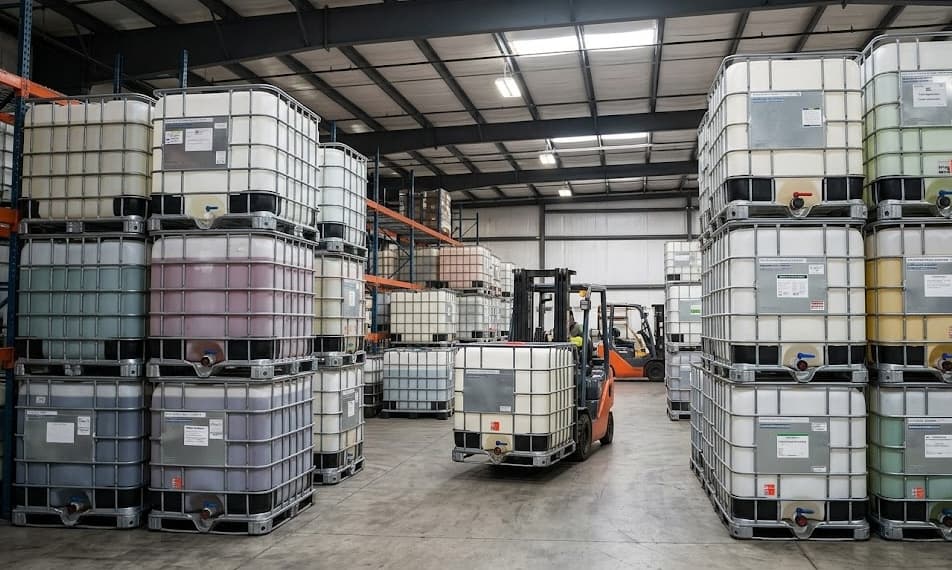
Reconditioned IBC Totes
Near-new performance without the new-unit price tag. Every reconditioned tote leaves our facility cleaned, repaired, pressure-tested, and certified.
The Reconditioning Process
Reconditioning is not just a rinse and resell. It is a five-step industrial process designed to return each tote to dependable, like-new operating condition.
Intake Inspection
Every incoming tote is visually assessed and tagged. Units with cracked bottles, warped cages, or unrepairable damage are diverted to recycling.
Triple-Wash Cleaning
A three-stage wash — hot caustic rinse, high-pressure freshwater blast, and sanitizing flush — removes residual product, odors, and biofilm.
Component Replacement
Valves, gaskets, cap seals, and any worn fittings are replaced with brand-new OEM-spec parts. Damaged cage panels are straightened or swapped.
Pressure & Leak Testing
Each tote is filled, pressurized to 2.5 PSI, and held for a minimum of 60 seconds. Any unit that fails is scrapped — no exceptions.
Final QA & Labeling
A quality inspector signs off on cosmetic condition, hardware torque, and leak-test records. The tote receives a dated certification label.
Quality Assurance
Batch Tracking
Every tote is assigned a unique lot number traceable back to its intake date, previous contents, and reconditioning technician.
Documented Testing
Pressure-test results, cleaning chemical concentrations, and sign-off timestamps are recorded for every unit.
Rejection Protocol
Any tote that fails visual, structural, or pressure criteria is pulled from the line and sent to recycling — never patched and resold.
Warranty
Reconditioned totes carry a 90-day warranty against manufacturing defects introduced during reconditioning.
Used vs. Reconditioned vs. New
| Feature | Used | Reconditioned | New |
|---|---|---|---|
| Price | $80 – $150 | $120 – $200 | $250 – $400+ |
| Cosmetic Condition | Varies (A/B/C) | Clean & uniform | Factory-fresh |
| Valves & Gaskets | Original | Brand-new | Brand-new |
| Cleaning | As-is or rinsed | Triple-washed | N/A (never used) |
| Leak Tested | Yes | Yes — certified | Yes — certified |
| Ideal For | Non-critical storage | Most applications | FDA / pharma |
Industries We Serve
- Agriculture — fertilizer, pesticide, and nutrient solutions
- Food & Beverage — syrups, oils, and non-dairy concentrates
- Chemical Manufacturing — solvents, detergents, and coatings
- Construction — concrete additives, sealants, and water supply
- Water Treatment — chlorine solutions, pH adjusters, and flocculants
- Cannabis & Hemp — extraction solvents and nutrient blends
Environmental Impact
Choosing reconditioned over new is one of the simplest sustainability wins in industrial packaging. Here is what a single reconditioned tote saves:
~135 lbs
HDPE diverted from landfill
~45 lbs
Steel kept in service
~310 kWh
Manufacturing energy saved
~0.4 tons
CO2 emissions avoided
Frequently Asked Questions
We answer these questions multiple times per week. If yours is not listed here, call or email us and we will get you a straight answer.
What chemicals can a reconditioned tote hold?
A properly reconditioned tote can safely hold the vast majority of water-based solutions, agricultural chemicals, cleaning agents, and industrial fluids. The key constraint is prior contents. During intake, we document what the tote previously held and match it to compatible product families. We will never sell a tote that previously held a hazardous solvent for food-grade use, regardless of how thoroughly it was cleaned. If you tell us what you plan to store, we will select totes from our inventory with an appropriate chemical history.
How many times can a tote be reconditioned?
Most composite IBC totes can be reconditioned two to three times before the HDPE bottle shows enough stress to warrant retirement. The steel cage and pallet typically outlast the bottle by a wide margin. On each reconditioning cycle, we inspect the bottle wall for thinning, micro-cracks, UV degradation, and chemical staining. If the bottle passes inspection, it goes back into service. If it does not, we install a new bottle into the existing cage and pallet, which extends the overall unit's life by another two to three cycles.
Is a reconditioned tote safe for food-grade liquids?
Yes, with conditions. A reconditioned tote that previously held food-grade product and has been triple-washed to FDA standards can be reused for food-grade applications. However, if traceability or audit requirements are strict, we recommend using a food-grade liner inside the reconditioned tote. The liner creates a virgin barrier between the product and the bottle wall, giving you the cost savings of a reconditioned container with the contact-surface purity of a new one.
What is the expected shelf life of a reconditioned tote?
A reconditioned tote stored outdoors in full sun has a usable life of approximately 3 to 5 years before UV degradation begins to compromise the HDPE. Indoors or under shade, expect 7 to 10 years of service. The gaskets and valve seals are the first components to wear out, typically after 12 to 18 months of continuous use. We include new gaskets and valves in every reconditioning cycle, so the clock resets on those wear items each time the tote comes through our facility.
How do I know if a reconditioned tote is high quality?
Look for five things: (1) The bottle should be uniformly clean with no residual odor when you open the fill cap. (2) The valve and gaskets should be visibly new, not worn or stained. (3) The cage should be straight with no bent panels, and all bolts and clips should be tight. (4) A dated certification label from the reconditioning facility should be affixed to the cage, showing the test date, lot number, and technician sign-off. (5) Ask the supplier for documentation of the pressure test result. Any reputable reconditioner will provide this on request.
What is the difference between a reconditioned tote and a rebottled tote?
Reconditioning means the original bottle is cleaned, tested, and returned to service with new gaskets and valve components. Rebottling means the original bottle is removed entirely and a brand-new HDPE bottle is installed into the existing cage and pallet. Rebottling costs more than standard reconditioning but less than buying a fully new tote. We offer both services and can advise which option makes sense based on the condition of your existing units.
Common Misconceptions About Reconditioned Totes
There is a lot of misinformation in the market. Here is what we hear most often and the reality behind each claim.
Myth: Reconditioned totes are just rinsed out and resold
A legitimate reconditioning process involves multi-stage caustic and sanitizing washes, complete valve and gasket replacement, structural inspection, and pressure testing. The process typically takes 45 to 60 minutes per tote and uses industrial wash equipment operating at 140 to 180 degrees F. A simple rinse would not meet the standards required for resale.
Myth: You cannot use reconditioned totes for regulated products
Reconditioned totes are used every day for EPA-regulated agricultural chemicals, DOT-regulated hazmat transport, and state-regulated cannabis production. The key is matching the tote's history and certification to the regulatory requirements of your specific product. Many regulations require documentation, not virgin packaging.
Myth: Reconditioned totes leak more than new ones
Every reconditioned tote from our facility passes the same 2.5 PSI pressure hold test that new totes are subjected to at the factory. New valves and gaskets are installed during every reconditioning cycle. In practice, the most common source of leaks in any tote is a damaged or improperly seated gasket, which is replaced regardless of whether the tote is new or reconditioned.
Myth: The cage is just cosmetic -- it does not matter if it is bent
The galvanized steel cage is a structural element. It holds the HDPE bottle in shape under the hydrostatic pressure of a full load (over 2,300 pounds for a 275-gallon tote). A bent or bulging cage panel allows the bottle to deform outward, which thins the wall at the stress point and creates a future failure zone. We straighten or replace every damaged cage panel during reconditioning.
Myth: All reconditioned totes are the same quality
Quality varies enormously across the reconditioning industry. Some operators do little more than a cold-water rinse and a visual check. Others invest in automated wash systems, pressure-test rigs, and lot-level traceability. Always ask a potential supplier to describe their process step by step, and request documentation of cleaning and testing records. If they cannot provide it, look elsewhere.
Myth: Reconditioned totes cannot be shipped as UN-rated packaging
A reconditioned tote can retain its UN 31HA1 rating provided the reconditioning process meets the requirements of 49 CFR 173.28 (for US DOT) and the tote passes all required performance tests. The reconditioner must be registered and the tote must be marked with the reconditioner's identification. We maintain full DOT compliance for our reconditioned units.
How to Evaluate Reconditioned Tote Quality on Delivery
When your reconditioned totes arrive, a quick five-point inspection will confirm they meet the standard you paid for. Here is what to check.
Visual Cleanliness
Open the fill cap and look inside the bottle. The interior walls should be uniformly clean with no residual staining, film, or product buildup. Sniff the opening -- there should be no chemical or organic odor. A musty or sour smell indicates incomplete cleaning.
Valve and Gasket Condition
The outlet valve should be clearly new -- look for bright, unstained polypropylene and a fresh EPDM gasket with no compression marks. Turn the valve handle through a full open-close cycle. It should move smoothly without binding or requiring excessive force.
Cage Integrity
Walk around the tote and visually inspect all four cage panels. Panels should be straight and evenly spaced from the bottle. Check that the top and bottom frames are square and that all bolts and clips are present and tight. Give the cage a firm push from one corner -- it should feel rigid, not flexible.
Pallet Condition
If the pallet is wood, check for cracks, rot, or missing slats. The tote should sit flat and level on the pallet with no rocking. For plastic pallets, look for stress fractures at the forklift entry points. For steel pallets, inspect for heavy rust or bent channels that could affect stacking.
Certification Label
Every properly reconditioned tote should carry a label showing the reconditioning date, facility name or code, lot or serial number, and the technician's sign-off. If the label is missing or illegible, request a replacement certificate from the supplier before putting the tote into service.
Reconditioning vs Buying New: The Complete Cost Analysis
The decision between reconditioned and new totes is ultimately a financial one. When you break down the numbers, reconditioned totes deliver dramatically better economics for the vast majority of applications. Here is a detailed cost comparison based on real-world pricing.
| Cost Factor | Reconditioned (275 gal) | New (275 gal) | Savings |
|---|---|---|---|
| Unit price (single) | $150 | $300 | $150 (50%) |
| Unit price (25+ volume) | $125 | $265 | $140 (53%) |
| Unit price (truckload 56+) | $105 | $230 | $125 (54%) |
| New valve + gaskets | Included | Included | -- |
| Cleaning / prep | Included (triple-wash) | N/A (virgin) | -- |
| Certification label | Included | Included | -- |
| Typical freight (CA delivery) | ~$15-25/unit (TL) | ~$15-25/unit (TL) | Same |
| Warranty period | 90 days | 1 year | New has longer warranty |
| Expected service life | 5-8 years (indoor) | 8-10 years (indoor) | New has longer life |
| Cost per year of service (indoor) | ~$16-25/year | ~$25-38/year | 36-50% lower for reconditioned |
| 100-tote fleet cost | $10,500 | $23,000 | $12,500 (54%) |
| Annual fleet replacement (20% turnover) | $2,100 | $4,600 | $2,500/year |
When Reconditioned Wins
For agricultural chemicals, water treatment, general industrial liquids, cleaning products, automotive fluids, and any application that does not require FDA food-contact certification or virgin chain-of-custody documentation, reconditioned totes deliver the same functional performance as new at roughly half the cost. The math is straightforward: you get brand-new valves, certified cleaning, and pressure-tested integrity for 40-55% less per unit.
When New Still Makes Sense
New totes are the right choice when your application requires FDA 21 CFR compliance without a liner, when your customer contract specifies new packaging, when you are exporting to countries that require virgin containers, or when the product being stored is chemically incompatible with any prior HDPE exposure. In these specific scenarios, the higher cost of new totes is justified by regulatory and contractual necessity.
The Hybrid Approach
Many of our customers use a hybrid strategy: new totes for their most sensitive product lines and reconditioned totes for everything else. A food manufacturer might use new totes for FDA-regulated ingredients and reconditioned totes for cleaning chemicals, water supply, and waste collection. This approach captures the cost savings of reconditioned where possible while maintaining compliance where required.
Food-Grade Reconditioning
Food and beverage applications demand the highest standards of cleanliness, traceability, and material safety. Our food-grade reconditioning process goes beyond standard reconditioning to meet the requirements of food-adjacent and food-contact applications.
Enhanced Cleaning Process
- Source selection: Only totes with documented food-grade prior contents are eligible for food-grade reconditioning. Totes that previously held industrial chemicals, solvents, or unknown products are excluded regardless of how clean they appear.
- Pre-wash rinse: Hot water rinse at 140 degrees F to remove gross residue and soften any dried product film on the interior bottle walls.
- Caustic wash: 2-3% sodium hydroxide solution at 160 degrees F for 10 minutes of contact time. This alkaline wash breaks down fats, oils, proteins, and organic residues that water alone cannot remove.
- High-pressure freshwater rinse: 1,500+ PSI freshwater rinse to remove all caustic residue and any loosened contaminants. Water is heated to 140 degrees F for additional cleaning power.
- Sanitizing rinse: Food-grade sanitizer (typically peracetic acid at 200 ppm) applied as a final rinse and allowed to drain. No additional water rinse follows, as the sanitizer residue evaporates to food-safe levels.
- Drying: Forced warm air drying to remove residual moisture and prevent microbial growth during storage prior to sale.
Food-Grade Certification and Documentation
- Certificate of reconditioning: Issued for every food-grade tote, documenting the cleaning chemicals used, concentrations, contact times, rinse temperatures, and sanitizer application.
- Previous contents verification: Each tote's prior product history is documented on the certificate. We verify prior food-grade contents through label inspection, supplier documentation, and residual odor assessment.
- Component traceability: New valves, gaskets, and caps installed during reconditioning are FDA 21 CFR compliant. Material certificates for valve and gasket components are available on request.
- Lot-level tracking: Every food-grade reconditioned tote is assigned a unique lot number that links back to the cleaning batch, inspection date, and technician. This supports HACCP and SQF audit requirements.
- Optional food-grade liner: For the highest level of food safety assurance, we offer food-grade LDPE liners pre-installed in reconditioned totes. The liner creates a virgin barrier between the product and the tote wall.
- Shelf life guidance: Food-grade reconditioned totes should be filled within 30 days of reconditioning for best results. Beyond 30 days, we recommend a re-sanitizing rinse before filling.
Reconditioning Capacity and Lead Times
Our reconditioning facility operates at industrial scale, processing hundreds of totes per week. Here is what you need to know about our capacity, scheduling, and how to plan your orders for the fastest turnaround.
400+
Totes processed per week
Standard capacity across all reconditioning lines
24-48 hrs
Standard turnaround
From intake to certified, ready-to-ship unit
Same Week
Typical order fulfillment
For in-stock reconditioned inventory
2-3 Weeks
Custom reconditioning
For specialized cleaning or non-standard specs
| Order Type | Quantity Range | Lead Time | Rush Available? | Notes |
|---|---|---|---|---|
| Standard (from stock) | 1-50 | 1-3 business days | Yes (same day) | Reconditioned totes already in finished inventory |
| Standard (processed to order) | 50-200 | 3-7 business days | Yes (2-3 days) | Totes pulled from used inventory and reconditioned for your order |
| Food-grade reconditioning | 1-100 | 3-5 business days | Limited | Additional cleaning steps add 1-2 days vs standard |
| Custom specification | Any | 2-4 weeks | No | Non-standard cleaning agents, specific valve types, or custom labeling |
| Rebottling (new bottle) | Any | 2-3 weeks | No | New HDPE bottle installed in existing cage and pallet |
Long-Term Supply Agreements
If your operation requires a steady, predictable supply of reconditioned IBC totes, a long-term supply agreement locks in your pricing, guarantees availability, and simplifies your procurement workflow. Here is how it works.
Price Lock Guarantee
Agree to a monthly or quarterly minimum volume and we lock your per-unit price for the duration of the agreement -- typically 6 or 12 months. Market fluctuations in used tote supply will not affect your cost. If market prices drop below your locked rate, we will renegotiate in your favor at the next review period.
Guaranteed Allocation
Supply agreement customers receive priority inventory allocation. During peak demand periods when spot-market availability may be limited, your committed volume is set aside first. We maintain a buffer stock equivalent to one month's committed volume to ensure we can always fulfill your orders on schedule.
Flexible Scheduling
Deliveries can be scheduled weekly, bi-weekly, or monthly -- whatever matches your consumption rate. Adjust delivery quantities with 2 weeks' notice at no penalty, as long as you meet the minimum volume commitment over the agreement period. We can also hold inventory at our facility for just-in-time release.
Dedicated Account Management
Every supply agreement customer is assigned a dedicated account manager who knows your specifications, delivery preferences, and operational schedule. Your account manager proactively monitors your order history, anticipates reorder timing, and contacts you before your inventory runs low.
Custom Specification Consistency
If your operation requires totes reconditioned to a specific standard -- particular cleaning agents, specific valve types, branded labeling, or color-coded caps -- we document your specification and apply it consistently to every batch. Your reconditioned totes arrive identical every time.
Agreement Tiers
We offer three tiers: Bronze (25-49 units/month, 6-month term), Silver (50-99 units/month, 12-month term), and Gold (100+ units/month, 12-month term). Each tier provides progressively deeper discounts, priority scheduling, and enhanced service levels. Contact us for a custom proposal based on your specific volume and requirements.
Custom Reconditioning Specifications
Standard reconditioning covers most applications, but some operations need specific cleaning protocols, particular hardware configurations, or branded packaging. Our custom reconditioning service tailors the process to your exact requirements.
Cleaning Customization
- Specific cleaning agents: If your quality system or customer requires a particular detergent, sanitizer, or rinse agent, we can substitute it into the cleaning process. Provide us with the SDS and concentration requirements.
- Temperature requirements: Some applications require specific wash and rinse temperatures. We can adjust our process from 120 degrees F to 180 degrees F depending on your product's cleaning validation protocol.
- Extended rinse cycles: For pharmaceutical-adjacent or ultra-sensitive applications, we can add additional freshwater rinse cycles and perform conductivity testing on the final rinse water to verify detergent removal.
- Dry vs wet delivery: Standard reconditioned totes are delivered dry. If you need totes delivered with a residual sanitizer film (common in brewing and dairy), we can adjust the final step accordingly.
- Microbiological testing: For food-grade and pharmaceutical applications, we can perform ATP swab testing or aerobic plate counts on cleaned totes and provide lab results with each batch.
Hardware and Labeling Customization
- Valve type selection: Choose from butterfly, ball, cam-lock, or threaded NPT valves in polypropylene or stainless steel. We install your preferred valve during the reconditioning process at a modest upcharge.
- Gasket material: EPDM is standard, but we can install Viton (for solvents and fuels), PTFE (for universal chemical resistance), or silicone (for food and pharma) gaskets on request.
- Cap configuration: Vented caps for gravity dispensing, non-vented caps for sealed transport, or tamper-evident caps with breakaway rings. Specify your preference and it will be installed as part of reconditioning.
- Custom labels: Your company name, logo, product name, batch tracking fields, and safety information printed on weather-resistant polyester labels and applied during reconditioning. Minimum order 50 totes per label design.
- Color-coded caps or tags: Assign specific colors to different product lines for easy visual identification in your warehouse. We stock caps in white, black, blue, red, and yellow.
- Pre-installed liners: Food-grade LDPE liners installed and sealed during reconditioning so totes arrive ready to fill with zero on-site prep work required.
Get Reconditioned Totes Delivered
We keep reconditioned 275- and 330-gallon totes in stock across multiple West Coast locations. Request a quote and we will lock in your pricing.