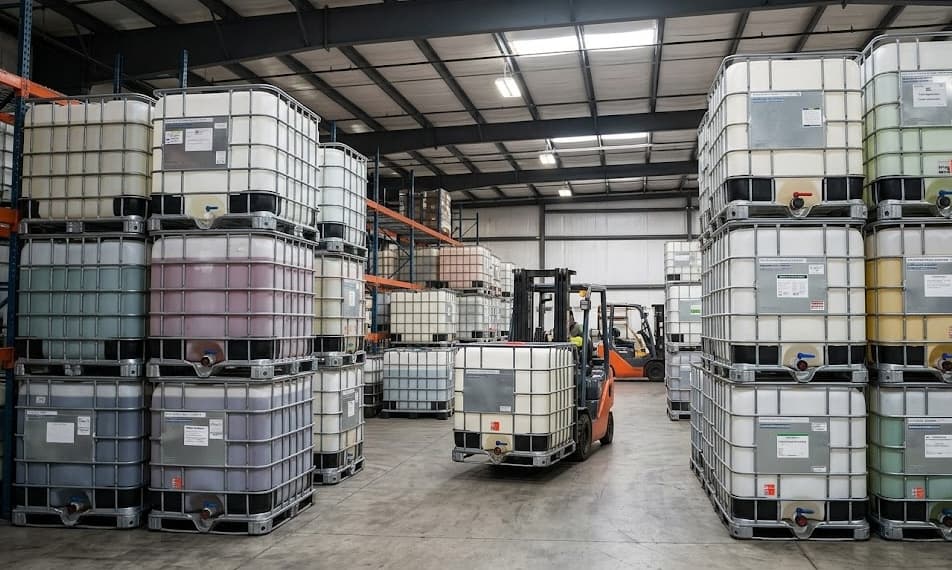
Custom IBC Tote Modifications
Off-the-shelf totes do not fit every application. We engineer and build custom modifications to match your exact operational requirements.
Types of Modifications
From simple valve swaps to fully engineered heated containment systems, we modify IBC totes to work the way your process demands.
Valve Upgrades
Replace standard butterfly valves with ball valves, camlock fittings, quick-disconnect couplings, or metered dispensing valves. Available in stainless steel, polypropylene, and PVDF for chemical resistance.
Heating Systems
Wrap-around heating blankets, immersion heaters, and thermostatically controlled heating jackets for viscous liquids, temperature-sensitive chemicals, and freeze protection in cold climates.
Insulation Wraps
Closed-cell foam insulation or reflective thermal blankets to maintain product temperature during storage and transport. Rated from -20°F to 200°F depending on material.
Custom Fittings & Ports
Additional inlet/outlet ports, sight glasses, level indicators, pressure relief valves, and venting systems. Welded or threaded connections per your specifications.
Secondary Containment
Spill containment pallets, drip trays, and bunded enclosures that meet EPA 40 CFR 264.175 secondary containment requirements for hazardous material storage.
Mixing & Agitation
Top-mount or side-mount mixer brackets, baffles, and agitation ports for totes used in blending, dissolving, or suspending materials.
Real-World Use Cases
See how businesses across different industries use our custom-modified IBC totes to solve specific challenges.
Heated and insulated IBC totes with chemical-resistant valves for dispensing viscous resins at controlled temperatures.
Stainless-steel ball valves and FDA-grade gaskets for hygienic dispensing of syrups, oils, and flavorings.
Quick-connect fittings and metered valves for precision application of liquid fertilizers and crop-protection chemicals.
Secondary containment pallets with integrated drain and spill capacity exceeding 110% of tote volume for regulatory compliance.
Custom Order Process
From concept to delivery, our process is collaborative and transparent. No surprises on price or timeline.
Describe Your Requirements
Tell us what you need — product type, operating temperature, connection sizes, regulatory requirements, and quantity.
Engineering Review
Our team evaluates your specs, selects materials, and provides a detailed proposal with pricing and lead time.
Prototype or Sample
For orders over 25 units, we build a sample unit for your approval before full production begins.
Production & Delivery
Modifications are completed in-house. Finished totes are inspected, tested, and delivered to your facility.
Engineering & Material Selection
Every modification begins with an engineering review. We evaluate your application requirements -- product chemistry, operating temperature range, pressure conditions, flow rate needs, and regulatory constraints -- before selecting materials and designing the modification.
Material compatibility is critical. A valve that works perfectly with water-based products can fail catastrophically with solvents. We reference chemical resistance charts for every material that will contact your product, including gasket compounds, valve body polymers, and fitting alloys. Common material options include 316 stainless steel for corrosive chemicals, polypropylene for strong acids and bases, PVDF for ultra-pure applications, and EPDM or Viton gaskets depending on chemical exposure.
For heating and insulation modifications, we calculate heat loss and energy input based on your product viscosity curve, ambient temperature range, and desired operating temperature. Heating blankets are sized to deliver the correct wattage per square foot, and thermostatic controls are set with safety cutoffs to prevent overheating of HDPE containers.
Materials We Work With
Valves, fittings, and ports for corrosive chemicals, food-grade products, and high-temperature applications
Valve bodies, adapters, and fittings for strong acids, bases, and water treatment chemicals
Ultra-pure chemical handling, semiconductor-grade fluids, and aggressive solvent service
Gaskets and seals for water-based products, food ingredients, and moderate chemicals
Gaskets and seals for fuels, solvents, oils, and high-temperature applications
Insulation wraps rated to 200 degrees Fahrenheit for thermal protection and freeze prevention
Lead Times & Production Capacity
Turnaround depends on modification complexity and current shop volume. We are transparent about timelines from the start and will notify you immediately if anything changes.
Simple Valve Swaps
2-3 business daysReplacing a standard butterfly valve with a ball valve, camlock, or quick-disconnect fitting. Stock parts, no fabrication required.
Fitting & Port Additions
5-7 business daysDrilling, threading, or welding additional ports into the cage or bottle. Includes leak testing and pressure verification.
Heating System Installation
7-10 business daysWrap-around heating blankets, thermostat wiring, and insulation application. Electrical testing and thermal calibration included.
Secondary Containment
5-10 business daysCustom spill pallets, bunded enclosures, and integrated drain systems. Fabricated to match your tote count and site layout.
Full Custom Engineering
2-4 weeksMulti-modification builds requiring engineering drawings, prototype approval, and production runs. Includes a sample unit for orders over 25.
Rush Service
Case by caseExpedited turnaround is available for critical situations. Rush fees apply and depend on current shop capacity and parts availability.
Common Questions About Custom Modifications
We receive these questions frequently from customers evaluating custom tote modifications. If your question is not answered here, contact our engineering team directly.
Can you modify totes I already own, or do I need to buy new ones?
We modify both. If you have existing totes that are structurally sound and clean, we can perform modifications on your units. We also sell pre-modified totes from our own inventory. For large orders, it is often more cost-effective to start with reconditioned totes from our stock.
Will modifications void the UN rating on my tote?
Any physical modification to the bottle or closure system -- such as adding ports, changing valves, or drilling holes -- will void the original UN certification for hazardous material transport. Modified totes can still be used for storage and non-regulated transport. If you need to maintain UN certification, we can work within the existing openings using adapter fittings that do not alter the bottle structure.
Do you provide engineering drawings or specifications for approval before work begins?
Yes. For all modifications beyond simple valve swaps, we provide a written specification sheet describing the modification, materials, dimensions, and expected performance. For fully engineered solutions, we provide CAD drawings. No work begins until you approve the spec.
What warranty do you offer on modifications?
All modifications carry a 12-month warranty against defects in materials and workmanship. Heating elements and electrical components are warranted for the manufacturer's standard term, typically 12 to 24 months. Warranty does not cover damage from chemical incompatibility if the product was not disclosed during the engineering review.
Popular Modification Packages
While every modification we perform can be customized to your exact specifications, we have found that certain combinations of modifications are requested frequently enough to offer them as standardized packages. These packages are pre-engineered, which means shorter lead times and lower costs compared to fully custom solutions.
Each package can be adjusted -- adding, removing, or substituting components -- without losing the pricing advantage of a standardized design.
Winterization Package
Freeze protection for cold-climate operations
Includes:
Ideal for: Water-based products, viscous liquids that thicken in cold weather, outdoor storage in northern states, unheated warehouses
Lead time: 7-10 business days
Food-Grade Conversion Package
Upgrade any industrial tote for food-contact applications
Includes:
Ideal for: Food and beverage processors, pharmaceutical companies, cosmetics manufacturers, potable water storage
Lead time: 5-7 business days
Chemical Handling Package
Engineered for aggressive chemical service
Includes:
Ideal for: Chemical manufacturers, water treatment facilities, metal finishing operations, laboratory supply distributors
Lead time: 7-14 business days
Dispensing Station Package
Turn any IBC tote into a metered dispensing station
Includes:
Ideal for: Janitorial supply distributors, agricultural field dispensing, chemical dilution stations, small-batch manufacturing
Lead time: 5-7 business days
Modification Case Studies
The best way to understand what our custom modification service can do is to see real examples. The following case studies describe actual modification projects we have completed, including the customer's challenge, our engineering solution, and the outcome. Company names have been omitted for confidentiality, but the technical details are accurate.
Each case study demonstrates a different aspect of our modification capabilities -- from simple valve upgrades to complex multi-system engineering solutions.
Case Study 1: Heated Resin Dispensing System for a Coatings Manufacturer
Challenge
A coatings manufacturer in Portland needed to store and dispense a viscous acrylic resin that solidifies below 55 degrees Fahrenheit. Their outdoor storage yard drops to freezing temperatures from November through March, making standard IBC totes unusable for half the year. They had been purchasing heated tanks at over $3,000 each, which was cost-prohibitive for their 40-tote fleet.
Our Solution
We modified 40 reconditioned IBC totes with our Winterization Package plus a custom-designed bottom-mount dispensing system. Each tote received a 1,500-watt silicone heating blanket with a digital thermostat set to maintain 65F, closed-cell foam insulation rated to R-10, a heated valve jacket to prevent freeze-up at the discharge point, and a 2-inch stainless steel ball valve with a quick-disconnect coupling compatible with their existing production line manifold. The electrical system was designed with a weatherproof NEMA 4X junction box and a 20-foot cord to reach their outdoor power drops.
Outcome
The modified totes maintain product temperature year-round at a per-unit cost of approximately $285, less than one-tenth the cost of the heated tanks they replaced. The customer has been running these totes for two winters with zero product solidification incidents and zero heating system failures. They have since ordered 15 additional modified totes to expand their fleet.
Case Study 2: Sanitary Dispensing Conversion for an Organic Juice Producer
Challenge
An organic juice producer in Central California needed IBC totes that could receive fresh-pressed juice from their production line and dispense it into bottling equipment, all while maintaining food-safety standards required for organic certification. Standard butterfly valves do not meet sanitary design criteria, and the existing totes had threaded connections that are difficult to clean and create potential harborage points for bacteria.
Our Solution
We converted 25 reconditioned food-grade totes using our Food-Grade Conversion Package with additional custom modifications. Each tote received a 316L stainless steel tri-clamp bottom valve assembly (replacing the standard butterfly valve), a tri-clamp top inlet with a sanitary gasket for CIP (clean-in-place) compatibility, a sight glass level indicator with stainless steel fittings for visual fill monitoring, and a stainless steel vent filter to allow air displacement during filling while preventing contamination. All welds were ground smooth and passivated, and all gaskets were FDA-compliant EPDM rated for juice contact.
Outcome
The modified totes passed the customer's third-party food safety audit on the first attempt, including surface swab testing at valve connections. The tri-clamp connections reduced cleaning time by 40% compared to the threaded fittings they replaced. The customer has been using these totes for over 18 months, cycling each tote through approximately 50 fill-and-clean cycles with no food safety findings.
Case Study 3: Secondary Containment System for a Water Treatment Facility
Challenge
A municipal water treatment facility in Nevada needed to store 12% sodium hypochlorite (industrial bleach) in IBC totes in an outdoor chemical storage area. The facility's environmental compliance requirements mandated 110% secondary containment capacity, chemical-resistant construction, and a system that could capture and contain a full tote failure without releasing chemical to the environment. The site had limited space, so the containment system needed to accommodate 8 totes in a compact footprint.
Our Solution
We designed and fabricated a custom secondary containment system consisting of two 4-tote containment pallets with a combined 130% capacity -- exceeding the 110% regulatory minimum. Each pallet was constructed from chemical-resistant polyethylene with reinforced steel framing to support the full loaded weight of 4 totes (approximately 9,200 lbs per pallet). Features included removable polyethylene grating for forklift access, integrated drain valves with chemical-resistant ball valves for controlled drainage during maintenance, and raised edges with ramped entry for spill containment. The totes themselves were fitted with PVDF valves and Viton gaskets for sodium hypochlorite compatibility, plus vent caps to manage off-gassing.
Outcome
The system passed the facility's environmental compliance inspection with no findings and has been operational for two years. The 130% containment capacity exceeds the regulatory minimum and provides a safety margin that the facility's risk management team specifically requested. Total project cost was approximately 60% less than a pre-fabricated commercial containment system of equivalent capacity.
Case Study 4: Mobile Mixing Station for an Agricultural Chemical Distributor
Challenge
An agricultural chemical distributor in the San Joaquin Valley needed a portable mixing station that could blend liquid fertilizer concentrates with water at variable ratios directly at farm sites. The system needed to handle corrosive ammonium-based fertilizers, mix accurately at flow rates up to 10 gallons per minute, and be rugged enough for daily loading and unloading from a flatbed truck.
Our Solution
We built a custom mixing station on a reconditioned IBC tote platform. The modification included a polypropylene ball valve with a calibrated flow meter on the main discharge, a side-mounted injection port with a metered chemical pump for concentrated fertilizer addition, top-mount mixer brackets with a portable agitator for blending, reinforced cage mounting points with vibration dampeners for transport stability, quick-connect hose fittings compatible with standard agricultural spray equipment, and a waterproof battery box for powering the metering pump and mixer in locations without electrical service.
Outcome
The distributor deployed 6 of these mobile mixing stations to serve farm customers across the Central Valley. The units have been in service for three growing seasons, traveling an average of 200 miles per week per unit. The calibrated mixing system reduced fertilizer waste by an estimated 15% compared to the customer's previous manual mixing process, and the quick-connect fittings cut setup time from 30 minutes to under 5 minutes at each farm stop.
Design Consultation Process
Our design consultation is a collaborative process that ensures the final modified tote meets your operational requirements exactly. We do not build first and ask questions later -- every detail is reviewed, confirmed, and documented before fabrication begins. This process eliminates rework, ensures material compatibility, and gives you full visibility into what you are getting before any money changes hands.
Design consultations are free for all projects. Even if you ultimately decide not to proceed, you receive a detailed specification document that you can use for your own reference or to obtain competitive quotes.
Initial Requirements Gathering
You provide details about your application: what product will the tote hold, what temperature range it needs to operate in, what flow rates you require, what connections need to interface with your existing equipment, and what regulatory standards must be met. We use a standardized requirements questionnaire that covers all the critical parameters, so nothing is overlooked.
Chemical and Material Compatibility Review
Our engineering team reviews the Safety Data Sheet for your product and cross-references every wetted material (valve body, gaskets, seals, fittings) against the chemical resistance chart. We verify that every material in contact with your product is rated for the exposure conditions -- including temperature, concentration, and duration. If any standard material is not compatible, we identify alternatives.
Technical Specification Development
We produce a written specification document that describes every modification in detail: component part numbers, materials of construction, dimensions, performance ratings, installation method, and testing protocol. For complex modifications, we produce CAD drawings showing placement, dimensions, and assembly details. This document becomes the binding agreement for what we build.
Pricing and Timeline Proposal
Based on the specification, we provide a fixed-price quote with a definite timeline. The quote breaks down costs by component and labor category so you can see where your money is going. For orders over 25 units, the quote includes a prototype unit at no additional charge that you inspect and approve before production begins.
Prototype Build and Approval (25+ Units)
For larger orders, we build a single prototype to the approved specification and ship it to you for hands-on evaluation. You test it in your actual operating environment, verify that all connections fit, confirm that flow rates and temperatures meet your needs, and provide feedback. Any adjustments are made to the prototype specification before production begins.
Production, Testing, and Delivery
Once the specification is approved (or the prototype is accepted for larger orders), we proceed to full production. Each unit is built to the same specification, individually tested for leak-free operation, and inspected against a quality checklist before shipment. You receive a documentation package with each unit including the specification sheet, material certificates, and test results.
Modification Warranty and Support
Every modification we perform is backed by a comprehensive warranty and ongoing technical support. We stand behind our work because our reputation depends on your modified totes performing reliably in real-world conditions, not just passing a bench test in our shop.
Warranty claims are handled directly -- no third-party administrators, no phone trees, no runaround. If something we modified fails within the warranty period, contact your account manager and we resolve it.
Warranty Coverage
Standard Warranty: 12 Months
All modifications carry a 12-month warranty against defects in materials and workmanship from the date of delivery. This covers valve failures, fitting leaks, weld defects, gasket failures, and any other issue attributable to the modification itself. If a warranted component fails, we repair or replace it at no charge including parts and labor.
Heating System Warranty: 12-24 Months
Heating blankets, thermostats, and electrical components are warranted for the manufacturer's standard warranty period, which ranges from 12 to 24 months depending on the specific product. Thermostat calibration drift that exceeds acceptable limits within the warranty period is corrected at no charge.
Extended Warranty Available
For customers who want longer coverage, we offer extended warranty plans of 24 or 36 months on mechanical modifications. Extended warranties are priced at 8-12% of the original modification cost and include the same full repair-or-replace coverage as the standard warranty.
What Is Not Covered
Warranty does not cover damage from chemical incompatibility if the product stored differs from what was specified during the engineering review, physical impact damage from forklift strikes or drops, normal wear on consumable components like gaskets (which we stock and sell at cost), or modifications performed by others after our work is delivered.
Ongoing Technical Support
Phone and Email Support
Our engineering team is available Monday through Friday, 7 AM to 5 PM Pacific for questions about your modified totes. Whether you need guidance on valve maintenance, thermostat adjustment, gasket replacement, or troubleshooting a flow issue, we provide direct access to the people who designed and built your modifications.
Spare Parts Stocking
We maintain stock of replacement parts for every modification we perform -- gaskets, valves, heating elements, thermostats, fittings, and seals. Parts are available for direct purchase and typically ship the same or next business day. For volume program customers, we can stock parts at your facility so replacements are always on hand.
Field Service
For issues that cannot be resolved remotely, we dispatch a technician to your facility. Field service is included at no charge for warranty repairs. For out-of-warranty service, we charge a flat service call fee plus parts. Response time is typically 1-3 business days depending on your location.
Reorder and Expansion Support
When you need more modified totes, reordering is simple. We keep your specification on file permanently, so a repeat order requires nothing more than a quantity and delivery date. If your requirements have changed, we update the specification accordingly. Repeat orders receive a 5% loyalty discount.
Minimum Quantities
Most modifications can be performed on a single unit, but pricing improves significantly with volume. Here is a general guide:
Lead times vary by complexity. Simple valve swaps ship in 2-3 days. Fully engineered solutions typically require 2-4 weeks.
Have a Custom Need?
Describe your application and requirements. Our engineering team will respond within one business day with a detailed proposal.
Request Custom QuoteBack to All Services