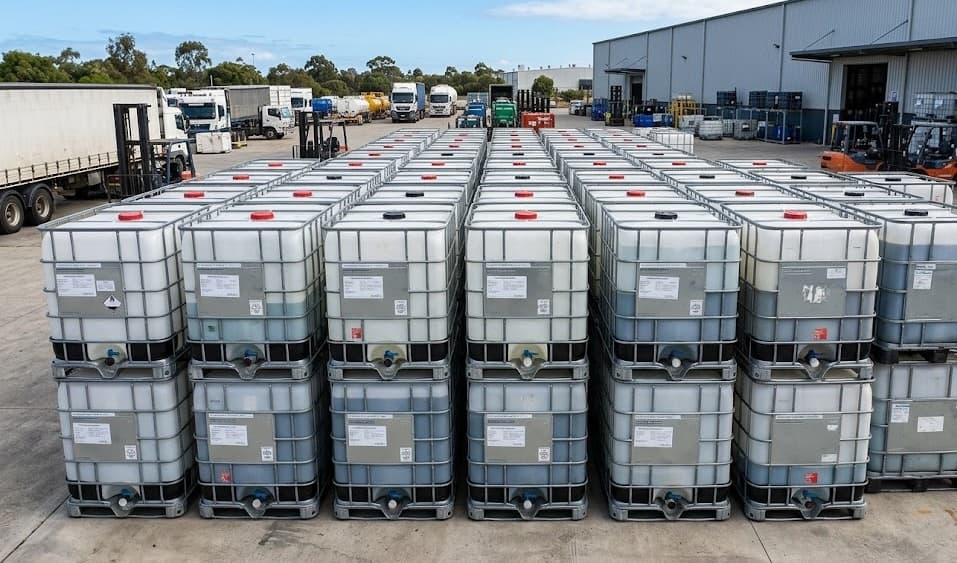
Cleaning & Reconditioning
Multi-step cleaning that returns your IBC totes to like-new condition — from standard industrial wash to food-grade sanitization.
Our 5-Step Cleaning Process
Every tote follows the same rigorous process. Additional steps are added for food-grade and chemical-grade requirements.
Drain & Pre-Rinse
All residual product is safely drained and disposed of according to EPA guidelines. A preliminary rinse removes loose material from interior walls.
High-Pressure Wash
Industrial pressure washers at 2,500+ PSI blast the interior and exterior, removing caked-on residue, labels, and surface contamination.
Sanitize & Decontaminate
Food-grade totes receive FDA-approved sanitizing agents. Chemical containers undergo neutralization and multi-rinse decontamination protocols.
Inspection & Testing
Every tote is checked for cracks, warping, valve integrity, and cage condition. Hydrostatic leak testing is performed on food-grade and chemical-grade units.
Certification & Labeling
Passed totes receive a cleaning certificate with date, process used, and grade rating. New labels are applied and the tote is ready for reuse.
Food-Grade Cleaning
For totes that will hold edible products, potable water, or any substance requiring FDA-level cleanliness. Our food-grade process exceeds industry standards.
- ✓FDA 21 CFR-compliant cleaning agents
- ✓Triple-rinse with potable water
- ✓Bacterial swab testing on request
- ✓Full traceability — cleaning certificates with batch numbers
- ✓Suitable for edible oils, syrups, juices, and potable water
Chemical Decontamination
For totes previously used with chemicals, solvents, or hazardous materials. We follow strict decontamination protocols to make containers safe for reuse or recycling.
- ✓Neutralization of acids, bases, solvents, and detergents
- ✓RCRA-compliant waste handling for hazardous residues
- ✓Multi-stage rinse with conductivity verification
- ✓Material compatibility assessment before cleaning
- ✓SDS documentation maintained for every tote processed
Cleaning Methods In Detail
We do not use a one-size-fits-all approach. The cleaning method is selected based on the previous contents, the intended reuse, and the condition of the tote upon arrival.
High-Pressure Water Wash
Our primary cleaning method uses industrial pressure washers operating at 2,500 to 3,500 PSI with water heated to 180 degrees Fahrenheit. Rotating spray heads are inserted through the top opening and reach every interior surface, including corners and the bottom seam where residue tends to accumulate.
High-pressure washing is effective for removing water-soluble products, particulate matter, light oils, and adhesive label residue from exterior surfaces. It is the standard method for general industrial totes that will be reused for non-food, non-hazardous applications.
Water from the wash process is captured, filtered through a multi-stage settling and filtration system, and either recycled back into the wash loop or discharged in compliance with local industrial wastewater permits.
Chemical Cleaning & Neutralization
For totes that held solvents, adhesives, resins, or other substances that do not respond to water alone, we use targeted chemical cleaning agents. The agent is selected based on the Safety Data Sheet of the previous contents -- alkaline detergents for organic soils, acidic solutions for mineral scale, and solvent-based cleaners for petrochemical residues.
After chemical application and dwell time, the interior is rinsed through multiple cycles until conductivity testing confirms that residual chemical levels fall below the required threshold. For hazardous materials, rinsewater is tested and disposed of through licensed waste haulers per RCRA regulations.
This method is essential for cross-contamination prevention when a tote previously held one chemical product and will be refilled with a different one. Material compatibility is always verified before the tote is cleared for reuse.
Steam Sanitization
Steam cleaning uses pressurized steam at 250 to 300 degrees Fahrenheit to sanitize the interior of a tote without chemicals. The high temperature kills bacteria, mold spores, and biofilm that can develop in totes used for organic products like food ingredients, cosmetic bases, and pharmaceutical intermediates.
Steam sanitization is often used as the final step in food-grade cleaning, following a full pressure wash and detergent cycle. It provides a thermal kill step that satisfies HACCP-based food safety programs and can be combined with bacterial swab testing to verify microbial counts are within acceptable limits.
Because steam sanitization uses no chemical agents, there is no chemical residue left on interior surfaces -- making it the preferred final step for totes destined for organic food products, potable water, and pharmaceutical applications.
Equipment & Facility
Our Hayward, California facility is purpose-built for IBC tote cleaning. The wash bay operates on a closed-loop water reclamation system that filters and recycles up to 85 percent of process water, reducing both consumption and discharge.
Key equipment includes industrial hot-water pressure washers rated to 3,500 PSI, automated rotating internal spray systems, a steam generator producing 300-degree sanitization steam, chemical dosing stations with metered injection pumps, and a conductivity meter for verifying rinse quality. All wastewater passes through oil-water separators, sediment filters, and pH adjustment tanks before discharge or recirculation.
The facility can process up to 120 totes per day across three parallel wash bays. Totes are moved through each stage on a linear flow path -- receiving, draining, washing, drying, inspection, and staging for pickup -- to prevent cross-contamination between dirty and clean units.
Certifications & Compliance
Our cleaning operations meet or exceed the following regulatory and industry standards. Documentation is available upon request for audits and supplier qualification.
- ✓FDA 21 CFR 177 compliant cleaning agents for food-contact containers
- ✓RCRA-compliant waste handling for hazardous residue streams
- ✓Bay Area Air Quality Management District (BAAQMD) permitted operations
- ✓Industrial wastewater discharge permit in good standing with the City of Hayward
- ✓SQF and GMP audit-ready facility for food-grade tote reconditioning
- ✓DOT-compliant handling and manifesting for containers with hazardous residues
Quality Assurance & Inspection
A clean tote is only useful if it is also structurally sound. Every unit passes through a multi-point inspection after cleaning, and any tote that does not meet our standards is pulled from service.
Visual Interior Inspection
Technicians visually confirm that interior walls are free of residue, staining, and odor. Any tote with persistent discoloration is re-washed or downgraded.
Hydrostatic Leak Test
Totes are filled with water and pressurized to check for leaks at seams, valve connections, and cap threads. Leaking units are repaired or retired from food-grade service.
Structural Assessment
The steel cage is checked for bent tubes, broken welds, and missing crossbars. The pallet is inspected for cracked stringers and loose fasteners. Damaged parts are replaced.
Valve & Gasket Check
Butterfly valves are operated to confirm smooth action and full seal. Worn gaskets and damaged cap seals are replaced with new OEM-spec components before the tote is released.
The Difference We Make
Side-by-side: what totes look like before and after our reconditioning process.
Typical used IBC tote received from industrial operations. Surface contamination, old labels, and minor cosmetic damage.
Same tote after our 5-step process. Sanitized interior, restored exterior, new gaskets, and certified ready for reuse.
Food-Grade Cleaning Protocol -- Complete Breakdown
Food-grade cleaning is the most rigorous service we offer. When a tote will be used to store or transport edible products -- oils, syrups, juices, flavorings, potable water, dairy-based liquids, or any product intended for human consumption -- the cleaning process must meet FDA 21 CFR standards and leave absolutely zero residue that could compromise food safety.
Our food-grade protocol goes beyond what most reconditioning facilities consider adequate. Every step is documented, every chemical is FDA-approved, and every tote is individually tested before certification. Here is exactly what happens when a tote enters our food-grade cleaning pipeline.
Step 1: Previous Contents Verification
Before any cleaning begins, we verify the previous contents of the tote using the original label, Safety Data Sheet, and seller's declaration. Totes that held non-food-safe chemicals, paints, solvents, or any substance not approved for food-contact container reconditioning are diverted to our industrial cleaning line. Only totes with verified food-safe or compatible previous contents proceed to the food-grade line.
Step 2: Complete Drain and Pre-Inspection
The tote is fully drained and the interior is visually inspected using a high-intensity LED inspection light. We look for residue patterns, staining, discoloration, biological growth, and any signs of contamination that would require additional treatment steps. The pre-inspection determines whether the tote needs a standard food-grade wash or an enhanced protocol with additional rinse cycles.
Step 3: Alkaline Detergent Wash
The first active wash uses an FDA 21 CFR 177-compliant alkaline detergent solution heated to 160-180 degrees Fahrenheit. This solution is circulated through the tote interior via high-pressure rotating spray heads at 2,500 PSI for a minimum of 8 minutes. The alkaline detergent breaks down organic residues, emulsifies oils and fats, and removes protein films that can harbor bacteria. The detergent is dispensed through a metered injection system that ensures consistent concentration on every wash.
Step 4: First Hot Water Rinse
After the detergent cycle, the interior is rinsed with potable hot water at 160 degrees Fahrenheit for a minimum of 5 minutes. This rinse removes the detergent solution and any suspended contaminants. Water quality is continuously monitored for conductivity -- a conductivity reading at or near the baseline for the incoming potable water supply confirms that detergent has been fully rinsed away.
Step 5: Sanitizer Application
An FDA-approved no-rinse sanitizing solution is applied to all interior surfaces via the rotating spray system. The sanitizer is a food-safe quaternary ammonium compound at a concentration of 200 ppm, which is effective against a broad spectrum of bacteria, molds, and yeasts while being safe for food-contact surfaces without an additional rinse. Contact time is a minimum of 2 minutes per industry best practice.
Step 6: Second and Third Rinse (Triple Rinse)
Two additional rinses with ambient-temperature potable water complete the triple-rinse protocol. Conductivity is tested after each rinse and must return to within 5% of baseline before the tote passes. The triple rinse ensures that no sanitizer residue, detergent traces, or suspended particulate remains on interior surfaces. All rinse water is captured and tested before discharge.
Step 7: Exterior Cleaning
The exterior of the tote, including the steel cage, pallet, and all exterior bottle surfaces, is pressure-washed to remove dirt, grease, old labels, and surface contamination. While exterior cleanliness does not affect food safety directly, it prevents cross-contamination during handling and presents a professional appearance consistent with food-grade operations.
Step 8: Drying and Final Inspection
Totes are air-dried in a covered, clean-air staging area to prevent recontamination. After drying, a quality inspector performs a final visual inspection under high-intensity lighting, checking for any remaining residue, staining, odor, or physical defects. A pH strip test is performed on interior surfaces to confirm neutral pH. If bacterial swab testing was requested, samples are taken at this stage and sent to a third-party laboratory for analysis.
Step 9: Certification and Sealing
Totes that pass all inspection criteria receive a food-grade cleaning certificate documenting the date, batch number, cleaning agents used, rinse verification results, and the name of the certifying inspector. A new cap gasket is installed, the top cap is sealed, and a tamper-evident seal is applied to the valve. The tote is labeled as food-grade cleaned and staged for pickup or delivery.
Chemical Cleaning Compatibility Matrix
Not every residue responds to the same cleaning approach. Using the wrong cleaning agent on certain residues can cause chemical reactions, damage the HDPE bottle, or create new contaminants that are harder to remove than the original residue. Our technicians reference a compatibility matrix before selecting the cleaning protocol for every chemical-bearing tote.
The matrix below covers the most common residue categories we encounter. For unusual or proprietary chemicals, we request the Safety Data Sheet and consult our cleaning chemistry reference library to determine the optimal approach.
| Previous Contents | Primary Cleaning Agent | Method | Rinse Cycles | Special Considerations |
|---|---|---|---|---|
| Edible oils (soy, canola, palm) | Alkaline detergent (FDA approved) | Hot water + detergent at 180F | Triple rinse | Oil film requires extended detergent dwell time. Conductivity verification critical. |
| Sugar syrups and corn syrup | Hot water only (most cases) | High-pressure hot water at 180F | Double rinse | Water-soluble. Residue dissolves quickly but can caramelize if not rinsed promptly. |
| Latex paint and coatings | Alkaline detergent + mechanical scraping | Pre-soak, then high-pressure wash | Triple rinse | Dried latex requires pre-soaking. May leave pigment staining that reduces grade. |
| Petroleum-based solvents | Solvent-compatible degreaser | Chemical wash + hot water | Triple rinse + conductivity test | Flammable residue requires ventilated wash area. Rinsewater collected for hazwaste disposal. |
| Acids (sulfuric, phosphoric, citric) | Alkaline neutralizer | Neutralization soak + pressure wash | Triple rinse + pH verification | pH must return to neutral (6.5-7.5) before release. Rinsewater tested and neutralized before discharge. |
| Caustic solutions (NaOH, KOH) | Acid neutralizer (dilute citric) | Neutralization soak + pressure wash | Triple rinse + pH verification | Opposite approach to acid residues. Same pH verification requirement. |
| Adhesives and resins | Solvent cleaner + mechanical | Solvent soak + scrape + pressure wash | Triple rinse | Most labor-intensive cleaning. Cured adhesive may require extended soak or heat application. |
| Agricultural chemicals (pesticides) | Triple-rinse per EPA guidelines | High-pressure water per EPA protocol | Triple rinse (EPA mandated) | Must follow EPA container rinsing guidelines. Rinsewater collected for proper disposal. |
| Ink and dye products | Alkaline detergent + oxidizer | Chemical wash + extended rinse | Triple rinse | Deep pigment staining of HDPE is often permanent. May result in grade downgrade regardless of cleaning. |
| Dairy and protein-based liquids | Alkaline detergent + sanitizer | Hot water + detergent + steam | Triple rinse + sanitizer | Biological growth risk. Steam sanitization recommended. Bacterial swab testing available. |
Volume Cleaning Programs
Businesses that need totes cleaned on a recurring basis benefit from our volume cleaning programs. These programs lock in per-unit pricing, guarantee turnaround times, and simplify your workflow by establishing a routine cleaning schedule that runs without requiring you to submit individual orders.
Volume programs are available for all cleaning levels -- standard industrial wash, food-grade sanitization, and chemical decontamination. The more totes you clean per month, the lower your per-unit cost.
Standard Volume
25-99 totes per monthHigh Volume
100-499 totes per monthEnterprise Volume
500+ totes per monthRapid Turnaround Options
When your production schedule cannot wait for standard turnaround times, our rapid cleaning service moves your totes to the front of the queue. Rush processing is available for all cleaning levels, and we maintain dedicated wash bay capacity specifically for rush orders to avoid displacing other customers.
Rush service carries a surcharge over standard rates, but for many operations the cost of a production delay far exceeds the cleaning premium. We are transparent about rush pricing and confirm availability before you commit.
Same-Day Rush
For totes already at our facility or dropped off by 10 AM
50% over standard rate
Subject to wash bay availability. Call to confirm before scheduling.
Next-Day Rush
For totes at our facility or arriving by end of current day
25% over standard rate
Most popular rush option. High availability except during peak season.
48-Hour Guaranteed
For any cleaning level including chemical decontamination
15% over standard rate
Available for all cleaning types. Includes pickup within 100 miles.
Weekend Processing
For urgent orders that cannot wait until Monday
75% over standard rate
Requires advance scheduling. Minimum 10 totes per weekend run.
Before and After -- Typical Cleaning Results
The transformation that our cleaning process achieves depends on the starting condition and previous contents of each tote. Below are descriptions of typical before-and-after results for the most common categories of totes we process. These examples represent real-world outcomes, not best-case scenarios.
Understanding what to expect from the cleaning process helps you make informed decisions about which totes are worth cleaning versus which should be recycled.
Food-Grade Totes (Edible Oils, Syrups)
Before Cleaning
Interior coated with a thin oily or sticky film. Slight yellowish tint on bottle walls from oil absorption. Exterior labels partially torn or weathered. Cap gasket compressed and showing wear. Faint sweet or oily odor.
After Cleaning
Interior walls visually clean and free of film or residue under high-intensity inspection lighting. Bottle returns to white or near-white appearance. All labels removed, exterior pressure-washed clean. New cap gasket installed. No detectable odor. Passes bacterial swab test. Certified food-grade with documentation.
Industrial Chemical Totes (Detergents, Soaps, Cleaning Agents)
Before Cleaning
Interior has a cloudy film from surfactant residue. Moderate suds generation when water is added. Some exterior staining from drips and spills. Valve may have buildup around the discharge area. Label remnants and adhesive residue on exterior.
After Cleaning
Interior thoroughly rinsed with no surfactant residue -- rinse water runs clear with no foaming. Conductivity testing confirms detergent-free surfaces. Exterior cleaned and de-labeled. Valve cleaned and gasket inspected. Certified for industrial reuse.
Agricultural Chemical Totes (Fertilizers, Herbicides)
Before Cleaning
Interior may have dried crystalline residue from concentrated fertilizer. Strong chemical odor. Potential corrosion on steel cage components from chemical exposure. Label may contain EPA-regulated product information. Some totes have multiple layers of different residues from sequential use.
After Cleaning
Interior clean with no visible residue. All crystalline deposits dissolved and rinsed. Odor eliminated or reduced to undetectable levels. Cage corrosion assessed -- minor surface rust cleaned, structural integrity confirmed. EPA triple-rinse protocol completed with documentation. Rinse water collected and disposed per regulations.
Paint and Coating Totes (Latex, Urethane, Stains)
Before Cleaning
Interior coated with dried paint film that ranges from thin residue to thick, caked-on layers depending on how long the tote sat empty. Strong pigment staining -- especially from reds, blues, and dark colors. Valve often clogged or restricted by dried paint. Exterior splattered and stained.
After Cleaning
Dried paint film removed through combination of pre-soaking, chemical softening, and high-pressure washing. Most pigment staining is removed, though deep HDPE penetration from dark pigments may leave a permanent light tint. Valve cleaned or replaced. Exterior restored to clean condition. Note: severe paint staining may permanently limit the tote to Grade C or D regardless of cleaning quality.
Heavy Contamination Totes (Adhesives, Resins, Tar)
Before Cleaning
Thick, hardened residue coating interior surfaces. May require heating to soften residue enough for removal. Strong solvent or chemical odor. Valve and cap threads often sealed shut with dried product. These totes represent the most challenging cleaning jobs we take on.
After Cleaning
Hardened residue removed through extended solvent soaking, heat application, and mechanical scraping followed by high-pressure washing. Interior surfaces restored to clean condition in most cases, though microscopic residue embedded in the HDPE surface texture may prevent food-grade recertification. Cleaned to industrial standard with full decontamination documentation.
Turnaround Times
We process totes quickly without cutting corners. Turnaround depends on the level of service required and current volume.
Need Totes Cleaned?
Drop off at our facility or let us handle pickup and delivery. We clean totes you own, totes you are buying from us, or totes headed for resale. Volume discounts available on batches of 25+.