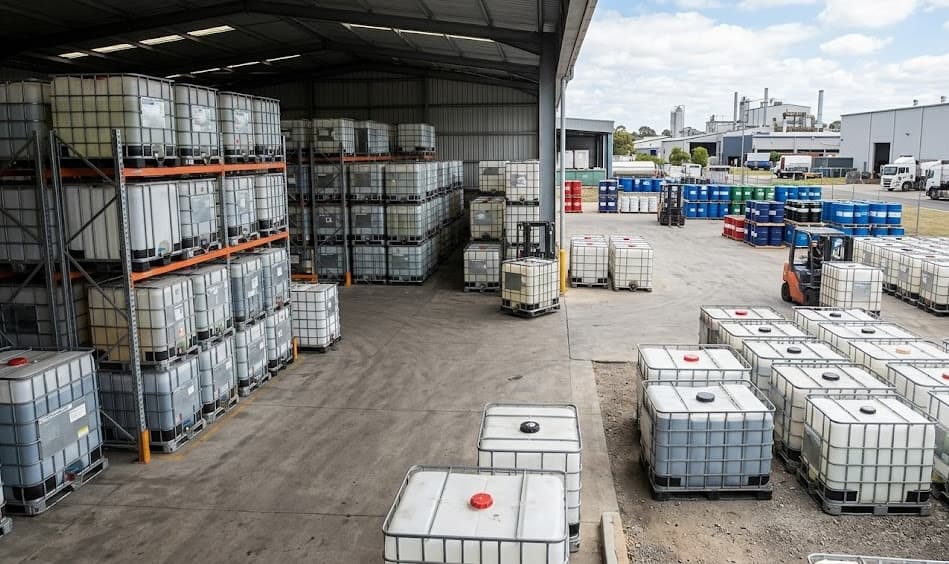
Used IBC Totes
Inspected, pressure-tested, and priced to move. Choose your grade, pick your size, and we'll have it on your dock within days.
Understanding Tote Grades
Every used IBC we sell is assigned a letter grade after a hands-on inspection. The grade reflects cosmetic condition — all grades pass the same structural and leak tests. Below is a detailed breakdown of what each grade means, so you can confidently select the right one for your application.
One-trip totes with minimal cosmetic wear. Bottles are clear or lightly tinted, labels intact, and cage panels straight. Perfect for food-adjacent, potable water, and clean chemical storage.
Best for: Low-risk reuse, water storage, food-grade adjacent
Price range: $120 - $150
Two- to three-trip totes showing moderate scuffing or slight discoloration. Structurally sound, pressure-tested, and fully functional. The workhorse choice for agriculture, irrigation, and general industrial liquids.
Best for: Agriculture, irrigation, non-hazardous chemicals
Price range: $95 - $125
Multi-trip totes with visible wear — staining, dents, or minor cage deformation — that do not affect structural integrity. Great for non-critical storage, rainwater collection, and job-site use.
Best for: Rainwater harvesting, job-site storage, non-critical uses
Price range: $80 - $110
Detailed Grade Criteria
The table below compares every grading criterion side-by-side. Use this as a reference when deciding which grade matches your needs and budget.
| Criteria | Grade A | Grade B | Grade C |
|---|---|---|---|
| Bottle Clarity | Clear to light tint — contents visible through bottle wall | Light to moderate tint or haze — contents may be partially obscured | Moderate to heavy tint, staining, or discoloration — contents not easily visible |
| Cage Condition | Straight panels, no dents, original paint/coating intact | Minor scuffing or surface rust, all panels intact and functional | Dents or minor deformation present but cage retains structural function |
| Label Status | Original manufacturer labels present and legible | Labels may be partially worn or removed; tote origin still identifiable | Labels may be missing, stained, or illegible |
| Valve Condition | Original valve in working condition, minimal wear on handle | Functional with moderate wear, handle operates smoothly | Functional; may show significant wear, replacement available on request |
| Typical Prior Trips | 1 (one-trip container) | 2-3 previous fill cycles | 4+ previous fill cycles |
| Expected Remaining Life | 8-10+ additional fill cycles with proper handling | 5-8 additional fill cycles with proper handling | 3-5 additional fill cycles with proper handling |
| Price Range (per unit) | $120 - $150 | $95 - $125 | $80 - $110 |
Detailed Size Specifications
We stock two standard sizes in used IBC totes. Both use the same 48-by-40-inch GMA pallet footprint, making them interchangeable in warehouse racking, freight trailers, and standard dock bays. The key difference is height and capacity.
275 Gallon
(1041 Liters)| External Dimensions (L x W x H) | 48" x 40" x 46" |
| Pallet Footprint | 48" x 40" (standard GMA) |
| Empty Weight | ~130 lbs |
| Filled Weight (water) | ~2,425 lbs |
| Bottle Wall Thickness | 3-4 mm HDPE |
| Fill Opening | 6" (150mm) threaded fill cap |
| Discharge Valve | 2" (50mm) butterfly valve standard |
| Stacking | Up to 2 high when filled (on racking up to 4 high) |
Standard pallet footprint. Fits most dock bays, freight trailers, and warehouse racking. The most widely available used IBC size in North America.
330 Gallon
(1249 Liters)| External Dimensions (L x W x H) | 48" x 40" x 53" |
| Pallet Footprint | 48" x 40" (standard GMA) |
| Empty Weight | ~145 lbs |
| Filled Weight (water) | ~2,900 lbs |
| Bottle Wall Thickness | 3-4 mm HDPE |
| Fill Opening | 6" (150mm) threaded fill cap |
| Discharge Valve | 2" (50mm) butterfly valve standard |
| Stacking | Up to 2 high when filled (on racking up to 3 high) |
Taller bottle for higher capacity on the same pallet base. Popular in chemical and ag sectors. Adds ~7 inches of height over the 275-gallon model, so verify ceiling clearance in enclosed trailers.
Need a different capacity? We occasionally stock 120-gallon and 550-gallon units. View the full size chart.
Material Composition
Understanding the materials in an IBC tote helps you assess chemical compatibility, weight capacity, and expected service life. Here is a breakdown of the primary components.
| Component | Material | Typical Weight | Function | Compatibility Notes |
|---|---|---|---|---|
| Bottle (inner container) | High-Density Polyethylene (HDPE) | 50-65 lbs | Liquid containment — the actual storage vessel | Compatible with most acids, bases, and solvents. Not suitable for concentrated oxidizers or aromatic solvents. |
| Cage (outer frame) | Galvanized or powder-coated carbon steel | 40-50 lbs | Structural protection, stacking support, forklift handling | Zinc galvanizing resists corrosion in outdoor environments. Powder-coated cages offer superior appearance. |
| Pallet base | HDPE plastic, steel, or wood composite | 25-35 lbs | Forklift and pallet jack entry, stacking stability, containment sump | Steel pallets are most durable. HDPE pallets are lightweight and corrosion-proof. Wood is economy-grade. |
| Discharge valve | Polypropylene body, EPDM gasket, stainless steel hardware | 1-2 lbs | Controlled liquid dispensing from bottom of tote | Standard butterfly valve handles most liquids. Ball valves recommended for viscous or particulate-laden fluids. |
| Fill cap and gasket | HDPE cap, EPDM or Viton gasket | <1 lb | Seals the 6-inch fill opening against leaks and contamination | Vented caps allow air exchange during gravity dispensing. Non-vented caps for sealed transport. |
Valve Types Available
Used totes come with their original discharge valves. We can also swap valves before delivery if you need a different configuration. Here are the most common types.
2" Butterfly Valve
The most common IBC discharge valve. Quarter-turn operation with a disc that rotates inside the flow path. Fast to open and close, minimal dripping, and easy to replace. Standard on 90% of used totes.
Pros: Simple, fast, inexpensive, widely available
Cons: Not full-bore — disc creates slight flow restriction
Best for: Water, thin chemicals, fertilizer, most general liquids
2" Ball Valve
Full-bore design where a drilled ball rotates to open or close flow. Zero restriction when open, which makes it superior for thick fluids, slurries, and high-flow-rate applications.
Pros: Full flow, handles viscous liquids, durable
Cons: Higher cost, slightly heavier
Best for: Oils, syrups, slurries, viscous chemicals, high-flow applications
Cam-Lock Quick-Connect
Lever-operated coupling that connects and disconnects in seconds without tools. Available in A through F configurations and in polypropylene or stainless steel. Standard in food, beverage, and chemical transfer operations.
Pros: Fast connection, tool-free, available in many materials
Cons: Requires matching cam-lock fitting on hose
Best for: Frequent connect/disconnect, food-grade transfer, chemical distribution
S60x6 Coarse Thread Adapter
The standard IBC outlet thread (60mm diameter, 6mm pitch). Most accessories and adapters screw directly onto this thread. Converting to garden hose, NPT pipe, or cam-lock starts with an S60x6 adapter.
Pros: Universal IBC standard, huge range of adapter options
Cons: Requires wrench or hand-tight connection (slower than cam-lock)
Best for: Permanent installations, garden hose connections, pipe systems
Gravity-Feed Spigot
A simple on/off spigot that threads onto the S60x6 outlet. Provides a basic faucet-style dispensing point for manual filling of buckets, watering cans, and small containers.
Pros: Simple, inexpensive, no tools needed
Cons: Low flow rate, not for large-volume dispensing
Best for: Rainwater taps, garden watering, small-volume dispensing
Heated Valve Jacket
An insulated electric wrap that fits around the discharge valve to prevent freezing in cold-weather outdoor installations. Thermostat-controlled to maintain above-freezing temperature at the valve and outlet pipe.
Pros: Prevents frozen valves, thermostat-controlled, easy install
Cons: Requires 120V power source
Best for: Outdoor winter storage, cold-climate operations
UN Markings Explained
Every IBC tote is manufactured with a UN performance marking molded or stamped into the bottle. This marking encodes critical information about the container's certification, capacity, and approved use. Here is how to read it.
UN 31HA1/Y/1250/0124/USA/SCHZ-1234
| Segment | Example | Meaning |
|---|---|---|
| UN Symbol | UN | United Nations certified container — meets international transport standards |
| Packaging Code | 31HA1 | 31 = rigid IBC; H = plastic (HDPE); A = with structural frame (cage); 1 = closed top with fill cap |
| Performance Level | Y | X = Packing Group I (high danger), Y = Packing Group II (medium), Z = Packing Group III (low) |
| Max Capacity (kg) | 1250 | Maximum gross mass (contents + container) in kilograms. 1250 kg is standard for 275-gal totes |
| Date of Manufacture | 0124 | Month and year of manufacture: January 2024 in this example |
| Country | USA | Country where the container was manufactured and certified |
| Manufacturer Code | SCHZ-1234 | Manufacturer identifier and serial/batch number for traceability |
Important:UN markings on used totes may be partially faded but should remain legible. If you are shipping regulated hazardous materials, the UN marking must be intact and the tote must be within its certified service life (typically 5 years from manufacture for composite IBCs). For non-regulated storage, faded markings do not affect the container's physical performance.
Our 16-Point Inspection Checklist
Every used IBC tote we sell passes this comprehensive inspection before it enters our inventory. No exceptions — any tote that fails a single point is diverted to recycling or reconditioning, never sold as-is.
Bottle wall integrity
No cracks, punctures, bulges, or stress whitening on the HDPE bottle. Wall thickness verified at 3mm minimum.
Cage panel alignment
All four cage panels and top frame are straight, securely welded, and free of breaks. Panels seat flush against bottle.
Cage corner posts
Vertical corner tubes are straight, not bent or crushed. Welds at top and bottom joints are intact.
Pallet base condition
Pallet (steel, HDPE, or wood) is not cracked, warped, or missing fork entry channels. Fork pockets clear of debris.
Bottle-to-pallet bond
HDPE bottle is properly seated in the pallet cradle. No gaps, shifting, or separation when lifted.
Discharge valve function
Valve opens and closes fully with smooth quarter-turn operation. No drips in closed position. Handle not stripped.
Valve gasket seal
EPDM or Viton gasket is present, flexible, and provides leak-free seal. No cracks, flattening, or missing gaskets.
Fill cap thread integrity
6-inch cap threads on smoothly and tightens to seal. No cross-threading, cracks, or stripped threads on cap or bottle neck.
Cap gasket condition
Fill cap gasket is present and pliable. Provides airtight seal when cap is hand-tightened. No gaps or deformation.
Pressure test (2.5 PSI)
Tote filled with water and pressurized to 2.5 PSI for 60+ seconds. Zero leakage at valve, cap, gasket, or bottle wall.
Previous contents identification
Prior product residue assessed by odor and visual inspection. Contents history documented where determinable.
UN marking legibility
UN/DOT performance markings on bottle checked for legibility. Marking presence confirmed even if partially faded.
Cage labeling / placards
Any hazmat or GHS labels from previous use are removed or marked as void. No misleading labeling remains.
Overall cosmetic grade assignment
Grade A, B, or C assigned based on aggregate cosmetic condition after all structural tests are passed.
Date stamp and lot tag
Inspection date, grade, and inspector initials recorded on a tag attached to the cage frame.
Photo documentation
Representative photos taken of each lot showing bottle condition, cage condition, valve, and cap for quality records.
Detailed Use Cases
Used IBC totes serve an incredibly wide range of industries and applications. Here is an in-depth look at the most popular use cases, including recommended grade and application-specific considerations.
Agriculture & Irrigation
Grade B or CUsed IBC totes are the backbone of modern farm liquid management. They store and dispense fertilizer concentrates, pesticide solutions, herbicide mixes, and adjuvant blends. Connected to drip irrigation or fertigation systems, they serve as gravity-feed or pump-fed reservoirs that deliver precise nutrient ratios directly to crop root zones. Livestock operations use them for watering stations, mineral supplement mixing, and cleaning solution storage. The 275-gallon size fits easily in a truck bed for field-to-field mobility.
Chemical Storage & Distribution
Grade A or BNon-hazardous industrial chemicals — detergents, degreasers, surfactants, pH adjusters, and cleaning agents — are routinely stored and transported in used IBC totes. The steel cage protects the HDPE bottle during forklift handling and stacking, while the standardized pallet base integrates with warehouse racking, dock levelers, and freight trailers. Used totes provide the same containment performance as new at a fraction of the cost, making them ideal for operations that cycle through large volumes of non-critical chemicals.
Water Storage & Emergency Reserves
Grade B or C (non-potable); Grade A (potable)Used IBC totes provide an affordable, stackable solution for bulk water storage. Applications range from emergency preparedness reserves and fire suppression supply to construction job-site potable water and dust suppression. Grade C totes are perfectly suited for non-potable water storage at the lowest possible cost. For potable water applications, Grade A totes with documented food-grade history or reconditioned totes with liners are recommended.
Food & Beverage (with precautions)
Grade A only (food-grade history required)Grade A used totes with verified food-grade prior contents history can be used for non-critical food applications like juice concentrates, syrups, cooking oils, vinegar, and beverage ingredients. However, any food-contact use requires careful verification of previous contents and thorough cleaning. For higher-assurance food safety, consider reconditioned totes with food-grade liners or new totes with FDA certification.
Rainwater Harvesting
Grade CIBC totes are one of the most popular containers for residential and commercial rainwater collection. Their 275-330 gallon capacity captures significant rainfall from rooftop downspouts, while the bottom discharge valve provides easy connection to garden hoses, soaker hoses, or drip irrigation. Multiple totes can be daisy-chained with simple S60x6 fittings to create larger storage arrays. Grade C totes offer the best price point for this application since cosmetic appearance is secondary to function.
Construction & Job-Site Operations
Grade B or CConstruction sites consume large volumes of water for concrete mixing, dust suppression, equipment wash-down, and crew drinking water. Used IBC totes provide portable, stackable, forkable water supply that can move from site to site on a flatbed trailer. They also store concrete additives, sealants, form-release oils, and curing compounds. The steel cage withstands the rough handling typical of construction environments.
Cannabis & Hemp Cultivation
Grade A or BLegal cannabis and hemp operations rely on precise nutrient mixing and delivery systems. Used IBC totes serve as mixing reservoirs for nutrient solutions, pH-adjusted water, and foliar sprays. Connected to automated fertigation controllers, they provide consistent feed to large-scale grow operations. Post-harvest processing may use totes for extraction solvent storage and waste collection. This industry typically prefers Grade A or B totes for cleaner starting conditions.
Automotive & Lubricant Storage
Grade A or BMotor oils, transmission fluids, antifreeze, windshield washer concentrate, and other automotive liquids are commonly stored in used IBC totes at service centers, fleet maintenance facilities, and lubricant distributors. The 275-gallon capacity is sufficient for high-volume service operations while remaining manageable for indoor storage. Butterfly valves provide controlled dispensing into smaller containers or directly into vehicle service bays.
Shelf Life & Storage Recommendations
Proper storage extends the service life of used IBC totes and protects both the container and its contents. Follow these guidelines to maximize your investment.
HDPE Bottle Lifespan
- UN-certified composite IBCs have a rated service life of 5 years from date of manufacture for regulated transport.
- For non-regulated storage (water, fertilizer, general chemicals), HDPE bottles can safely function for 8-10+ years if kept out of prolonged direct sunlight.
- UV exposure is the primary degradation factor for HDPE. Bottles stored outdoors without shade will become brittle faster than indoor-stored units.
- Black or opaque bottles include UV stabilizers and last significantly longer in outdoor applications than clear or translucent bottles.
- Chemical compatibility affects lifespan — some aggressive chemicals will degrade HDPE faster than water or mild solutions. Consult a compatibility chart for your specific product.
Storage Best Practices
- Store on level, solid surfaces — concrete pads, compacted gravel, or warehouse flooring. Soft or uneven ground can cause pallet distortion.
- Keep filled totes out of direct sunlight when possible. Use shade structures, tarps, or indoor storage to protect HDPE from UV degradation.
- Do not stack filled totes more than 2 high without rated racking. The bottom tote's cage and pallet must be rated for the combined weight above.
- Empty totes can be stored nested (bottle removed from cage) to save space, or stacked 3-4 high if cages are undamaged.
- In freezing climates, ensure water-based contents have adequate freeze protection. Water expands approximately 9% when frozen and can crack HDPE bottles.
- Close valves fully and cap fill openings during storage to prevent contamination by rainwater, insects, or debris.
- Inspect stored totes periodically (every 3-6 months) for valve drips, cap seal deterioration, and UV damage to the bottle.
Cleaning History & Previous Contents
Used totes have held a variety of products in their prior life. Understanding previous contents is important for determining suitability for your intended application.
Food-Grade History
Totes previously used for food-grade products (juices, oils, syrups) command a premium because their prior contents were non-toxic and the container has a cleaner baseline. These are best for food-adjacent reuse, potable water, or applications where contamination risk must be minimal.
Chemical History
Totes that previously held industrial chemicals (detergents, solvents, coatings) are suitable for similar chemical reuse, agriculture, and non-food applications. HDPE absorbs trace amounts of previously held chemicals, so cross-contamination must be considered.
Unknown History
Some used totes arrive with labels removed and contents history undeterminable. These are graded on physical condition alone and priced accordingly. They are appropriate for non-critical applications like rainwater collection, construction water, and general non-food storage.
What We Verify
Our inspectors assess residual odor, visible residue, and label information to determine likely previous contents. We document this information on the inspection tag so you can make an informed purchasing decision based on your intended use.
Cleaning Responsibility
Used totes are sold as-is after inspection — they are not professionally cleaned. Any residual product from previous use remains in the tote. If your application requires a clean interior, consider purchasing a reconditioned tote (triple-washed) or adding a disposable liner.
Liner Option
For applications that need a clean barrier without the cost of a reconditioned or new tote, we offer disposable LDPE liners that fit inside the tote bottle. The liner creates a sealed interior surface with zero contact to the tote wall, effectively making any used tote suitable for sensitive products.
Benefits of Buying Used
- Save 40-60% compared to new container pricing
- Reduce plastic waste — each reused tote keeps ~135 lbs of HDPE out of landfills
- Same structural performance: steel cage + HDPE bottle built for repeat use
- Immediate availability — no 6-8 week factory lead times
- Stackable, forkable, and pallet-jack compatible out of the box
- Standardized 48x40 pallet footprint integrates with existing warehouse infrastructure
- Compatible with all standard IBC accessories, adapters, and fittings
- Lower insurance and replacement costs compared to new-container fleets
- Contribute to circular economy — keeping functional containers in productive service
- Ideal for testing new applications before committing to new-container investment
What Affects Pricing?
Grade
Grade A commands a premium for near-new cosmetic condition; Grade C is the most budget-friendly option for non-critical applications.
Quantity
Truckload orders (50+ units) unlock volume discounts of 15-30%. Even 10-unit orders qualify for 5-10% off list price.
Valve Type
Standard butterfly valves are included. Ball valves, cam-lock fittings, or specialty adapters may add $10-$30 per unit.
Previous Contents
Totes with documented food-grade history cost more than general industrial-use totes due to higher demand and limited supply.
Delivery Distance
Local pickup is cheapest; freight is quoted per delivery zone. Full truckloads get better per-unit freight rates than partial shipments.
Pallet Type
Steel-pallet totes command a slight premium over HDPE or wood-pallet units due to superior durability and longer service life.
Seasonal Demand
Prices tend to be lowest in winter (Dec-Feb) when agricultural demand drops, and highest in spring (Mar-May) when planting season begins.
Market Supply
Used tote supply fluctuates with industrial production cycles. When supply tightens, prices rise. We recommend stocking up when prices are favorable.
Frequently Asked Questions
Are used IBC totes food-safe?
It depends on the grade and prior contents. Grade A totes with documented food-grade history can be reused for food products, but it is your responsibility to verify suitability for your specific application. For higher assurance, use a reconditioned tote with a food-grade liner or purchase a new FDA-compliant tote. HDPE is an FDA-approved food-contact material, but prior non-food contents can leave trace residues.
How many times can a used IBC tote be refilled?
A well-maintained steel-cage IBC tote can typically endure 10 or more fill cycles over its service life. The HDPE bottle is the limiting factor — it gradually becomes more brittle from UV exposure and chemical contact. The steel cage, valves, and pallet can often outlast multiple bottle replacements. Grade A totes (one prior trip) have the most remaining service life; Grade C totes may have 3-5 cycles left.
Can I use a used tote for drinking water?
For potable water storage, we recommend Grade A totes with confirmed food-grade prior contents, or better yet, reconditioned totes with food-grade liners. HDPE is safe for water contact, but any residue from previous industrial contents must be eliminated. If you are setting up emergency water storage, a new tote or a used tote with a liner provides the safest option.
What is the difference between used and reconditioned totes?
Used totes are sold as-is after inspection and pressure testing. They retain their original valves, gaskets, and caps. Reconditioned totes go through a complete industrial process: triple washing, new valve and gasket replacement, pressure testing, and QA certification. Reconditioned totes cost 30-50% more than used but provide a cleaner, more reliable starting point with new hardware.
Do you ship used totes on pallets?
Yes — every IBC tote includes an integrated pallet base (HDPE, steel, or wood depending on the specific unit). The tote ships as a complete, ready-to-use unit. You do not need to provide separate pallets. Totes are shipped standing upright on their own pallets and secured to the delivery truck.
Can I return a tote if it doesn't meet my expectations?
We grade and describe every tote accurately, and we stand behind our inspection process. If a tote arrives in a condition that does not match the quoted grade, contact us within 48 hours of delivery. We will arrange a replacement or credit. However, used totes are sold with the understanding that cosmetic wear is present — the grading system exists to set appropriate expectations.
How are used totes shipped?
Small orders (1-5 totes) typically ship via LTL (Less Than Truckload) common carrier on flatbed or enclosed trailers. Larger orders ship as partial or full truckloads for better per-unit freight rates. Local pickup is available at our West Coast facilities. We arrange all freight logistics and provide tracking information.
Do you buy back or take trade-ins on used totes?
Yes, we actively purchase used IBC totes from businesses that have surplus containers. If you have empty totes to sell or trade, contact us with the approximate quantity, condition, and location. We offer pickup service for bulk quantities in our West Coast service area. Trade-in credits can be applied to your next purchase.
Are used totes legal for transporting hazardous materials?
Used IBC totes may be used for hazmat transport only if the UN marking is intact, legible, and the tote is within its certified service life (typically 5 years from manufacture for composite IBCs). The tote must also be in good condition per DOT 49 CFR requirements. For non-DOT-regulated storage, UN marking condition does not restrict use.
What should I do when my used tote reaches end of life?
When a tote can no longer hold liquid safely, the components can be recycled separately. The HDPE bottle is recyclable through industrial plastic recyclers (resin code #2). The steel cage is recyclable as scrap metal. Pallet bases vary by material. Contact your local recycler or ask us — we can often pick up end-of-life totes as part of a buy-back arrangement.
What Makes Our Used Totes Different
Used IBC totes are available from dozens of suppliers across the West Coast. What separates IBC West Coast from the rest is the rigor of our inspection process, the transparency of our grading system, and the consistency of what you receive on delivery day. Here is exactly what we do differently.
Multi-Point Inspection
Every tote passes our 16-point inspection checklist -- not a cursory glance, but a hands-on evaluation of bottle wall integrity, cage alignment, pallet condition, valve function, gasket seal, cap thread integrity, and more. We use ultrasonic thickness gauges on HDPE bottles to detect wall thinning that visual inspection would miss. Our rejection rate averages 12-15%, which means more than one in ten incoming totes never makes it to our sales floor.
Guaranteed Valve Function
We test every valve through a complete open-close cycle before the tote enters inventory. The valve must operate smoothly with a quarter-turn, seat fully closed with zero drip, and provide a leak-free seal under 2.5 PSI pressure. If the original valve shows any sign of wear, stiffness, or incomplete sealing, we replace it with a new OEM-spec valve at no additional charge. You will never receive a tote with a non-functional valve.
Documented History
We track the source, arrival date, previous contents (when identifiable), and inspection results for every tote that enters our facility. Each tote carries an inspection tag with its assigned grade, inspector initials, and date. For customers who require traceability documentation, we can provide lot-level reports showing the inspection history for every unit in your order.
Honest Grading System
Our A/B/C grading system is standardized and consistently applied. Grade A means one trip with near-new cosmetics. Grade B means moderate wear with full function. Grade C means visible wear that does not affect structure. We never upsell a Grade B as an A, and we never ship a unit that does not match the quoted grade. If you disagree with the grade on arrival, we make it right within 24 hours.
Pressure-Tested, Not Just Inspected
Visual inspection alone cannot detect slow leaks, hairline cracks, or gasket seal failures. That is why every single tote we sell -- regardless of grade -- is filled with water and pressurized to 2.5 PSI for a minimum of 60 seconds. We watch for leaks at every possible failure point: bottle wall, valve connection, cap seal, and gasket. Any leak, no matter how small, results in immediate rejection.
Clean Labeling
Before a tote enters our sales inventory, any misleading labels from previous use are removed. Old GHS placards, hazmat diamonds, and product-specific labels are peeled or scraped off so you receive a tote with a clean exterior. This prevents confusion in your facility and avoids regulatory issues from carrying forward another company's hazard communication labels.
Volume Buying Guide for Large Orders
Buying used IBC totes in volume is the most cost-effective way to build or replenish a container fleet. Here is everything you need to know about placing large orders, from pricing tiers and freight optimization to quality control at scale.
| Order Size | Typical Savings | Freight Method | Delivery Timeline | Notes |
|---|---|---|---|---|
| 10-24 units | 5-10% off list | LTL or partial truckload | 3-5 business days | Minimum threshold for volume pricing. Can mix grades within a single order. |
| 25-49 units | 10-15% off list | Half truckload | 3-5 business days | Dedicated account manager assigned. Recurring order scheduling available. |
| 50-99 units | 15-20% off list | Full or near-full truckload | 5-7 business days | Pre-shipment inspection photos available on request. Grade consistency guaranteed per lot. |
| 100+ units | 20-30% off list | Full truckload(s) | 5-10 business days | Best per-unit pricing. Multi-truck orders staged across multiple delivery dates if needed. |
| 500+ units | Custom contract pricing | Multi-truck dedicated | 2-4 weeks staged | Long-term supply agreements with locked pricing. Dedicated inventory allocation. |
Truckload Logistics
A standard 53-foot dry van trailer holds approximately 56 to 60 IBC totes stacked two high. A flatbed trailer can carry similar quantities but allows side-loading for facilities without a dock. We handle all freight coordination, including carrier selection, load planning, and delivery scheduling.
For customers receiving at a facility without a loading dock, we can arrange liftgate delivery or schedule a flatbed with a Moffett (truck-mounted forklift) for self-unloading. These services add a modest surcharge but eliminate the need for on-site equipment.
Quality at Scale
Large orders receive the same per-unit inspection rigor as single totes. We do not cut corners on volume orders. However, we understand that consistency matters more at scale, so we offer optional pre-shipment inspection photos for orders of 50+ units. You will receive a representative photo set showing the general condition of the lot before it leaves our warehouse.
For orders of 100+ units, we assign a quality lead who personally oversees the selection and loading process to ensure grade consistency throughout the entire lot. This person serves as your direct contact for any quality questions during and after delivery.
Storage Recommendations for Used Totes
How you store your used IBC totes directly impacts their service life and the quality of their contents. Whether you are setting up a permanent tank farm or staging totes for seasonal use, these detailed recommendations will help you get the most out of every unit.
Site Preparation
- Place totes on level, hard surfaces only -- concrete pads, compacted gravel, or asphalt. Soft ground allows pallets to sink unevenly, stressing cage and bottle joints.
- For outdoor storage, grade the surface for drainage so rainwater does not pool around pallet bases. Standing water accelerates wood pallet rot and steel pallet corrosion.
- Install secondary containment (berms, dikes, or spill pallets) if storing chemicals. Many jurisdictions require 110% containment capacity for the largest single container in the array.
- Leave at least 36 inches between rows for forklift access and visual inspection. Tight spacing makes leak detection and maintenance nearly impossible.
- For permanent installations, consider pouring a simple concrete slab with a slight crown for drainage. The upfront cost pays for itself in reduced pallet damage and easier cleanup.
Environmental Protection
- UV radiation is the primary enemy of HDPE bottles. Prolonged direct sun exposure causes embrittlement, surface cracking, and eventual failure. Use shade structures, tarps, or opaque covers for outdoor installations.
- Black or pigmented bottles contain UV stabilizers and last 2-3 times longer in outdoor sun exposure than clear or natural bottles. If your totes will live outdoors, request pigmented bottles when ordering.
- In freezing climates, insulate or heat totes containing water-based products. Water expands approximately 9% when it freezes, generating enough force to crack HDPE bottles and pop gasket seals.
- Wind exposure can topple empty totes. If storing empties outdoors, strap them to a fixed structure or weigh them down with 2-3 inches of water in the bottom to prevent tipping.
- Dust, insects, and debris enter through uncapped fill ports and open valves. Always cap fill openings and close discharge valves fully during storage, even for empty totes.
Stacking and Racking
- Filled totes can be stacked a maximum of 2 high on level ground with no intermediate racking. The bottom tote's cage and pallet must be rated for the combined weight of the stacked unit above it.
- For higher stacking (3-4 levels), use purpose-built IBC racking systems that transfer the load through the rack structure rather than through the totes themselves.
- Never stack totes of different footprint sizes. A 330-gallon tote stacked on a 275-gallon unit creates an unstable, top-heavy configuration that can topple without warning.
- Empty totes can be nested (bottle removed from cage) for space-efficient storage. Four to six empty cages with pallets can typically fit in the footprint of two full totes.
- When stacking on racking, verify that the racking system is rated for the loaded weight. A filled 330-gallon tote weighs approximately 2,900 pounds -- standard warehouse shelving is not rated for this load.
Ongoing Maintenance Schedule
- Monthly: Visual walk-around of all stored totes. Check for visible leaks, valve drips, cap looseness, and any cage damage from handling equipment.
- Quarterly: Test valve operation on every tote by performing a full open-close cycle. Replace any valve that shows stiffness, incomplete sealing, or a cracked handle.
- Semi-annually: Inspect gaskets on fill caps and discharge valves. EPDM gaskets lose elasticity over time and may need replacement every 12-18 months, especially in hot climates.
- Annually: Assess HDPE bottle condition for UV degradation (yellowing, chalking, surface cracking). Bottles showing visible UV damage should be moved to shaded storage or replaced.
- After any freeze event: Inspect all totes for frost damage. Even if the contents did not freeze solid, partial freezing near the valve and cap areas can crack gaskets and loosen seals.
Return and Exchange Policy
We stand behind every tote we sell. While used containers are sold with the understanding that cosmetic wear is present, our commitment to accurate grading and structural integrity means you should never be surprised by what arrives on your dock. Here is our complete return and exchange policy.
What Is Covered
- Grade mismatch: If a tote arrives in a condition that clearly does not match the quoted grade (e.g., you ordered Grade A and received a Grade B or lower), we will replace it or issue a full credit.
- Structural defect: Any tote that leaks under normal use within 30 days of delivery, provided the leak is due to a pre-existing defect and not customer-caused damage.
- Valve failure: If the discharge valve fails to operate properly (sticking, dripping when closed, or leaking at the connection) within 30 days, we replace the valve at no charge.
- Missing components: If a tote arrives without its fill cap, valve, or gaskets, we will ship the missing parts immediately at no charge.
- Incorrect size: If we ship a 275-gallon tote when you ordered 330-gallon (or vice versa), we will arrange the exchange including freight in both directions.
What Is Not Covered
- Normal cosmetic wear consistent with the quoted grade. Used totes are sold with the understanding that they have been previously filled and show evidence of prior use.
- Damage caused by the customer after delivery, including forklift punctures, overfilling, chemical incompatibility, dropping, or exposure to conditions outside the tote's rated specifications.
- Residual odor or staining from previous contents. Used totes are sold as-is with respect to interior condition. If you need a clean interior, order a reconditioned tote or add a liner.
- Issues reported more than 48 hours after delivery. We require prompt inspection on receipt so we can distinguish between pre-existing conditions and delivery damage.
- Buyer's remorse or specification changes after delivery. If you realize you need a different grade or size after receiving your order, we will work with you on a new order but cannot accept returns of otherwise conforming totes.
How to File a Return or Exchange Request
Document
Take photos of the issue and note the inspection tag number on the tote's cage frame.
Contact Us
Call or email within 48 hours of delivery. Include your order number, photos, and a description of the issue.
Resolution
We will respond within one business day with a replacement, credit, or pickup authorization.
Return Freight
If a return is necessary, we cover freight in both directions. We arrange the carrier and schedule the pickup at your convenience.
Ready to Order?
Tell us the grade, size, and quantity you need. We will reply with a firm quote — usually within a few hours during business days. Volume discounts available for orders of 10+ units.