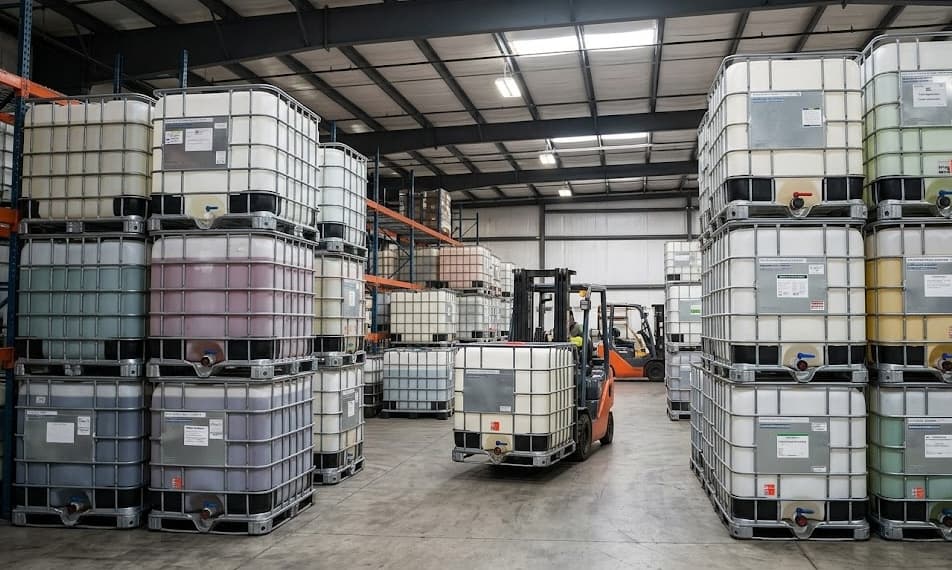
IBC Safety & Handling Guide
Safe handling procedures, storage requirements, stacking rules, inspection checklists, and PPE guidelines — everything your team needs to handle IBCs safely.
Safe Handling Procedures
Moving IBCs
- •Always use a forklift or pallet jack. Never attempt to roll, drag, or manually lift an IBC. A full 275-gallon IBC weighs approximately 2,400 lbs.
- •Insert forklift forks fully into the pallet slots. Partial insertion can cause tipping or pallet breakage.
- •Tilt the mast slightly back before lifting. Keep the load as low as possible during transport — maximum 6 inches above ground level.
- •Travel speed should not exceed 5 mph with a loaded IBC. Slow down on turns — the high center of gravity makes IBCs prone to sway.
- •Never lift an IBC by the cage with a crane or sling unless it is specifically designed for top-lift (stainless IBCs with rated lift points).
Filling & Dispensing
- •Verify chemical compatibility before filling any IBC. Check the SDS and the IBC material. See our types guide for the compatibility chart.
- •Do not overfill. Leave a minimum 2-inch headspace to allow for thermal expansion. The standard fill line is marked on most HDPE bottles.
- •For flammable liquids, ground and bond the IBC before filling. HDPE plastic is non-conductive — use a grounding clamp on the metal cage and a bonding wire to the fill equipment.
- •Close the fill cap and bottom valve immediately after filling or dispensing. Open containers create spill, contamination, and vapor hazards.
- •Use drip trays or containment pallets under the discharge valve during dispensing to catch minor drips and prevent slip hazards.
Storage Requirements
Indoor Storage
- Store on level, smooth concrete or sealed flooring
- Maintain ambient temperature between 35°F and 110°F for HDPE IBCs
- Keep away from heat sources, open flames, and welding areas
- Maintain minimum 3-foot clearance from sprinkler heads (NFPA requirement)
- Provide adequate ventilation — especially for volatile or off-gassing contents
- Aisle width: minimum 10 feet for forklift access
- Secondary containment required for hazardous materials (110% of largest container volume)
- Keep fire extinguisher within 50 feet of IBC storage area
Outdoor Storage
- HDPE bottles degrade in UV sunlight — use covers or shade structures for storage beyond 6 months
- Secure IBCs against wind with strapping, especially when empty (they act like sails)
- Ensure ground is level, compacted gravel or concrete — not bare soil
- Provide secondary containment per EPA SPCC rules if storing oils or hazmat
- Temperature extremes: HDPE handles freeze-thaw cycles but contents may not. Verify product tolerance.
- Protect valves from impact — orient discharge valves toward the interior of the storage area
- Label outdoor IBCs clearly — rain can wash off adhesive labels. Use weather-resistant tags.
- Check local fire codes for maximum allowable outdoor IBC quantities near buildings
Stacking Limits & Guidelines
Improper stacking is the leading cause of IBC-related workplace injuries. A collapsed stack can release thousands of pounds of liquid and crush anyone in the fall zone.
| Scenario | Max Stack Height | Requirements |
|---|---|---|
| Full, SG ≤ 1.2 | 2 high | Cage undamaged, pallet flat, corners aligned |
| Full, SG > 1.2 | 1 high (floor only) | Check data plate — some models rated for 2-high at higher SG |
| Empty with cage | 3–4 high | Must be secured; lower in seismic or high-wind zones |
| In racking | Per racking design | IBC weight must not exceed beam capacity |
| Mixed (full on bottom, empty on top) | 2 high | Empty IBC on top only; full always on bottom |
Never Stack If:
- Cage has bent or broken corner posts, cross-members, or top frame
- Pallet is cracked, warped, or missing boards
- IBC is leaking or shows signs of bottle bulging
- Floor surface is uneven, sloped, or soft (e.g., compacted gravel outdoors)
- Contents are unknown or specific gravity is unverified
IBC Inspection Checklist
Inspect every IBC before filling, before stacking, and upon receipt. This 30-second visual check prevents the majority of IBC-related incidents.
Cage & Frame
- All four corner posts are straight and undamaged
- Top frame is square and latches securely
- Cross-members show no bowing, cracks, or corrosion
- Cage is firmly attached to the pallet base
- No welds are cracked or broken
Bottle & Valve
- No cracks, holes, or bulges in the HDPE bottle
- Bottle is seated properly in the cage (no shifting)
- Fill cap threads are clean and cap seals tight
- Bottom valve operates freely and seals without drip
- Valve gasket is present and not cracked or compressed
Pallet
- No cracked, broken, or missing boards
- Forklift entry points are clear and not obstructed
- Pallet sits flat on level ground — no rocking
- Wood pallets show no rot, mold, or pest damage
Labels & Markings
- UN/DOT data plate is legible and present
- Previous content label is visible (for used IBCs)
- Manufacture date is within acceptable range
- Hazmat placards match contents (if applicable)
PPE Requirements
Required PPE depends on the contents being handled. At minimum, the following applies to all IBC handling operations:
Safety Footwear
Steel-toe or composite-toe boots. Required whenever moving IBCs by forklift or pallet jack.
Safety Glasses
Splash-proof goggles when filling, dispensing, or handling chemicals. Standard safety glasses for dry handling.
Chemical-Resistant Gloves
Nitrile, neoprene, or butyl depending on contents. Check SDS Section 8 for specific recommendations.
Hard Hat
Required when working in areas where IBCs are stacked overhead or being moved by crane/forklift at height.
Respiratory Protection
Required when handling volatile chemicals in poorly ventilated areas. Type depends on vapor/particulate hazard.
Chemical Apron / Coveralls
Required when filling or dispensing corrosive or irritating liquids. Tyvek coveralls for splash protection.
Incident Prevention: Common Hazards and How to Avoid Them
Most IBC-related incidents are preventable. The following covers the five most common incident types we see in the field, their root causes, and the specific steps to prevent them.
Stack Collapse
Root cause: Stacking IBCs with damaged cages, warped pallets, misaligned corners, or on uneven surfaces. Overloading beyond the rated stacking limit (typically 2-high for full IBCs with SG below 1.2).
Prevention Steps
- •Inspect every cage corner post and top frame before stacking. Reject any IBC with bent, cracked, or corroded structural members.
- •Verify the pallet sits flat with no rocking. Replace pallets with cracked or missing boards.
- •Align all four corners precisely -- even 2 inches of offset shifts the load path and dramatically increases collapse risk.
- •Never stack on soft ground (gravel, dirt, asphalt in hot weather). Use concrete or steel plates.
- •Post maximum stacking height limits in the storage area. Include specific gravity limitations on the signage.
Chemical Spill During Dispensing
Root cause: Valve left open, hose disconnection under pressure, gasket failure, or incompatible connections (wrong thread type causing cross-threading and leaks).
Prevention Steps
- •Use a containment pallet under every IBC during dispensing. The containment must hold 110% of the IBC volume.
- •Replace valve gaskets at every reconditioning cycle. Inspect gaskets visually before each use -- compressed, cracked, or chemically degraded gaskets must be replaced.
- •Use camlock safety clips on all hose connections to prevent accidental disconnection.
- •Verify thread compatibility (NPS vs S60x6) before connecting. Cross-threaded connections are the leading cause of valve leaks.
- •Close valves immediately after dispensing. Post a "Close Valve After Use" sign at every dispensing station.
Static Ignition with Flammable Liquids
Root cause: HDPE is non-conductive. Liquid flowing through or into an HDPE bottle generates static charge. Without grounding, the accumulated charge can discharge as a spark -- igniting flammable vapors.
Prevention Steps
- •Ground the metal cage of HDPE IBCs to a verified earth ground point before filling or dispensing flammable liquids.
- •Bond the fill nozzle or pump to the cage with a bonding wire to equalize potential.
- •Use conductive (ATEX-rated) IBCs for regular flammable liquid handling. The conductive HDPE bottle eliminates the static buildup risk.
- •Fill at low velocity to minimize charge generation. Splash filling from height is especially dangerous.
- •Stainless steel IBCs are inherently conductive and eliminate the static risk entirely -- they are the preferred choice for flammable solvents.
Forklift Tip-Over or Drop
Root cause: A full 275-gallon IBC weighs approximately 2,400 lbs with a high center of gravity. Turning too fast, lifting too high during transport, or partial fork insertion can cause tipping.
Prevention Steps
- •Insert forks fully into the pallet -- the tips should extend through to the other side. Partial insertion concentrates the load on the fork tips and can split the pallet.
- •Keep the load as low as possible during transport (6 inches above ground). Raise only when placing on a stack or rack.
- •Reduce speed on turns. The liquid inside the IBC sloshes and shifts the center of gravity during turns.
- •Never transport an IBC with a person riding on or near it.
- •Verify the forklift capacity rating exceeds the loaded IBC weight. A standard 5,000 lb forklift is the minimum for a full 275-gallon IBC.
Chemical Incompatibility Failure
Root cause: Filling an IBC with a chemical that degrades its material -- solvent in HDPE (softening/permeation), chlorides in stainless 304 (pitting corrosion), or acids through a damaged carbon steel lining.
Prevention Steps
- •Cross-reference the product SDS with the IBC material compatibility chart before every first fill with a new product.
- •Never assume compatibility based on similar product names. Formulation changes can alter chemical behavior significantly.
- •For used IBCs, verify previous contents are compatible with the new product. Some chemical residues react dangerously with certain refills.
- •Monitor HDPE IBCs filled with borderline-compatible chemicals for signs of softening, swelling, discoloration, or odor permeation.
- •Inspect carbon steel linings before each fill. Even a small chip in the lining can lead to rapid corrosion and catastrophic failure.
Emergency Response Procedures
Even with the best prevention practices, incidents can occur. Having clear, rehearsed response procedures minimizes harm to people and the environment. Post these procedures in all IBC storage and handling areas.
Chemical Spill Response
- Alert: Warn nearby workers. If the spill involves toxic or flammable material, activate the facility alarm and evacuate the immediate area.
- Identify: Check the IBC label and SDS to identify the spilled material. Do not approach an unknown spill without PPE.
- Don PPE: Put on chemical-resistant gloves, splash goggles, and appropriate respiratory protection before approaching.
- Stop the source: Close the valve, cap the opening, or reposition the IBC to stop further release -- only if safe to do so.
- Contain: Deploy absorbent socks or berms to prevent the spill from reaching drains, waterways, or soil. Block nearby floor drains with drain covers.
- Absorb and collect: Use appropriate absorbent material (clay, vermiculite, or chemical-specific absorbent pads). Collect in compatible containers.
- Report: Notify your supervisor and environmental coordinator. Reportable quantities (RQ) under CERCLA trigger mandatory notification to the National Response Center (1-800-424-8802) and state agencies.
- Dispose: Contaminated absorbent is hazardous waste if the spilled material is hazardous. Dispose through a licensed hazardous waste hauler.
Fire Involving IBCs
- Activate alarm: Pull the nearest fire alarm and call 911. Do not attempt to fight a large fire involving multiple IBCs.
- Evacuate: Clear the area. HDPE bottles will melt and release their contents, potentially creating a secondary spill and spreading the fire.
- Small fires only: If the fire is small and contained (single IBC, early stage), use the appropriate extinguisher. Class B (foam or CO2) for flammable liquids. Never use water on oil or solvent fires.
- Inform responders: Tell arriving firefighters exactly what chemicals are stored in the area, the number of IBCs, and their contents. Provide the SDS binder.
- Runoff containment: Firefighting water contaminated with chemicals is hazardous. Secondary containment systems should capture firewater runoff. Alert the environmental coordinator about potential water contamination.
Personal Injury from IBC Contact
- Skin contact with chemicals: immediately flush with water for at least 15 minutes. Remove contaminated clothing. Refer to SDS Section 4 for specific first aid.
- Eye contact: use the nearest eyewash station for 15 minutes minimum. Hold eyelids open. Seek immediate medical attention.
- Inhalation of vapors: move the person to fresh air. If breathing is difficult, call 911. Administer oxygen if trained and equipped.
- Crush injury from fallen IBC: call 911 immediately. Do not attempt to move the IBC off the victim unless you can do so safely without causing further injury.
Training Requirements for IBC Handlers
OSHA and DOT require specific training for employees who handle IBCs containing hazardous materials. Even for non-hazardous products, proper training prevents injuries and property damage. Here are the training requirements organized by regulatory source.
| Training Topic | Required By | Frequency | Who Needs It |
|---|---|---|---|
| Hazard Communication (HazCom) -- reading SDS, understanding labels, chemical hazards | OSHA 29 CFR 1910.1200 | Initial + when new hazards are introduced | All employees handling or working near IBCs with chemicals |
| Forklift operator certification | OSHA 29 CFR 1910.178 | Initial + 3-year refresher + after incidents | All forklift operators moving IBCs |
| Hazardous materials handling (HazMat employee) | DOT 49 CFR 172.704 | Initial + every 3 years (recurrent) | Anyone who fills, labels, marks, loads, or transports IBCs of hazmat |
| Spill response (awareness level) | OSHA 29 CFR 1910.120(q) | Initial + annual refresher | All employees in areas where chemical IBCs are stored |
| Spill response (operations level) | OSHA 29 CFR 1910.120(q) | Initial + annual refresher + 24 hours minimum | Designated spill response team members |
| Fire extinguisher use | OSHA 29 CFR 1910.157 | Initial + annual | All employees in IBC storage areas with extinguishers |
| Personal protective equipment (PPE) | OSHA 29 CFR 1910.132 | Initial + when PPE changes | All employees required to wear PPE during IBC operations |
| Lockout/tagout (if IBCs feed process equipment) | OSHA 29 CFR 1910.147 | Initial + annual | Employees who connect/disconnect IBCs to process lines |
Recommended Additional Training (Not Legally Required but Best Practice)
- IBC inspection procedures -- teach all handlers the 30-second visual inspection checklist (see above) so they can identify damaged containers before use.
- Stacking safety -- hands-on demonstration of proper alignment, corner-post inspection, and floor-surface requirements.
- Valve operation and maintenance -- how to open, close, and replace butterfly valves and gaskets without tools or excessive force.
- Chemical compatibility awareness -- basic training on why certain chemicals damage certain IBC materials, with real-world examples of failures.
- Grounding and bonding for flammable liquids -- demonstration of proper grounding clip placement and bonding wire connection.
- Emergency shutdown procedures specific to your facility -- how to stop pumps, close valves, and activate containment systems.
Regulatory Requirements
Safety procedures must align with federal and state regulations. For detailed information on UN/DOT markings, OSHA storage rules, EPA used-container regulations, FDA food-grade requirements, and West Coast state-specific rules, see our dedicated regulations page.
IBC Regulations & Compliance Guide →