IBC Industry Glossary
A comprehensive reference of terms, abbreviations, and definitions used in the IBC tote and industrial container industry.
Ambient Temperature
The temperature of the surrounding environment in which an IBC tote is stored or used. Ambient temperature affects the physical properties of the HDPE bottle (which becomes more brittle at low temperatures and softer at high temperatures), the viscosity and vapor pressure of the contents, and the effectiveness of gasket seals. Standard IBC totes are rated for ambient temperatures between minus 40 and plus 60 degrees Celsius (minus 40 to 140 degrees Fahrenheit). Products stored outside this range may require insulated totes, heating blankets, or temperature-controlled storage.
Autoignition Temperature
The minimum temperature at which a substance spontaneously ignites in normal atmosphere without an external ignition source such as a spark or flame. Autoignition temperature is listed on Safety Data Sheets and is relevant for fire safety planning when storing combustible or flammable materials in IBC totes. Storage areas must be designed to keep temperatures well below the autoignition temperature of the stored materials, with adequate ventilation and fire suppression systems as required by NFPA and local fire codes.
Baffle
An internal partition inside a liquid container that reduces sloshing during transport, improving vehicle stability and reducing stress on the container walls.
Ball Valve
A valve with a spherical disc that controls flow through a port. Ball valves provide reliable shut-off and are commonly used on IBC tote outlets for their durability and ease of operation.
Batch Number
An identifier assigned to a specific quantity of product filled into IBC totes during a single production or packaging run. While lot number typically refers to the container itself, batch number usually refers to the contents. Batch numbers enable product recall traceability: if a quality issue is detected in a finished product, the batch number allows the manufacturer to identify all containers that hold product from the same production batch and recall them if necessary.
Bill of Lading
A legal document issued by a carrier to a shipper that details the type, quantity, and destination of goods being transported. For IBC tote shipments, the bill of lading (BOL) specifies the number of totes, total weight, description of contents, shipper and consignee information, and any hazardous material designations. When shipping hazmat, the BOL must include the proper shipping name, hazard class, UN number, packing group, and emergency contact number as required by 49 CFR 172.200.
Blow Molding
A plastics manufacturing process used to produce the HDPE inner bottle of composite IBC totes. A heated tube of polyethylene (parison) is inflated inside a mold using compressed air, forming a seamless, hollow container. Blow-molded bottles have uniform wall thickness and are free of weld seams, which improves chemical resistance and structural integrity.
Boiling Point
The temperature at which a liquid changes to a gas at atmospheric pressure. Boiling point is relevant to IBC tote storage because products with low boiling points may generate excessive vapor pressure inside a sealed tote, especially during warm weather or in heated indoor environments. If the vapor pressure exceeds the pressure relief rating of the vent cap, the tote can rupture. Products with boiling points near or below ambient storage temperatures should be stored in properly vented totes with adequate pressure relief devices.
Bung
A threaded opening on the top of an IBC tote used for filling. Standard IBC totes have a large 6-inch (150mm) fill opening and a smaller 2-inch (50mm) vent or secondary fill port.
Butterfly Valve
A quarter-turn valve commonly used on IBC tote outlets, consisting of a disc mounted on a rotating shaft inside the valve body. When the handle is turned 90 degrees, the disc rotates from fully closed to fully open. Butterfly valves provide fast operation and good flow rates but are generally less suitable for throttling applications compared to ball valves.
Buttress Thread
A thread profile used on IBC valve connections, specifically designed to handle high axial loads. The standard 2-inch buttress thread (S60x6) is the most common IBC outlet thread type.
Cage
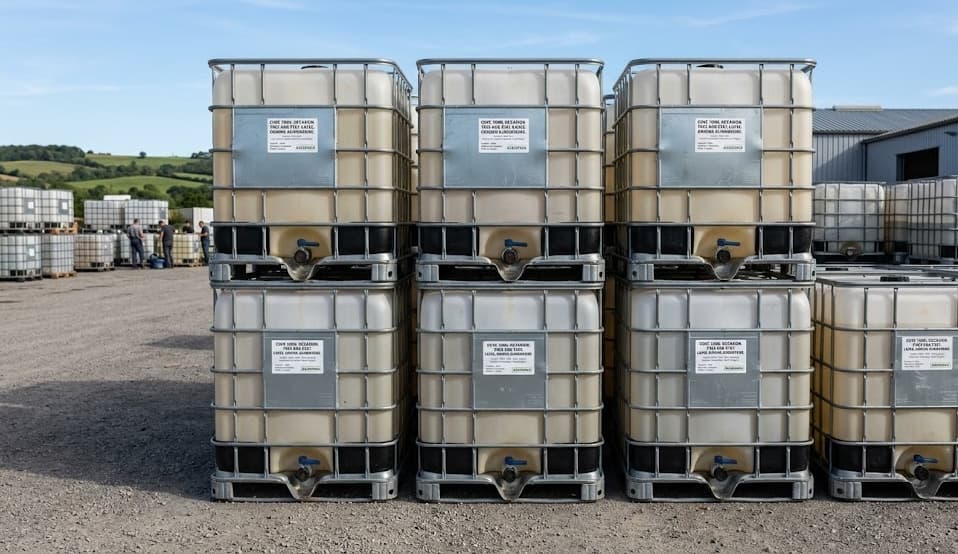
The galvanized steel framework that surrounds and protects the HDPE bottle of a composite IBC tote. The cage provides structural rigidity, stacking strength, and forklift handling capability.
Cam Lock
A quick-connect coupling system used for rapid attachment and disconnection of hoses to IBC valves. Available in various materials including polypropylene, stainless steel, and aluminum.
CAS Number
Chemical Abstracts Service registry number, a unique numerical identifier assigned to every chemical substance. CAS numbers are used on Safety Data Sheets, shipping documents, and container labels to unambiguously identify the contents of an IBC tote. For example, sulfuric acid is CAS 7664-93-9 and sodium hydroxide is CAS 1310-73-2.
Certificate of Analysis
A document issued by a testing laboratory or quality assurance department that certifies the results of testing performed on an IBC tote or its contents. For reconditioned totes, a certificate of analysis (COA) may document the results of pressure testing, cleanliness testing (swab test results, rinse water conductivity, turbidity), and visual inspection. For food-grade and pharmaceutical totes, a COA provides documented evidence that the container meets the required cleanliness and material compliance standards.
cGMP
Current Good Manufacturing Practice, a set of regulations enforced by the FDA (21 CFR Parts 210 and 211) that establish minimum standards for the methods, facilities, and controls used in the manufacture and handling of pharmaceutical and food products. IBC tote reconditioning facilities that serve pharmaceutical or food customers may operate under cGMP guidelines to ensure cleanliness, traceability, and documented procedures.
Chain of Custody
A documented record of the sequence of individuals or organizations that have had possession of an IBC tote, from original manufacture through each fill, transfer, reconditioning, and final disposal. Chain of custody documentation is essential for food-grade and pharmaceutical containers to ensure traceability and prevent cross-contamination. It is also required for containers that have held hazardous waste, where regulatory agencies may need to verify that the container was handled in compliance with waste management regulations throughout its lifecycle.
Composite IBC
The most common type of IBC tote, consisting of an HDPE inner bottle enclosed in a steel cage, mounted on a pallet. Composite IBCs combine the chemical resistance of plastic with the structural strength of steel.
Conductivity
A measure of a solution's ability to conduct electrical current, expressed in microsiemens per centimeter (uS/cm). Conductivity is used in IBC tote reconditioning to verify the effectiveness of rinsing. High conductivity in rinse water indicates the presence of dissolved salts, detergents, or chemical residues. The target conductivity for final rinse water depends on the intended use of the tote -- food-grade and pharmaceutical applications require lower residual conductivity than general industrial use.
Containment Berm
A portable, collapsible secondary containment structure made from PVC-coated fabric or polyethylene, designed to be placed around IBC totes to capture spills, leaks, or rainwater contaminated by stored chemicals. Containment berms are commonly used in temporary field operations, construction sites, and outdoor storage areas where permanent spill containment infrastructure is not available. Berms are sized to hold at least 110 percent of the largest container volume within the contained area, as required by SPCC and local fire code regulations.
Cross-Contamination
The unintended transfer of residual chemicals from a previous load to a new product. Proper cleaning and reconditioning procedures are essential to prevent cross-contamination between uses.
DOT
The U.S. Department of Transportation, which regulates the transport of hazardous materials. DOT-compliant IBC totes meet specific performance standards for transporting regulated substances.
Drip Tray
A shallow, flat-bottomed containment tray placed beneath an IBC tote outlet valve during dispensing operations to catch drips and minor spills. Drip trays are typically made from polyethylene or stainless steel and hold between 5 and 20 gallons. They prevent floor contamination, reduce slip hazards, and simplify cleanup during routine filling and dispensing operations. Drip trays are considered good practice even when full-scale secondary containment is in place.
Drum
A cylindrical container, typically 55 gallons (208 liters), used for storing and transporting liquids and solids. IBCs hold 4 to 6 times more volume than a standard drum while occupying a similar pallet footprint.
EPDM
Ethylene Propylene Diene Monomer, a synthetic rubber elastomer commonly used in IBC tote gaskets and seals. EPDM offers excellent resistance to water, steam, alkalis, dilute acids, and weathering. It is the standard gasket material for IBC valves used in food-grade, water, and general chemical applications but is not suitable for use with petroleum-based products or concentrated solvents.
Expiration Date
The date after which an IBC tote is no longer considered fit for its certified use. For UN-certified totes used to transport hazardous materials, the expiration date is determined by adding the maximum service life (typically five years for composite IBCs) to the manufacture date stamped in the UN marking. After expiration, the tote must be recertified through hydrostatic testing and inspection, or retired from hazmat service. Expired totes can still be used for non-regulated storage applications if they pass a physical inspection.
Extrusion
A continuous manufacturing process in which raw HDPE pellets are melted and forced through a die to form a tube or profile. In IBC production, extrusion blow molding combines extrusion with blow molding to create the tote bottle in a single step. Extruded HDPE is also used to manufacture pallets and other container components.
FDA 21 CFR
Title 21 of the Code of Federal Regulations, the body of rules published by the U.S. Food and Drug Administration that governs food safety, pharmaceuticals, and medical devices. Section 177.1520 specifically addresses the use of polyolefins (including HDPE) in food-contact applications. IBC totes intended for food-grade use must be manufactured from FDA 21 CFR-compliant resins and cleaned to standards that prevent adulteration.
Fill Port
The opening at the top of an IBC tote through which the container is filled. Standard fill ports are 150mm (6 inches) in diameter with a screw-on lid and gasket.
First-Flush Diverter
A plumbing device installed in rainwater harvesting systems that redirects the initial flow of water (the 'first flush') away from the storage tank to prevent accumulated contaminants from entering the supply. When IBC totes are repurposed for rainwater collection, a first-flush diverter is installed between the downspout and the tote inlet to keep debris, bird droppings, and roofing chemicals out of the stored water.
Flash Point
The lowest temperature at which a liquid gives off sufficient vapor to form an ignitable mixture with air near the surface of the liquid. Flash point is a critical safety parameter for determining the fire hazard of materials stored in IBC totes. Liquids with flash points below 100 degrees Fahrenheit (37.8 degrees Celsius) are classified as flammable, while those between 100 and 200 degrees Fahrenheit are classified as combustible. IBC totes used for flammable liquids must be equipped with static dissipative features and stored in compliance with NFPA 30 and OSHA 29 CFR 1910.106.
Flow Meter
A device installed in the dispensing line of an IBC tote to measure the volume or mass of liquid being transferred. Common flow meter types used with IBC totes include turbine meters, oval gear meters, and electromagnetic meters. Flow meters are essential for batch control, inventory management, and accurate billing when dispensing from bulk containers. They are often paired with digital totalizers and can be installed directly on the tote outlet or in downstream plumbing.
Food-Grade
An IBC tote that has been cleaned and certified for use with food products and ingredients. Food-grade totes meet FDA and USDA cleanliness standards and have not previously held toxic or hazardous materials.
Gasket
A sealing ring placed between mating surfaces (such as the lid and fill port, or valve and outlet) to prevent leaks. IBC gaskets are typically made from EPDM, Viton, or silicone depending on chemical compatibility.
GHS
The Globally Harmonized System of Classification and Labelling of Chemicals, a United Nations framework that standardizes hazard communication worldwide. GHS requires specific pictograms, signal words, and hazard statements on labels applied to chemical containers, including IBC totes used for hazardous substances. Compliance with GHS labeling is mandatory in the United States under OSHA's Hazard Communication Standard.
Grade A
The highest quality rating for used or reconditioned IBC totes. Grade A totes show minimal cosmetic wear, have clean interiors, and feature fully functional valves and components.
Grade B
A mid-range quality rating for used IBC totes. Grade B totes are structurally sound and pressure-tested but show moderate cosmetic wear such as label residue, minor scuffs, or slight discoloration.
Grade C
The lowest reusable quality rating for IBC totes. Grade C totes have visible wear and cosmetic damage but remain structurally intact. They are typically used for non-critical storage applications.
Gross Weight
The total weight of a filled IBC tote, including the weight of the container (tare weight) plus the weight of the contents (net weight). The gross weight of a standard 275-gallon IBC tote filled with water is approximately 2,400 to 2,450 pounds. The maximum allowable gross weight for a specific tote is stamped on the UN marking and must not be exceeded during transport. Exceeding the rated gross weight can cause structural failure of the pallet, cage, or bottle.
HDPE
High-Density Polyethylene, the thermoplastic polymer used to manufacture IBC tote bottles. HDPE is chemical-resistant, UV-stabilized, and FDA-approved for food contact applications.
Hose Barb
A type of fitting with a series of ridged barbs that grip the inside of a flexible hose when the hose is pushed over the fitting. Hose barbs are commonly used to connect flexible tubing to IBC tote outlet valves for gravity dispensing applications. They are available in polypropylene, stainless steel, and brass in sizes from half an inch to two inches. A hose clamp is typically used to secure the hose on the barb and prevent it from slipping off under pressure.
Hydrostatic Test
A pressure test in which the IBC tote is completely filled with water and pressurized to a level above its rated working pressure to verify the structural integrity of the bottle and valve assembly. Hydrostatic testing is a key step in the reconditioning process and is required by UN certification standards before a tote can be re-rated for hazardous material transport.
IBC
Intermediate Bulk Container. A standardized reusable industrial container designed for the transport and storage of bulk liquid, semi-solid, or granular materials. Standard capacity ranges from 110 to 550 gallons.
ISPM-15
International Standards for Phytosanitary Measures No. 15, an international treaty that regulates the treatment of wood packaging materials used in international trade. Wooden IBC pallets shipped across borders must be heat-treated or fumigated and stamped with the ISPM-15 mark to prevent the spread of invasive pests. Plastic and steel pallets are exempt from ISPM-15 requirements.
LEL / UEL
Lower Explosive Limit (LEL) and Upper Explosive Limit (UEL) define the concentration range of a vapor in air within which an explosion can occur if an ignition source is present. Below the LEL, the mixture is too lean (not enough vapor) to ignite. Above the UEL, the mixture is too rich (not enough oxygen) to ignite. LEL and UEL values are listed on Safety Data Sheets and are critical for ventilation design in areas where IBC totes containing volatile liquids are stored, filled, or dispensed. Atmospheric monitoring with LEL detectors is standard practice in facilities handling flammable liquids.
Liner
A removable, often single-use plastic bag fitted inside an IBC tote to protect the inner bottle from contamination. Liners are common in food, pharmaceutical, and chemical applications.
Lot Number
A unique identifier assigned to a group of IBC totes that were processed together under the same conditions during a specific production or reconditioning run. Lot numbers enable traceability: if a quality issue is discovered after delivery, the lot number allows the reconditioner to identify all totes from the same batch and take corrective action. Lot numbers are recorded on the tote label, in the reconditioning facility's records, and on the shipping documentation.
Manifold
A piping assembly with multiple inlet or outlet ports that allows a single pump or supply line to be connected to multiple IBC totes simultaneously. Manifolds are used in bulk dispensing operations where several totes of the same product need to be drained in sequence or in parallel. They typically include individual shut-off valves on each port so that totes can be connected and disconnected independently without interrupting flow from other containers in the system.
Melting Point
The temperature at which a solid substance becomes a liquid. For IBC tote management, the melting point of the HDPE bottle material is a critical specification. HDPE has a melting point of approximately 130 degrees Celsius (266 degrees Fahrenheit). While normal storage conditions are well below this threshold, IBC totes should never be used for hot-fill applications that approach the HDPE melting point, as this can cause permanent deformation, wall thinning, and structural failure of the bottle.
Net Weight
The weight of the contents of an IBC tote, excluding the weight of the container itself. Net weight is calculated by subtracting the tare weight from the gross weight. For liquids, net weight can also be determined by multiplying the volume by the specific gravity of the product. Accurate net weight measurement is essential for billing, inventory control, and regulatory compliance when shipping hazardous materials.
NFPA Diamond
A standardized hazard identification system developed by the National Fire Protection Association (NFPA 704). The NFPA diamond is a four-colored diamond-shaped placard with numerical ratings from 0 (minimal hazard) to 4 (severe hazard) for health (blue), flammability (red), instability/reactivity (yellow), and special hazards (white). NFPA diamonds are posted on IBC tote storage areas, chemical storage rooms, and building exteriors to communicate hazard information to emergency responders.
Outlet Valve
The valve assembly located at the bottom of an IBC tote used for dispensing contents. Standard outlets use a 2-inch (DN50) butterfly or ball valve with buttress thread connections.
Overfill Protection
Safety systems and procedures designed to prevent an IBC tote from being filled beyond its rated capacity. Overfilling creates dangerous hydraulic pressure on the bottle walls, can cause valve failure, and increases the risk of rupture during temperature fluctuations. Overfill protection methods include mechanical float valves, ultrasonic level sensors, and graduated sight gauges mounted on the cage.
Packing Group
A classification assigned to hazardous materials under the UN system that indicates the degree of danger they present during transport. Packing Group I denotes great danger, Packing Group II denotes medium danger, and Packing Group III denotes minor danger. The packing group rating determines the performance level required for the IBC used to transport that substance.
Pallet
The base platform of an IBC tote that allows forklift and pallet jack handling. IBC pallets are made from wood, plastic, or steel, with standard dimensions of 48 x 40 inches in the U.S.
Pallet Jack
A manual or powered material handling device used to lift and transport palletized loads, including IBC totes. Standard IBC pallets are designed with entry points that accommodate pallet jack forks. Powered (electric) pallet jacks can handle loads up to 6,000 pounds, which is sufficient for a fully loaded 330-gallon IBC tote.
pH
A logarithmic scale measuring the acidity or alkalinity of a solution, ranging from 0 (strongly acidic) to 14 (strongly alkaline), with 7 being neutral. pH is relevant to IBC tote management because it affects chemical compatibility with HDPE, gasket materials, and valve components. HDPE is resistant to most acids and bases but can be degraded by strong oxidizing acids. Extremely low or high pH products may require Viton or PTFE gaskets rather than standard EPDM. pH testing of rinse water is also part of the reconditioning quality control process.
Placard
A standardized hazard warning sign required by DOT regulations (49 CFR 172) on vehicles transporting hazardous materials and on containers of certain sizes. Diamond-shaped placards display the hazard class (flammable, corrosive, oxidizer, poison, etc.) and the four-digit UN identification number of the material being transported. Individual IBC totes containing hazardous materials must also display appropriate labels, which are smaller versions of placards applied directly to the container.
Pressure Relief Valve
A safety valve designed to open automatically when internal pressure in an IBC tote exceeds a set threshold, preventing catastrophic failure of the container. Pressure relief valves are installed in the fill port or vent cap and are essential for totes containing products that can generate gas or vapor through chemical reaction, thermal expansion, or biological activity. The relief pressure is typically set below the rated burst pressure of the HDPE bottle to provide an adequate safety margin.
Pressure Test
A quality assurance procedure where the IBC tote is filled with water and pressurized to check for leaks, cracks, or structural weaknesses. Pressure testing is a critical step in the reconditioning process.
PTFE
Polytetrafluoroethylene, a fluoropolymer known by the brand name Teflon. PTFE is used for IBC valve seats, gaskets, and sealing tape because it is chemically inert to virtually all substances, has a very low coefficient of friction, and withstands temperatures from minus 200 to plus 260 degrees Celsius. PTFE-lined valves and gaskets are specified for highly aggressive acids, solvents, and pharmaceutical applications.
Quick Disconnect
A coupling system that allows rapid connection and disconnection of hoses, pipes, or accessories to an IBC tote without the need for threaded fittings or tools. Quick disconnect fittings, also known as quick-connect or quick-release couplings, come in various standards including cam-lock, dry-disconnect, and hydraulic quick-connect. They reduce changeover time between totes in production environments and are designed to minimize spills during disconnection.
Rebottled
An IBC tote that has had its HDPE inner bottle replaced with a new one while retaining the original steel cage and pallet. Rebottling extends the life of the cage assembly and is more cost-effective than buying a completely new tote.
Rebottling
The process of replacing the HDPE inner bottle of a composite IBC tote while retaining the existing steel cage and pallet assembly. The old bottle is removed, the cage is inspected and repaired as needed, and a new blow-molded HDPE bottle is fitted inside. Rebottling typically costs 50 to 70 percent less than purchasing a completely new tote and extends the usable life of the cage by an additional 5 to 8 years.
Reconditioned
A used IBC tote that has been professionally cleaned, inspected, pressure-tested, and restored to a functional condition with replacement of worn components. Reconditioning extends the tote's service life.
Regrind
HDPE plastic material that has been shredded from end-of-life IBC bottles. Regrind is sold to plastics recyclers who process it into pellets for manufacturing new plastic products.
SDS
Safety Data Sheet, a standardized document that provides detailed information about a chemical substance or mixture, including its hazards, composition, first-aid measures, handling and storage requirements, and disposal considerations. An SDS must accompany every chemical product shipped in an IBC tote and is required to be accessible to workers who handle the container.
Secondary Containment
A backup containment system designed to capture the entire volume of the largest container stored within it, plus additional capacity for precipitation. For IBC totes, secondary containment is typically a bermed area, a containment pallet, or a walled enclosure sized to hold at least 110 percent of the tote's capacity. SPCC regulations and local fire codes mandate secondary containment for petroleum products and hazardous chemicals.
Shelf Life
The period of time during which a product stored in an IBC tote remains fit for its intended use without unacceptable deterioration. Shelf life depends on the product's chemical stability, the storage temperature, light exposure, and the container material. For the IBC tote itself, shelf life refers to the period during which the HDPE bottle retains sufficient structural integrity and chemical resistance for safe use, typically five to six years from the manufacture date when stored under normal conditions.
Specific Gravity
The ratio of the density of a substance to the density of water at a reference temperature (typically 4 degrees Celsius). IBC totes are rated for a maximum specific gravity, commonly 1.5 to 1.9, which determines the maximum weight of the contents the container can safely hold. For example, a 275-gallon tote rated at SG 1.9 can hold approximately 4,362 pounds of product.
Spill Containment
Measures and equipment designed to capture and contain accidental releases of liquid from IBC totes. Common spill containment solutions include polyethylene spill pallets, containment berms, and drip trays placed beneath totes during storage or dispensing. Spill containment is required by EPA regulations (40 CFR 264.175) for facilities storing hazardous materials.
Stackable
The ability of IBC totes to be stacked on top of one another for storage and transport. Standard composite IBCs are designed to be stacked 2 to 4 high when filled, depending on the manufacturer's specifications.
Static Dissipative
A property of materials that allows the controlled dissipation of static electrical charges, preventing electrostatic discharge (ESD) that can ignite flammable vapors. Static dissipative IBC totes incorporate conductive additives in the HDPE bottle and grounding connections on the cage to safely dissipate static charges. These totes are required when filling or dispensing flammable liquids such as solvents, alcohols, or petroleum products.
Strapping
The process of securing IBC totes to pallets or transport vehicles using plastic or metal bands (straps) tensioned with a strapping tool. Strapping prevents totes from shifting during transit, which can cause cage damage, valve breakage, or load instability. Polyester strapping is the most common type used for IBC totes due to its high tensile strength, UV resistance, and ability to maintain tension over time. DOT regulations require adequate securement of all cargo during highway transport.
Stretch Wrap
A highly stretchable plastic film, typically made from linear low-density polyethylene (LLDPE), used to wrap around palletized loads including IBC totes to secure them during storage and transport. Stretch wrapping provides load unitization, dust protection, and some degree of tamper evidence. Machine stretch wrap applied by a pallet wrapping machine provides more consistent tension than hand-applied wrap. For IBC totes, stretch wrap is often used in combination with strapping for maximum load security.
Tare Weight
The weight of an empty IBC tote, including the bottle, cage, pallet, valve, and all hardware. A standard 275-gallon composite IBC has a typical tare weight of 100 to 145 pounds, depending on the pallet material and cage construction. Tare weight is subtracted from gross weight to determine the net weight of the contents.
Tote
A colloquial term for an IBC (Intermediate Bulk Container). The terms 'tote,' 'IBC tote,' and 'IBC tank' are used interchangeably in the industry.
Triple Wash
A three-stage cleaning process used during IBC reconditioning. The tote is rinsed, washed with detergent, and rinsed again to remove all residues and contaminants from the interior surface.
Turbidity
A measure of the cloudiness or haziness of a liquid caused by suspended particles. In the context of IBC tote reconditioning, turbidity measurement of final rinse water is used as a quality indicator to verify that cleaning has removed residues and particulates from the tote interior. Low turbidity in the rinse water indicates a clean container. Turbidity is measured in Nephelometric Turbidity Units (NTU) using an optical instrument called a turbidimeter.
UN 31HA1
The UN type code for a composite IBC consisting of a rigid plastic (HDPE) inner receptacle with a structural outer packaging (steel cage). The '31' indicates a rigid IBC for liquids, 'H' indicates a plastic inner receptacle, 'A' indicates a steel outer cage, and '1' indicates it is designed for stacking. This is the most common IBC configuration in industrial use worldwide.
UN Certification
A United Nations performance rating that certifies an IBC tote meets international standards for the transport of dangerous goods. UN-certified totes display a marking code indicating material, capacity, and test performance.
UN Marking Code
An alphanumeric code stamped on UN-certified IBC totes that identifies the container type (31HA1 for composite IBC), performance level, manufacture date, and authorized contents.
UV Stabilization
Chemical additives in the HDPE bottle material that protect against degradation from ultraviolet sunlight exposure. UV stabilization extends the outdoor service life of IBC totes.
Valve Adapter
A fitting that converts one valve thread type to another, allowing connection of hoses, pumps, or fittings that do not match the tote's standard outlet thread.
Vent Cap
A cap on the smaller top opening of an IBC tote that allows air exchange during filling and dispensing while preventing contamination from entering the container.
Viscosity
A measure of a fluid's resistance to flow, expressed in centipoise (cP) or Pascal-seconds (Pa.s). Viscosity is critical for IBC tote applications because it affects dispensing rate, cleaning difficulty, and valve selection. Low-viscosity liquids like water (1 cP) flow easily through standard butterfly valves, while high-viscosity products like honey (10,000 cP), resins, or thick slurries may require larger valve openings, ball valves, or pump-assisted dispensing. Temperature changes significantly affect viscosity -- heating blankets are often used to reduce viscosity and improve flow during cold weather.
Viton
A brand name for fluoroelastomer (FKM) synthetic rubber, used for IBC gaskets and seals in demanding chemical applications. Viton gaskets resist petroleum fuels, aromatic solvents, mineral acids, and temperatures up to 200 degrees Celsius. They are specified when EPDM is not chemically compatible with the tote contents, particularly for hydrocarbons, oils, and aggressive chemicals.
Need More Information?
If you have questions about specific terms or need help understanding IBC specifications, our team is ready to assist.