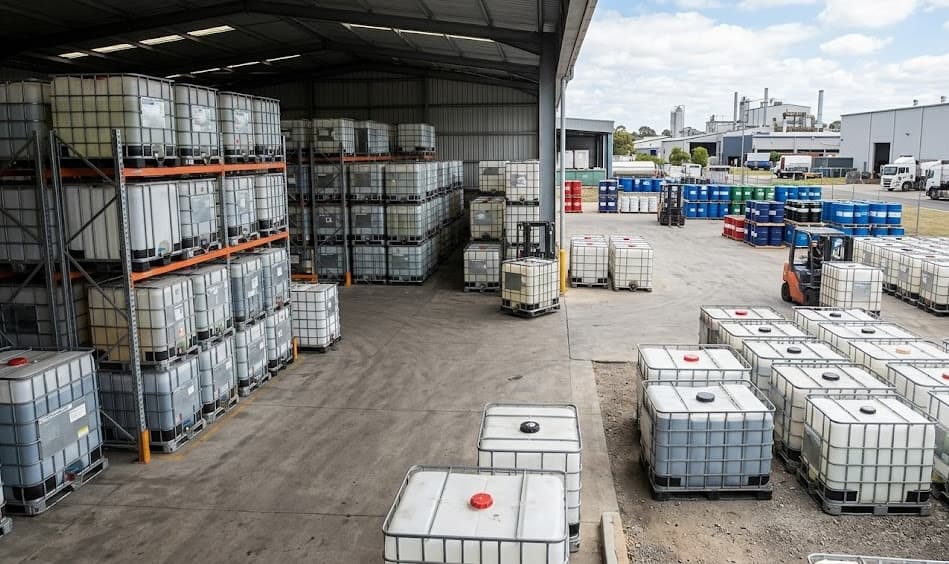
IBC Totes vs. 55-Gallon Drums
A complete side-by-side comparison to help you decide which container is right for your operation — and whether it is time to make the switch.
The Core Difference
The 55-gallon steel or plastic drum has been the workhorse of liquid handling for over a century. It is simple, widely available, and universally understood. But for operations handling hundreds or thousands of gallons, drums introduce significant labor, storage, and cost inefficiencies.
An IBC tote holds 275 to 330 gallons — the equivalent of 5 to 6 drums — in a single forklift-movable, stackable container. For many operations, switching from drums to IBCs reduces per-gallon handling cost by 30 to 50 percent.
That said, drums remain the better option for small-batch production, products requiring tight inventory segregation, or facilities with limited ceiling height and no forklift access. The right choice depends on your specific volume, logistics, and regulatory requirements.
This guide provides a data-driven comparison across every dimension that matters: cost, space, labor, environmental impact, and compliance.
Side-by-Side Comparison
| Factor | 55-Gal Drum | 275-Gal IBC | Winner |
|---|---|---|---|
| Capacity | 55 gal (208 L) | 275 gal (1,041 L) | IBC — 5x capacity |
| Footprint per gallon | ~0.14 ft² / gal | ~0.05 ft² / gal | IBC — 65% less floor space |
| Weight empty | ~18 lbs (steel) / ~22 lbs (plastic) | ~118 lbs | Drum — lighter individual unit |
| Stackable loaded? | 4 drums per pallet, 2 pallets high | 2 IBCs high | Tie — similar density |
| Forklift moves per 1,000 gal | ~5 pallet loads (4 drums each) | ~4 IBCs (single unit each) | IBC — fewer touches |
| Discharge method | Drum pump or tilt/pour | Gravity via bottom valve or pump | IBC — faster, less labor |
| Residual product (waste) | 2–5% left in drum | <0.5% via bottom drain | IBC — 3–10x less waste |
| Cleaning/reconditioning | Full wash and recoating needed | Rebottle or full wash | Tie — depends on system |
| UN/DOT hazmat rated? | Yes (1A1/1A2 steel, 1H1/1H2 plastic) | Yes (31HA1 composite, 31A metal) | Tie |
| Typical new price | $30–80 each | $250–400 each | Drum per unit; IBC per gallon |
| Reconditioned price | $15–35 each | $90–180 each | IBC — lower per-gallon cost |
Cost Analysis: Per Gallon Stored
While a single IBC costs more than a single drum, the per-gallon economics heavily favor IBCs at scale. Here is a realistic cost comparison for storing 1,000 gallons of a non-hazardous water-based chemical.
| Cost Item | Drums (19 needed) | IBCs (4 needed) | Savings |
|---|---|---|---|
| Container cost (reconditioned) | 19 x $25 = $475 | 4 x $120 = $480 | ~Even |
| Pallet cost | 5 pallets x $12 = $60 | Integrated (included) | $60 |
| Labor to fill (est.) | 19 connections x 5 min = 95 min | 4 connections x 5 min = 20 min | 75 min labor |
| Forklift moves | 5 pallet moves | 4 single moves | 20% fewer |
| Floor space | 5 pallet spots (~67 ft²) | 4 pallet spots (~53 ft²) | ~20% less |
| Residual product lost | ~2% = ~20 gal wasted | ~0.5% = ~5 gal wasted | 15 gal saved |
| Disposal / return cost | 19 drums to manage | 4 IBCs to manage | 79% fewer units |
The total cost-per-gallon for containers is roughly similar, but the labor savings, reduced waste, and lower handling complexity deliver significant ROI — especially for operations moving 10,000+ gallons per month. At that scale, the drum-to-IBC switch typically pays for itself within 2 to 4 months.
Space Efficiency Comparison
Drums
- Round shape wastes ~21% of pallet area (corners are empty)
- 4 drums per standard 48" x 40" pallet
- 220 gallons per pallet spot
- Drum pallets can be double-stacked in racking
- 20 pallets (80 drums) fit per 53' trailer = 4,400 gal
IBCs
- Square shape fills the pallet completely — no wasted corners
- 1 IBC per pallet spot (275 or 330 gal)
- 275–330 gallons per pallet spot
- IBCs can be double-stacked (2 high loaded)
- 20 IBCs fit per 53' trailer single-layer = 5,500–6,600 gal
Bottom line: IBCs store 25–50% more liquid per square foot of warehouse floor compared to drums on pallets. On a truck, the advantage is even greater because IBCs eliminate the dead space between round drums.
Environmental Comparison
Sustainability is increasingly a factor in packaging decisions. Here is how IBCs and drums compare on key environmental metrics.
| Environmental Factor | 55-Gal Drums | 275-Gal IBCs |
|---|---|---|
| Packaging material per gallon | ~0.33 lbs/gal (steel) or ~0.40 lbs/gal (plastic) | ~0.43 lbs/gal (but reusable) |
| Typical reuse cycles | 1–3 (steel); 1–2 (plastic) | 5–15 (rebottled cage reused indefinitely) |
| Recyclability | Steel: high. Plastic: moderate | HDPE bottle: recyclable. Steel cage: recyclable |
| Truck trips per 10,000 gal | ~2.3 truckloads | ~1.5–1.8 truckloads |
| Product waste (residual) | 2–5% per drum | <0.5% via bottom drain |
| Landfill volume | Higher per gallon of product | Much lower due to rebottling and recycling |
When to Use Drums vs. IBCs
Drums Are Better When:
- You use fewer than 200 gallons per product per month
- Strict lot segregation requires small batch sizes
- Your facility has no forklift access
- Products are hand-poured at point of use
- Ceiling height under 6 feet in storage areas
- You need many different products in small quantities
- One-way export where container return is impractical
IBCs Are Better When:
- You use 500+ gallons per product per month
- Reducing labor and handling is a priority
- You have forklift access throughout your facility
- Liquid is dispensed by pump or gravity to a process
- Warehouse floor space is at a premium
- Sustainability and waste reduction are corporate goals
- You ship full truckloads and want to maximize payload
Migration Guide: Switching from Drums to IBCs
Transitioning is straightforward if you plan ahead. Follow these steps to avoid common pitfalls.
1. Audit your current drum usage
List every product stored in drums, monthly volume, and current drum count. Identify the 2–3 highest-volume products — these are your best candidates for IBC conversion.
2. Verify chemical compatibility
Cross-reference each product's SDS with HDPE compatibility. For solvents or flammables, you may need stainless steel IBCs. See our types guide for details.
3. Check your infrastructure
Ensure your facility has forklift access where IBCs will be stored and dispensed. Verify door widths, aisle widths (minimum 10 feet for standard forklifts), and ceiling height (minimum 110 inches for stacking 275-gal IBCs 2-high).
4. Update dispensing equipment
Replace drum pumps with IBC-compatible discharge systems. Most IBCs use a 2-inch butterfly valve — you may need camlock adapters or a gravity-fed manifold.
5. Order a pilot batch
Start with your highest-volume product. Order 4–6 IBCs (reconditioned is fine for non-food), fill and run for one month, and track labor savings and waste reduction.
6. Scale and establish return logistics
Once proven, expand to other products. Set up a return program for empty IBCs — IBC West Coast picks up empties across the West Coast for reconditioning or recycling.
Real-World Cost Scenarios
Abstract comparisons only go so far. Here are three realistic scenarios based on actual operations we have helped transition on the West Coast. All figures use 2025-2026 market pricing.
Scenario 1: Agricultural Chemical Distributor -- 5,000 Gallons per Month
- •Current drum setup: 91 drums per month at $22 each (reconditioned plastic) = $2,002 in containers. Palletizing requires 23 pallets at $10 each = $230. Two workers spend 6 hours filling and palletizing drums. At $25/hour, labor = $300. Total monthly cost: approximately $2,532.
- •IBC alternative: 19 IBCs per month at $120 each (reconditioned HDPE) = $2,280 in containers. No separate pallets needed. One worker spends 2 hours filling. Labor = $50. Total monthly cost: approximately $2,330.
- •Monthly savings: $202 in direct costs plus 4 hours of freed labor. Annual savings: approximately $2,400 in direct costs. The labor hours freed up are the bigger win -- those workers can be redeployed to higher-value tasks.
Scenario 2: Cleaning Product Manufacturer -- 20,000 Gallons per Month
- •Current drum setup: 364 drums per month at $25 each (reconditioned steel) = $9,100. Pallets: 91 at $12 = $1,092. Filling labor: 3 workers, 3 days = $4,500. Forklift moves: 91 pallet loads. Product waste at 2.5%: 500 gallons lost at $3/gal = $1,500. Monthly total: approximately $16,192.
- •IBC alternative: 73 IBCs per month at $130 each = $9,490. No separate pallets. Filling labor: 1 worker, 1.5 days = $750. Forklift moves: 73 individual lifts. Product waste at 0.4%: 80 gallons lost = $240. Monthly total: approximately $10,480.
- •Monthly savings: $5,712. Annual savings: approximately $68,544. The payback period for any infrastructure changes (dispensing equipment, valve adapters) is typically under 60 days at this volume.
Scenario 3: Small Winery -- 2,000 Gallons per Month (Seasonal)
- •Current drum setup: 37 drums per month at $45 each (new food-grade steel) = $1,665. Pallets: 10 at $15 = $150. Filling labor: 1 worker, 4 hours = $100. Product waste at 3%: 60 gallons of juice at $8/gal = $480. Monthly total: approximately $2,395.
- •IBC alternative: 8 IBCs at $320 each (new food-grade HDPE) = $2,560. Filling labor: 1 worker, 1 hour = $25. Product waste at 0.3%: 6 gallons = $48. Monthly total: approximately $2,633.
- •Monthly difference: IBCs cost $238 more in direct container costs. However, the product waste savings ($432/month) make IBCs the better choice. More importantly, the time savings during the crush season -- when labor is at a premium -- is the decisive factor. Net annual benefit: approximately $2,328 plus freed labor.
Warehouse Space Efficiency: The Numbers
Warehouse space in the Bay Area and greater West Coast market costs $12 to $20 per square foot per year. Space savings from switching to IBCs translate directly into reduced rent or freed capacity for revenue-generating inventory.
| Storage Metric | Drums on Pallets | 275-Gal IBCs | IBC Advantage |
|---|---|---|---|
| Floor space for 10,000 gal (single layer) | 46 pallets x 13.3 ft2 = 612 ft2 | 37 IBCs x 13.3 ft2 = 492 ft2 | 20% less floor space |
| Floor space for 10,000 gal (stacked 2 high) | 23 pallet spots = 306 ft2 | 19 IBC spots = 253 ft2 | 17% less floor space |
| Gallons per square foot (single layer) | 16.3 gal/ft2 | 20.3 gal/ft2 | 24% more gallons per ft2 |
| Gallons per square foot (stacked 2 high) | 32.7 gal/ft2 | 39.5 gal/ft2 | 21% more gallons per ft2 |
| Trailer capacity (53-ft, single layer) | 20 pallets = 4,400 gal | 20 IBCs = 5,500 gal | 25% more per truck |
| Trailer capacity (53-ft, double stacked) | 40 pallets = 8,800 gal | 40 IBCs = 11,000 gal | 25% more per truck |
| Annual space cost at $15/ft2 (10,000 gal stored) | $4,590 / year | $3,795 / year | $795 / year saved |
The space advantage is even more significant in narrow-aisle warehouse configurations. Round drums on pallets waste corner space that square IBCs fill completely. For operations storing 50,000+ gallons, the space savings alone can justify the switch -- especially in high-rent markets like the San Francisco Bay Area, Los Angeles basin, and Portland metro area.
Labor Time Comparison: Task by Task
Labor is often the largest hidden cost in drum-based operations. Here is a task-level breakdown comparing the time required for common operations handling 1,000 gallons of product.
| Task (per 1,000 gallons) | Drums (19 units) | IBCs (4 units) | Time Saved |
|---|---|---|---|
| Position containers for filling | 19 drums placed, bungs removed -- 25 min | 4 IBCs placed, caps removed -- 8 min | 17 min |
| Connect fill hose and fill | 19 connections, 19 starts/stops -- 60 min | 4 connections, 4 starts/stops -- 16 min | 44 min |
| Seal, label, palletize | 19 bungs, 19 labels, load onto 5 pallets -- 35 min | 4 caps, 4 labels, already palletized -- 8 min | 27 min |
| Move to storage | 5 forklift trips -- 15 min | 4 forklift trips -- 12 min | 3 min |
| Dispense at point of use | 19 drum-pump setups -- 95 min total | 4 valve connections -- 12 min total | 83 min |
| Clean empty containers | 19 drums rinsed and dried -- 60 min | 4 IBCs rinsed via top fill -- 20 min | 40 min |
| Stage empties for pickup | Stack 19 drums on pallets -- 20 min | Nest 4 IBCs in staging area -- 8 min | 12 min |
Total Labor Savings: 226 Minutes per 1,000 Gallons
That is nearly 4 hours of labor saved per 1,000 gallons processed. At an average fully loaded labor cost of $35/hour (including benefits, insurance, and overhead), the labor savings alone are worth $131 per 1,000 gallons. For an operation processing 10,000 gallons per month, that translates to $1,310 per month or $15,720 per year in labor cost reduction -- before accounting for any container, space, or waste savings.
The Hybrid Approach: When to Use Both
Many operations do not need to choose exclusively between drums and IBCs. A hybrid approach uses each container where it performs best. Here is how to structure it.
Use IBCs For:
- Your 3-5 highest-volume products (the 80/20 rule applies -- a few products usually account for most of your volume)
- Bulk receiving from suppliers -- ask vendors to ship in IBCs instead of drum pallets
- Process feed tanks -- IBCs connected directly to production lines via gravity or pump
- Water and rinse solutions used in large quantities
- Products dispensed by pump at a fixed station
Keep Drums For:
- Low-volume specialty products used in small batches (under 100 gallons per month)
- Products requiring strict lot segregation for traceability (quality control samples, pilot batches)
- Hand-pour applications at point of use where gravity dispensing from an IBC is impractical
- Products shipped to customers in small quantities (retail, sample distribution)
- Hazardous waste collection where drum-by-drum tracking is required
Hybrid Implementation Tips
- •IBC-to-drum decanting: Receive bulk product in IBCs, then decant into drums for distribution to point-of-use locations within your facility. This gives you the bulk-receiving savings of IBCs with the portability of drums at the workstation.
- •Dedicated IBC dispensing stations: Set up fixed dispensing points where IBCs sit on containment pallets with connected pumps. Workers bring drums or smaller containers to the station for fills. This centralizes spill containment and reduces the number of open containers in the facility.
- •Standardize valve fittings: When running a hybrid operation, standardize on one thread type (NPS 2-inch is the most common in North America) and keep a stock of camlock adapters for compatibility with drum pumps and other equipment.
- •Track ROI by product: Monitor container costs, labor time, and waste for each product separately. This data tells you which products are ready to graduate from drums to IBCs and which should stay in drums.