OSHA Requirements for IBC Tote Handling in the Workplace
The Occupational Safety and Health Administration (OSHA) does not have regulations specifically dedicated to IBC totes, but numerous general industry standards directly apply to how these containers are handled, stored, and managed in the workplace. Understanding and complying with these requirements protects your workers and your business. This guide maps the relevant OSHA standards to common IBC tote operations.
Hazard Communication (29 CFR 1910.1200)
The Hazard Communication Standard, often called HazCom, is the most broadly applicable OSHA regulation for IBC tote operations. It requires employers to establish a comprehensive hazard communication program for any workplace where employees are exposed to hazardous chemicals.
For IBC tote operations, HazCom compliance means every IBC tote containing a hazardous chemical must be labeled with the product identifier, the appropriate hazard pictograms, signal word, and hazard and precautionary statements. Labels must be legible, in English (additional languages are permitted but English is required), and prominently displayed.
Safety Data Sheets (SDS) must be available for every hazardous chemical stored in IBC totes in the workplace. These documents must be readily accessible to employees during their work shifts. Many facilities maintain a binder of SDS documents near the IBC storage area, and electronic access via tablets or terminals at the point of use is increasingly common.
Employee training under HazCom must cover the hazards of the chemicals they work with, how to read and understand labels and SDS documents, protective measures available to them, and the details of the workplace's hazard communication program. Training must be conducted at the time of initial assignment and whenever a new chemical hazard is introduced.
Powered Industrial Trucks (29 CFR 1910.178)
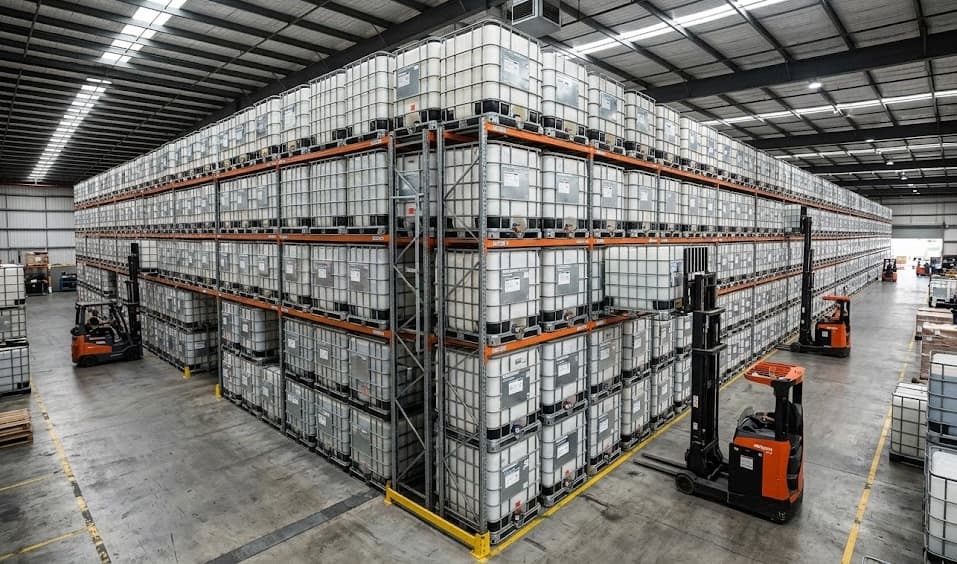
IBC totes are almost always handled with forklifts or powered pallet jacks, making the powered industrial truck standard directly applicable. This standard requires that only trained and certified operators may operate forklifts and similar equipment.
Operator training must cover vehicle inspection and maintenance, operating instructions for the specific vehicle type, load handling including weight limits and stability, traveling rules and speed limits, and refueling or recharging procedures.
Certification must be renewed at least every three years, and retraining is required after an accident, near-miss, or observed unsafe operation.
For IBC tote handling specifically, operators should understand the weight of fully loaded totes (approximately 2,300 to 2,500 pounds for a 275-gallon tote filled with water), proper fork positioning in the pallet pockets, the importance of slow, controlled movements when handling liquid-filled containers (liquid sloshing shifts the center of gravity), and stacking procedures including height limits and alignment requirements.
Walking and Working Surfaces (29 CFR 1910 Subpart D)
IBC tote operations often involve spills, drips, and wet floors, making the walking and working surfaces standard relevant. Employers must keep floors clean and in good repair, with no conditions that could cause slips, trips, or falls.
In areas where IBC totes are filled, dispensed, or stored, this means promptly cleaning up any spills or drips from valve connections, ensuring adequate drainage in areas prone to wet conditions, providing anti-slip mats or coatings in high-traffic areas near dispensing stations, and maintaining clear aisles between IBC tote rows (a minimum of 44 inches for pedestrian access, wider for forklift traffic).
Personal Protective Equipment (29 CFR 1910.132-138)
The general PPE standard requires employers to assess the workplace for hazards that require personal protective equipment and to provide appropriate PPE to employees at no cost.
Common PPE requirements for IBC tote operations include eye protection (safety glasses or goggles) when handling chemicals or making/breaking valve connections, chemical-resistant gloves appropriate for the materials being handled, foot protection (safety shoes with chemical resistance if applicable), and respiratory protection if operations generate vapors, mists, or dust above permissible exposure limits.
The specific PPE requirements depend on the materials stored in the IBC totes. Consult the SDS for each chemical to determine the appropriate protective equipment.
Flammable and Combustible Liquids (29 CFR 1910.106)
If your IBC totes contain flammable or combustible liquids, this standard imposes additional requirements for storage room design and ventilation, quantity limitations based on the storage configuration, fire protection systems (sprinklers, fire extinguishers), electrical equipment classification (explosion-proof in areas where flammable vapors may be present), and grounding and bonding during dispensing operations.
IBC totes containing flammable liquids must be stored in areas that meet the standard's requirements for the specific class and quantity of material. The standard differentiates between inside storage rooms, general purpose warehouses, and outdoor storage areas, with different requirements for each.
Grounding is particularly important for IBC totes containing flammable liquids. The HDPE bottle is non-conductive and can accumulate static charge. A grounding wire connecting the steel cage to a proper ground point prevents static discharge that could ignite flammable vapors.
Emergency Action Plans (29 CFR 1910.38)
Workplaces that use IBC totes for hazardous materials must have an emergency action plan that addresses spill response procedures specific to the materials stored, evacuation routes and procedures in case of a large release, employee roles and responsibilities during an emergency, and communication procedures for alerting employees and emergency responders.
Spill response equipment appropriate for the stored materials should be available near IBC tote storage areas. This typically includes absorbent materials (pads, pillows, socks), containment equipment (portable berms, drain covers), PPE for spill response personnel, and waste containers for contaminated absorbent and materials.
Process Safety Management (29 CFR 1910.119)
For facilities that store highly hazardous chemicals above threshold quantities, the Process Safety Management (PSM) standard imposes comprehensive requirements for managing the risks associated with these materials. While PSM applies to the facility level rather than individual containers, IBC tote operations within a PSM-covered facility must be integrated into the facility's process safety program.
Record-Keeping
OSHA requires employers to maintain records related to workplace safety, including training records for HazCom, forklift operation, and PPE use, injury and illness records (OSHA 300 log) including any incidents related to IBC tote handling, equipment inspection records for forklifts and other powered industrial trucks, and exposure monitoring records if employees are exposed to hazardous substances.
Practical Compliance Steps
Conduct a hazard assessment specific to your IBC tote operations. Walk through every aspect of how totes are received, stored, moved, dispensed from, cleaned, and shipped. Identify the hazards at each step and match them to the applicable OSHA standards.
Develop written procedures for each IBC tote operation. Clear, step-by-step procedures ensure consistency and provide a training reference. Include safety precautions, PPE requirements, and emergency procedures for each task.
Train employees thoroughly and document the training. OSHA does not accept "on-the-job training" as a substitute for formal, documented training programs.
Conduct regular inspections. Walk your IBC tote storage and handling areas weekly to identify and correct hazards before they result in injuries or citations.
Stay current with OSHA updates. Standards are periodically revised, and new guidance documents address emerging issues. OSHA's website and subscription services provide timely notification of changes.
OSHA compliance is not optional, and the penalties for violations can be substantial (up to $16,131 per violation for serious citations, and up to $161,323 per violation for willful violations as of 2025). More importantly, compliance protects the people who work with IBC totes every day.
Need IBC Totes for Your Operation?
IBC West Coast offers new, used, and reconditioned IBC totes with West Coast delivery. Get a free quote today.
Get a Free Quote