Choosing the Right IBC Tote Size for Your Application
While the 275-gallon IBC tote dominates the market, it is not the only size available, and it is not always the best choice for every application. Understanding the full range of IBC tote sizes and the factors that determine the optimal size for your needs can improve operational efficiency and reduce costs. This guide walks you through the decision-making process.
Available IBC Tote Sizes
The IBC tote market offers several standard sizes, each designed for specific use cases.
The 275-gallon (1,040-liter) tote is the global standard and accounts for the vast majority of IBC totes in circulation. Its dimensions are approximately 48 inches long by 40 inches wide by 46 inches tall. This size was designed to match standard pallet dimensions and optimize container ship and truck loading.
The 330-gallon (1,250-liter) tote is the second most common size. It shares the same 48 by 40-inch footprint as the 275-gallon model but is taller, typically about 53 inches. The additional 55 gallons of capacity come from the increased height.
The 550-gallon (2,082-liter) tote is a larger format used for high-volume applications. These containers have a larger footprint (typically 48 by 48 inches) and stand about 52 inches tall.
Smaller IBC sizes include 110-gallon and 150-gallon models, sometimes called mini IBCs. These serve niche applications where the standard sizes are too large.
Flexible IBCs (FIBCs or bulk bags) are technically a separate category but serve overlapping applications. They range from 100 to 500 gallons and are used primarily for dry goods, though some lined models can handle liquids.
Factor 1: Volume Requirements
The most obvious sizing factor is how much material you need to store or transport at a time. But the decision is not as simple as matching the tote size to the batch size.
Consider your typical order or batch quantities. If you regularly handle 250 to 270 gallons at a time, the 275-gallon tote is a natural fit. If your standard batch is 300 gallons, the 330-gallon size eliminates the need for a second partial container.
Think about fill efficiency. A partially filled IBC tote wastes both container capacity and storage space. If your typical fill volume is 200 gallons, using a 275-gallon tote means nearly 30 percent of the capacity is unused. In this scenario, either accept the inefficiency or look at combining shipments to fill totes more completely.
For high-volume operations, the 550-gallon tote reduces the number of containers needed per batch. Fewer containers means fewer connections, fewer handling operations, and less floor space required.
Factor 2: Weight Constraints
Liquid weight is a critical constraint that many people overlook when selecting IBC tote size. Water weighs approximately 8.34 pounds per gallon, so a full 275-gallon tote of water weighs about 2,294 pounds, plus the approximately 150-pound tare weight of the container itself, for a gross weight of roughly 2,444 pounds.
A 330-gallon tote of water weighs approximately 2,753 pounds, plus tare, for about 2,900 pounds gross. A 550-gallon tote of water weighs approximately 4,587 pounds plus tare, reaching nearly 4,800 pounds gross.
These weights matter because forklift capacity must match the load. Standard warehouse forklifts are typically rated for 4,000 to 6,000 pounds, easily handling 275 and 330-gallon totes. The 550-gallon tote pushes into the range where forklift capacity should be verified.
Floor loading limits may be a concern, particularly in older buildings or on elevated floors. Check your facility's floor loading specification and compare it to the per-square-foot load imposed by a filled tote.
Truck weight limits constrain how many full IBC totes can be loaded on a single trailer. A standard 53-foot dry van has a maximum payload of approximately 44,000 pounds. At 2,450 pounds per full 275-gallon tote, the weight limit allows about 18 totes per trailer, even though the physical space might accommodate 20.
For materials denser than water, these weight calculations become even more significant. A chemical with a specific gravity of 1.3, for example, weighs about 10.8 pounds per gallon. A 275-gallon tote of this material would weigh approximately 2,970 pounds plus tare -- still within most forklift ratings but approaching the limit.
Factor 3: Storage Space
The footprint of your containers determines how many will fit in your available storage space. The 275 and 330-gallon totes share the same 48 by 40-inch footprint, so the choice between them does not affect floor space utilization. However, the taller 330-gallon tote may not fit under low shelving, mezzanines, or building clearances.
The 550-gallon tote's larger footprint (48 by 48 inches) reduces the number of containers per row but increases the volume stored per square foot. In some configurations, the 550-gallon size actually provides better space utilization because fewer containers and fewer aisles are needed.
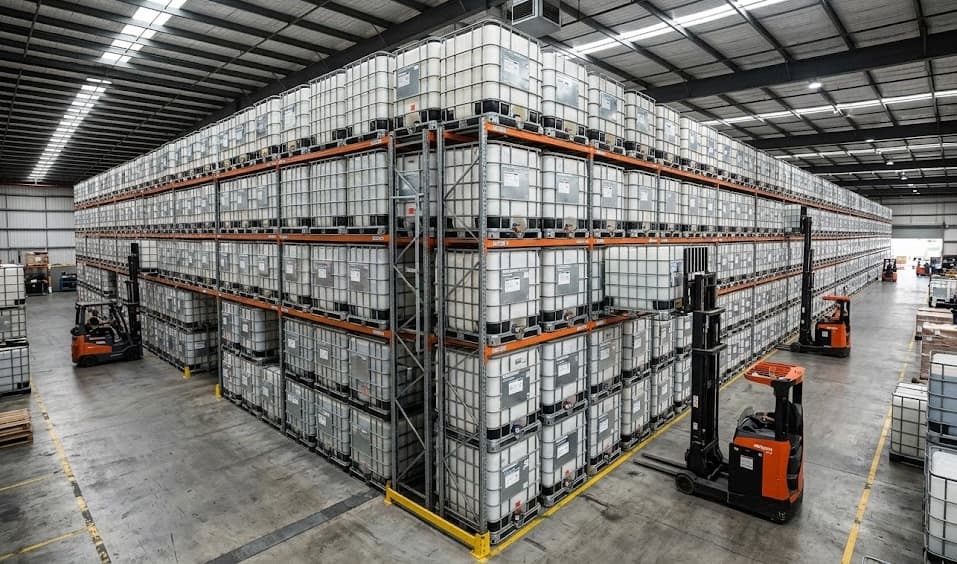
Vertical space utilization depends on stacking capabilities. Standard composite IBC totes can be stacked two high when filled. Two stacked 330-gallon totes reach approximately 106 inches (nearly 9 feet), which fits under most standard warehouse ceilings with room for sprinklers. Two stacked 275-gallon totes reach about 92 inches (7.7 feet).
Factor 4: Compatibility with Existing Infrastructure
Your existing equipment and systems may constrain your size choice. Pallet racking designed for 48 by 40-inch containers will not accommodate 48 by 48-inch models without modification. Filling equipment calibrated for 275-gallon batches requires adjustment for different sizes. Container handling procedures and training may need updating.
If you are already operating with one size, the switching cost (in equipment, procedures, and training) should be factored into any decision to change.
Factor 5: Market Availability
The 275-gallon size enjoys the broadest market availability, both new and used. Reconditioning services are widely available for this size, and replacement parts (valves, gaskets, caps) are stocked by virtually every supplier.
The 330-gallon size has good but somewhat more limited availability in the secondary market. Reconditioning services handle this size readily.
The 550-gallon size has the most limited secondary market availability. Used 550-gallon totes are harder to find, and reconditioning services may not stock replacement bottles in this size.
For businesses that rely on the secondary market for cost management, the 275-gallon size offers the most options and the most competitive pricing.
Factor 6: Transport Optimization
For businesses that ship IBC totes via truck, optimizing container size to truck capacity can yield significant logistics savings.
A standard 53-foot trailer can accommodate 20 standard 48 by 40-inch IBC totes (arranged 4 wide by 5 deep). The choice between 275 and 330-gallon totes therefore determines whether each truckload carries 5,500 or 6,600 gallons. If you regularly ship full truckloads, the 330-gallon size delivers 20 percent more product per load with no increase in shipping cost per truck.
This 20 percent improvement in shipping efficiency can be significant for high-volume operations. The annual savings on freight for a company shipping 10 truckloads per month could easily exceed the marginal cost difference between 275 and 330-gallon containers.
Making Your Decision
For most operations, the 275-gallon tote remains the default choice, supported by the broadest availability, lowest cost in the secondary market, and universal compatibility with existing infrastructure. Choose the 330-gallon size when shipping efficiency is a priority and your infrastructure accommodates the taller container. Choose the 550-gallon size for high-volume, space-constrained operations where the larger footprint and weight are manageable.
When in doubt, start with the standard and adjust based on operational experience. The flexibility of the IBC tote market means you can always add larger or smaller containers to your fleet as your needs evolve.
Need IBC Totes for Your Operation?
IBC West Coast offers new, used, and reconditioned IBC totes with West Coast delivery. Get a free quote today.
Get a Free Quote