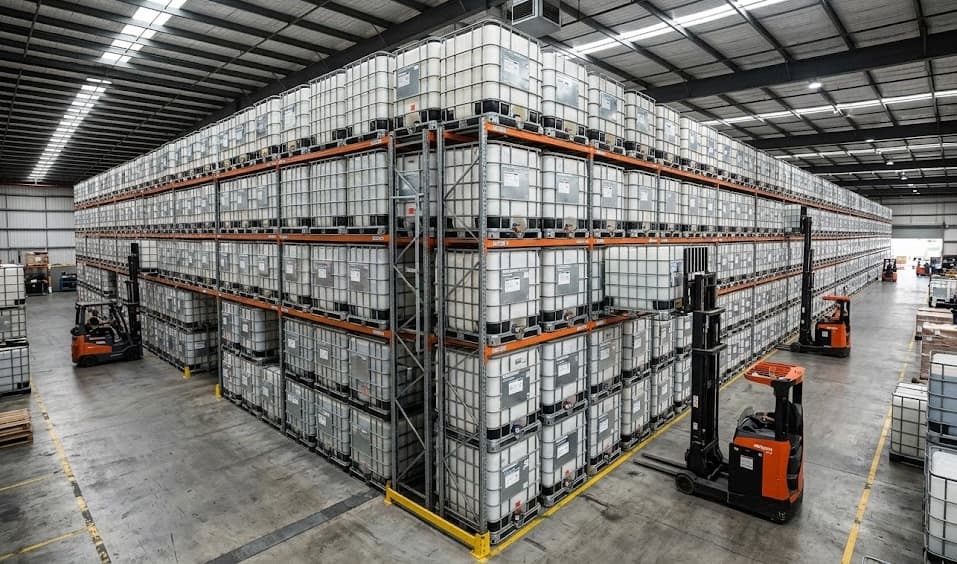
How West Coast Logistics Are Changing IBC Tote Distribution
The West Coast of the United States occupies a unique position in the national IBC tote market. The concentration of ports, diverse industrial activity, progressive environmental policies, and geographic factors create a logistics landscape that significantly influences how IBC totes are distributed, used, and recycled across the region. Understanding these dynamics helps businesses make better decisions about container sourcing and management.
Port Activity Drives Supply
The ports of Los Angeles, Long Beach, Oakland, Seattle, and Tacoma handle approximately 40 percent of all US container ship imports. This massive volume of international trade generates a continuous flow of IBC totes into the West Coast market.
Many imported products -- chemicals, food ingredients, cosmetics raw materials, industrial fluids -- arrive in IBC totes. Once the contents are delivered to the end user and emptied, these containers become available for the secondary market. The result is a steady, large-volume supply of used IBC totes concentrated in the West Coast metropolitan areas near the ports.
This supply abundance benefits West Coast businesses in several ways. Container availability is generally reliable, with fewer supply disruptions than markets farther from port activity. Pricing tends to be competitive due to the volume of containers entering the secondary market. Variety of container types and conditions is broad, making it easier to find totes meeting specific requirements. And turnaround time from order to delivery is typically shorter because local inventory levels are high.
The port-driven supply also creates a geographic gradient. Areas closest to the major ports (Los Angeles, Oakland, and the surrounding regions) have the most abundant and lowest-cost supply. As you move inland, transport costs increase the effective price of containers. This gradient influences the economics of IBC tote use versus alternative packaging for businesses in different locations.
Agricultural Demand Centers
California's Central Valley is one of the most productive agricultural regions in the world, and it is a massive consumer of IBC totes. The agriculture sector uses totes for crop protection chemicals (herbicides, pesticides, fungicides), liquid fertilizers and soil amendments, fruit juice concentrates and wine, dairy products, and irrigation water management.
The seasonal nature of agriculture creates predictable demand patterns. Spring and early summer see peak demand as planting and growing season activities require large volumes of crop inputs. Fall harvest season drives demand for containers to transport and store agricultural products. Winter is the low-demand period, when surplus containers are typically recondititioned and prepared for the next season.
This cyclical pattern means that pricing and availability can fluctuate with the agricultural calendar. Savvy buyers stock up during the winter low season when prices are most favorable.
Wine Industry Influence
California's wine industry, concentrated in Napa, Sonoma, Paso Robles, and the Central Coast, has particular IBC tote requirements. Wineries use food-grade totes for grape juice transport, wine transfer between facilities, and bulk wine shipment.
The wine industry's demand for food-grade containers has helped develop a specialized reconditioning infrastructure on the West Coast. Several facilities specialize in food-grade IBC reconditioning, providing the documented cleanliness and traceability that the wine industry requires. This infrastructure benefits other food-industry users as well, creating a robust food-grade tote supply that might not exist without the wine industry's scale.
Technology Sector Impact
The West Coast's technology sector influences the IBC tote market in less obvious ways. Semiconductor manufacturing, solar panel production, and other high-tech manufacturing processes use ultra-pure chemicals that are often shipped in specialized IBC totes. These totes, once emptied, require careful handling due to the residual chemicals they contain.
The tech sector also drives innovation in container tracking and management. West Coast companies have been early adopters of RFID-tagged IBC totes, IoT-enabled monitoring systems, and digital platforms for container fleet management. These technologies are gradually filtering into broader industrial use, improving efficiency across the IBC tote supply chain.
Transportation Networks
The West Coast's transportation infrastructure shapes how IBC totes move through the supply chain. Interstate 5, the primary north-south corridor, connects the major West Coast markets from San Diego to Seattle. The vast majority of IBC tote distribution follows this corridor.
The concentration of trucking and logistics companies in the LA Basin, Bay Area, and Pacific Northwest provides competitive freight rates for IBC tote transport. For businesses located along the I-5 corridor, the economics of sourcing containers from West Coast reconditioning facilities are favorable.
East-west movement is more expensive due to the distances involved and the mountainous terrain. This creates a natural market boundary where, beyond a certain distance inland, it becomes more economical to source containers from Midwest or regional suppliers rather than the West Coast.
Rail transport plays a limited role in individual IBC tote distribution but is significant for bulk movements. Major reconditioning facilities near rail terminals can receive and ship large quantities of containers via rail, reducing costs for high-volume transactions.
Environmental Policy Effects
California's environmental policies shape the West Coast IBC tote market in several ways. Stringent waste diversion requirements encourage reconditioning over disposal. This increases the volume of containers flowing through the secondary market, keeping supply strong and prices moderate.
Air quality regulations affect the transportation component of IBC tote logistics. California's CARB (California Air Resources Board) requirements for trucks impact shipping costs and may favor local sourcing over long-distance transport.
Water quality regulations in California create demand for IBC totes in water management applications, particularly for storm water management, construction site water control, and agricultural water recycling.
Regional Market Structure
The West Coast IBC tote market is served by a mix of national companies and regional specialists. National container companies (Mauser, Schutz, Greif) operate large-scale new production and reconditioning facilities. Regional specialists (including IBC West Coast) provide localized service with faster turnaround and more personalized attention.
The regional specialists play a critical role in the market's efficiency. They provide the local collection, sorting, and redistribution infrastructure that keeps containers moving efficiently through the circular system. Without these regional players, the logistical friction of moving containers back to centralized national facilities would reduce the economic viability of reconditioning for many smaller users.
Looking Ahead
Several trends are likely to shape the West Coast IBC tote market in coming years. Continued growth in West Coast port volume will sustain the supply of used containers. Expansion of food and agricultural processing in the Central Valley will drive demand. Increasing environmental regulation will further incentivize reconditioning over disposal. Technology-driven logistics optimization will improve the efficiency of container collection, reconditioning, and redistribution. The growth of new industries (cannabis, alternative proteins, advanced materials) will create new IBC tote applications and demand centers.
For businesses operating on the West Coast, these trends suggest that the IBC tote market will remain well-supplied, competitively priced, and increasingly supported by the infrastructure needed for efficient circular container management.
Need IBC Totes for Your Operation?
IBC West Coast offers new, used, and reconditioned IBC totes with West Coast delivery. Get a free quote today.
Get a Free Quote