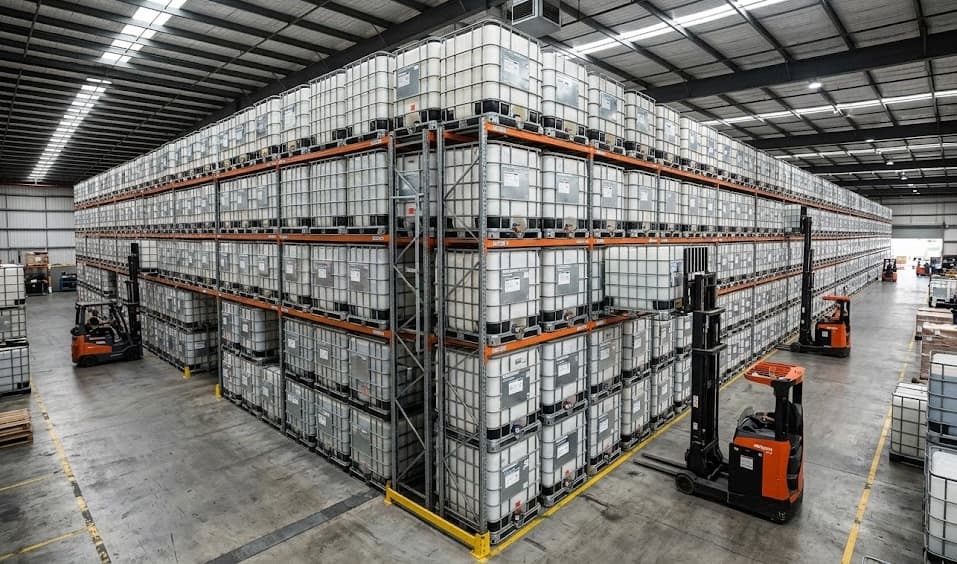
The Role of IBC Totes in the Circular Economy
The circular economy has become a central concept in sustainability discourse, but concrete examples of circular systems operating at industrial scale are less common than the theory might suggest. The IBC tote industry provides one of the most complete and well-functioning examples of circular economy principles in practice. Understanding how this system works offers valuable lessons for any business seeking to reduce waste and improve resource efficiency.
Linear vs Circular: The Basic Framework
In a linear economy, resources follow a one-directional path: extract raw materials, manufacture products, use them, and discard them as waste. This model worked when resources were abundant and disposal capacity was unlimited. Neither condition holds true today.
A circular economy seeks to keep resources in use for as long as possible, extracting maximum value before recovering and regenerating materials at the end of each product life. The key strategies are designing for durability and disassembly, maintaining and repairing products to extend their useful life, reusing components when complete products reach end of life, and recycling materials when components can no longer be reused.
The IBC tote industry employs all four strategies, creating a system that significantly outperforms the linear alternative.
The IBC Tote Circular System
A composite IBC tote is ideally suited for circular economy management because it consists of distinct components with different lifespans, each component is readily separable, materials used are fully recyclable, and a robust secondary market exists for reused and reconditioned containers.
The lifecycle of an IBC tote through the circular system typically proceeds through several phases.
Phase 1 is initial manufacture and first use. A new IBC tote is manufactured from virgin materials and sold to an end user who fills it with product. The end user ships the filled tote to their customer, who empties it. This first use extracts the initial value from the manufacturing investment.
Phase 2 is direct reuse. Many IBC totes are reused directly by the same company for the same product. A chemical manufacturer may ship product to a customer, receive the empty tote back, refill it, and ship again. This direct reuse cycle can continue for 2 to 4 years before the bottle or valve needs attention.
Phase 3 is secondary market sale. When an IBC tote is no longer suitable for its original use (perhaps the product has changed, or the company has switched to a different container size), it enters the secondary market. Companies like IBC West Coast purchase used totes, inspect and grade them, and resell them to buyers whose applications match the container's condition.
Phase 4 is reconditioning. When the HDPE bottle reaches the end of its useful life (due to age, UV degradation, chemical exposure, or physical damage), the tote enters the reconditioning process. The old bottle is removed, the cage and pallet are inspected and repaired if needed, and a new bottle is installed. The reconditioned tote returns to service with a new effective life.
Phase 5 is materials recycling. When components finally reach the point where repair and reconditioning are no longer viable, they are recycled as raw materials. The steel cage and pallet are recycled as scrap steel. The HDPE bottle is ground into pellets and used in manufacturing new plastic products. Even the wooden pallet, if applicable, is chipped for mulch or biomass fuel.
Value Retention Analysis
To quantify the circular economy benefit, consider the value retained at each phase compared to the linear alternative.
In a linear model, a 300-dollar tote used once and discarded has a total lifetime value extraction of one use cycle. All 300 dollars of manufacturing value becomes waste.
In the circular model, the same tote might complete 4 direct reuse cycles (Phase 2), then be sold on the secondary market for 90 dollars and complete 3 more cycles with a second user (Phase 3). The bottle is then replaced for 120 dollars during reconditioning (Phase 4), and the tote completes another 4 cycles. This pattern might repeat 3 to 4 times over a 20-year cage life.
The total value extraction from the circular model might look like this: 4 cycles of direct use (original user), 3 cycles via secondary market, 4 cycles after first reconditioning, 3 cycles via secondary market again, 4 cycles after second reconditioning, 3 cycles via secondary market again, and 4 cycles after third reconditioning, totaling 25 use cycles from an initial investment of 300 dollars plus three reconditionings at 120 dollars each (660 dollars total) versus 25 new totes at 300 dollars each (7,500 dollars) in the linear model.
The circular model captures 91 percent less virgin material cost while delivering the same number of use cycles.
Environmental Value
The environmental benefits mirror the economic ones. Each reconditioning cycle avoids the production of a complete new tote, saving approximately 50 to 90 kg of CO2e in manufacturing emissions, 30 to 55 pounds of virgin HDPE, 55 to 70 pounds of virgin steel, and hundreds of gallons of industrial water.
Over 25 cycles, the circular model avoids the equivalent of manufacturing approximately 22 new totes (accounting for the reconditioned bottles produced). The total material savings amount to several hundred pounds of plastic, more than a thousand pounds of steel, and several tons of CO2e emissions.
Enabling Factors
The IBC tote circular economy works because several enabling factors align.
Standardization makes it possible for totes from any manufacturer to enter the secondary market and be used by any buyer. The standard dimensions, valve connections, and pallet footprint ensure universal compatibility.
Durability of the steel cage provides a long-lived chassis that supports multiple bottle replacements. The cage's 15 to 20-year lifespan is the anchor of the circular system.
Modularity allows the bottle, valve, and pallet to be replaced independently. This means that degradation of one component does not condemn the entire assembly.
Economic incentive is critical. The circular system works because it saves money for every participant. End users save on container costs. Reconditioners generate revenue from processing used containers. Recyclers earn income from material recovery. No subsidy or mandate is required to drive participation.
Market infrastructure connects supply with demand. Companies specializing in used IBC totes create an efficient marketplace where containers move from users who no longer need them to buyers who do.
Lessons for Other Industries
The success of the IBC tote circular economy offers lessons that other industries can apply.
Design for circularity from the start. The composite IBC tote's modular design (replaceable bottle, durable cage) is what enables the circular system. Products designed as monolithic units are much harder to maintain, repair, and recondition.
Create market infrastructure. Circular material flows need someone to aggregate, process, and redistribute used items. Without the network of reconditioning and recycling companies, used IBC totes would simply pile up.
Align economics with sustainability. The most successful circular systems are those where the sustainable choice is also the economical choice. When reconditioned totes cost less than new ones, the market drives circularity naturally.
Standardize where possible. Industry-wide standards for dimensions, connections, and quality grades make it possible for products to move between users freely. Proprietary designs that lock users into specific supply chains impede circular flows.
The IBC tote industry demonstrates that a circular economy is not a theoretical ideal but a practical, profitable reality. The principles that make it work -- modularity, durability, standardization, and economic alignment -- are applicable to packaging and products across the industrial spectrum.
Need IBC Totes for Your Operation?
IBC West Coast offers new, used, and reconditioned IBC totes with West Coast delivery. Get a free quote today.
Get a Free Quote