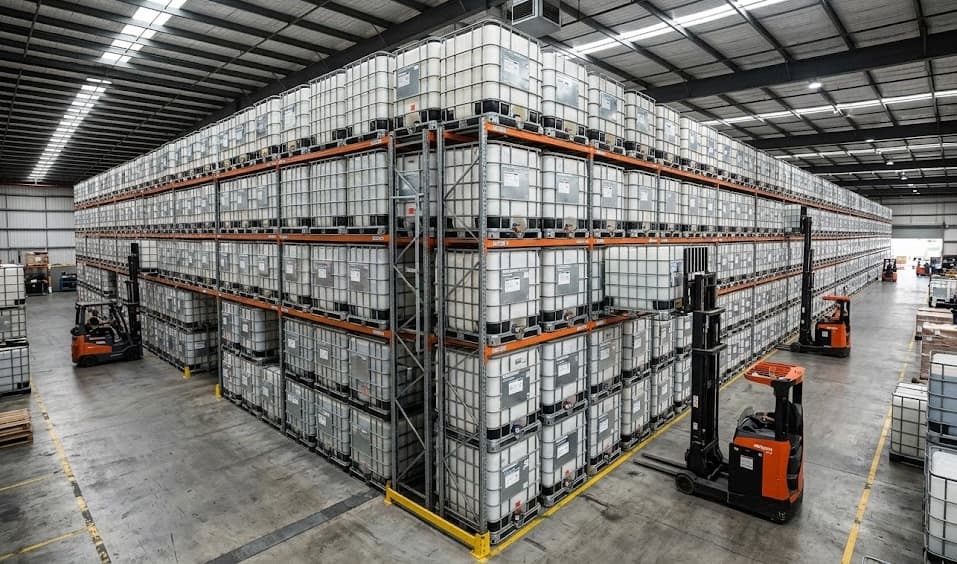
The Environmental Impact of IBC Tote Recycling: Facts and Figures
The environmental case for IBC tote recycling and reconditioning is compelling, but it is most powerful when supported by concrete data. This article examines the measurable environmental benefits of extending IBC tote life through reconditioning and recycling, providing the facts and figures that quantify the difference these practices make.
The Carbon Footprint of a New IBC Tote
To understand the environmental benefit of recycling, we first need to establish the baseline: the carbon footprint of manufacturing a new composite IBC tote.
The HDPE bottle requires approximately 40 to 55 pounds of virgin high-density polyethylene. Producing one pound of HDPE from petroleum feedstock generates approximately 1.8 to 2.0 kg of CO2 equivalent emissions, accounting for raw material extraction, refining, polymerization, and transport. The bottle alone therefore represents 72 to 110 kg of CO2e.
The steel cage uses approximately 55 to 70 pounds of galvanized steel. Steel production generates roughly 1.85 kg of CO2e per kilogram, placing the cage's carbon footprint at approximately 46 to 59 kg of CO2e.
Manufacturing energy (blow molding, welding, assembly, testing) adds another 15 to 25 kg of CO2e per unit. Transportation of raw materials and finished products adds a variable amount depending on distances, but a reasonable estimate is 10 to 20 kg of CO2e.
The total carbon footprint of a new composite IBC tote is therefore approximately 143 to 214 kg of CO2e, with a midpoint of roughly 175 kg CO2e per container. This is equivalent to driving an average car about 430 miles.
The Reconditioning Advantage
Reconditioning an IBC tote (replacing the HDPE bottle while retaining the cage and pallet) requires manufacturing a new bottle (72 to 110 kg CO2e), cleaning and inspecting the cage (minimal energy input, approximately 2 to 5 kg CO2e), assembling the reconditioned unit (5 to 10 kg CO2e), and recycling the old bottle (which generates a credit by displacing virgin material production).
The net carbon footprint of a reconditioned IBC tote is approximately 80 to 125 kg CO2e, depending on the efficiency of the reconditioning operation and the recycling credit for the old bottle. This represents a 35 to 45 percent reduction compared to manufacturing a new unit.
Over the lifetime of a cage that goes through four reconditioning cycles, the cumulative savings are substantial. Four reconditioned totes produce approximately 320 to 500 kg CO2e total, versus 572 to 856 kg CO2e for four new totes. The savings of 250 to 350 kg CO2e per cage lifetime is equivalent to eliminating 600 to 850 miles of driving per container.
Water and Energy Savings
Beyond carbon emissions, reconditioning conserves water and energy throughout the supply chain.
Manufacturing HDPE from virgin feedstock requires significant water input for cooling, washing, and processing. Estimates range from 10 to 15 gallons of water per pound of HDPE produced. A single IBC bottle therefore requires 400 to 825 gallons of water in its production.
Steel production is even more water-intensive, with estimates ranging from 10,000 to 60,000 gallons per ton. The cage accounts for a substantial water footprint that is entirely avoided when the cage is reused through reconditioning.
Energy savings from reconditioning versus new production are proportional to the carbon savings, reflecting the heavy reliance on fossil fuels in materials production. Each reconditioning cycle avoids the energy equivalent of approximately 15 to 25 gallons of gasoline per container.
Landfill Diversion
An IBC tote sent to landfill takes up approximately 80 cubic feet of space. The HDPE bottle will not decompose in any meaningful timeframe -- polyethylene is estimated to persist in landfill conditions for hundreds of years. The galvanized steel cage will eventually corrode but represents a permanent loss of recyclable material.
The US industrial sector generates millions of IBC totes per year. Without active reconditioning and recycling programs, a significant portion of these containers would end up in landfills. The reconditioning industry diverts an estimated 8 to 12 million containers from landfill annually in North America alone, representing millions of cubic feet of avoided waste.
On the West Coast, where environmental regulations and awareness are particularly strong, the IBC tote recycling rate is among the highest in the nation. California's recycling infrastructure and environmental policies encourage container reuse, and companies like IBC West Coast play a vital role in keeping used totes in productive circulation rather than allowing them to become waste.
The Circular Economy in Practice
IBC tote reconditioning is one of the clearest examples of circular economy principles applied to industrial packaging. The circular model works as follows.
A new IBC tote is manufactured and sold to an end user. The end user fills, ships, and empties the tote. The empty tote is returned to a reconditioning facility. The facility inspects the cage and pallet, replaces the bottle, installs new gaskets and valve components as needed, and sells the reconditioned tote. The old HDPE bottle is ground into flakes and sold to manufacturers of plastic lumber, drainage pipe, and other products. The cycle repeats until the cage reaches end of life, at which point the steel is recycled and the materials return to the manufacturing stream.
At no point in this cycle does material become waste. Every component is either reused or recycled, maintaining the value of the raw materials within the economic system. This stands in stark contrast to the linear model (manufacture, use, dispose) that has historically dominated industrial packaging.
Measuring Your Own Impact
If you are considering the switch from single-use to reconditioned IBC totes, here is a simple framework for estimating your environmental benefit.
Count the number of IBC totes your operation uses per year. Estimate how many of those currently go to landfill versus reconditioning or recycling. Calculate the carbon savings by multiplying the number of totes diverted from landfill by the reconditioning carbon savings (approximately 50 to 90 kg CO2e per tote). Translate the savings into equivalent metrics that are meaningful to your stakeholders: miles of driving avoided, homes powered for a day, trees planted equivalent, and similar comparisons.
For a mid-sized operation using 200 IBC totes per year, switching from single-use to a reconditioning program could save approximately 10,000 to 18,000 kg of CO2e annually -- equivalent to taking two to four cars off the road permanently.
Beyond Carbon: Broader Environmental Benefits
While carbon footprint gets the most attention, IBC tote recycling delivers environmental benefits across multiple dimensions. Reduced petroleum consumption (less virgin HDPE production), reduced mining impacts (less iron ore extraction for steel), reduced industrial water consumption, reduced air pollution from manufacturing processes, and reduced transport emissions from shipping lighter containers all contribute to the overall environmental picture.
The cumulative effect of industry-wide reconditioning and recycling practices is substantial. It demonstrates that sustainable practices and sound economics are not in conflict -- they are complementary.
The data supports a clear conclusion: IBC tote recycling and reconditioning represent one of the most impactful sustainability practices available to industrial operations today.
Need IBC Totes for Your Operation?
IBC West Coast offers new, used, and reconditioned IBC totes with West Coast delivery. Get a free quote today.
Get a Free Quote