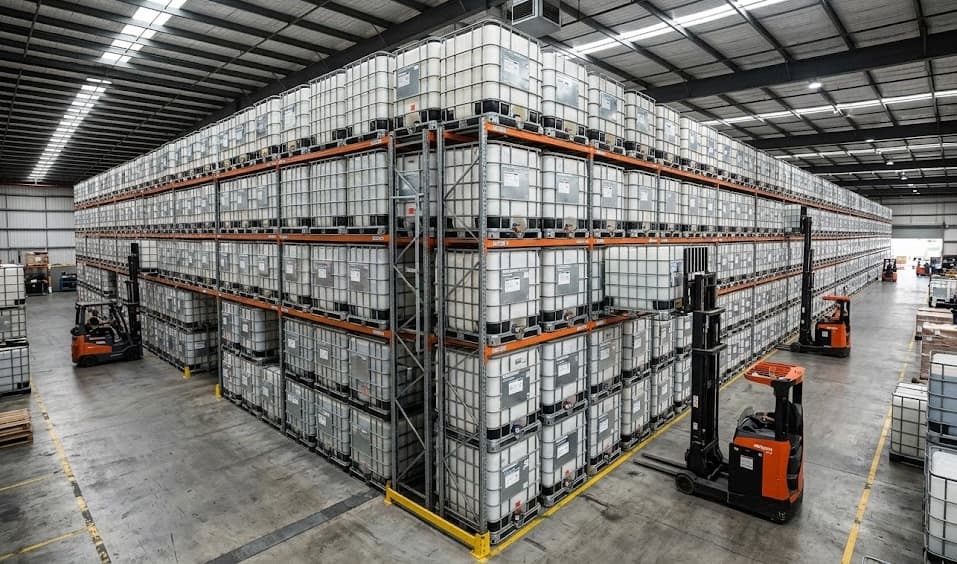
Cost Analysis: New vs Used vs Reconditioned IBC Totes
The choice between new, used, and reconditioned IBC totes is primarily a financial decision, but the real costs extend well beyond the purchase price. A complete cost analysis must account for the total cost of ownership over the container's service life, including maintenance, downtime, and disposal. This analysis provides the framework for making the most economically sound choice for your operation.
Purchase Price Comparison
At the most basic level, the price differences between new, used, and reconditioned IBC totes are significant.
New IBC totes range from 200 to 400 dollars for standard composite totes, depending on the manufacturer, specifications, and order quantity. Food-grade totes tend to be at the higher end, while standard industrial models are more affordable. Volume discounts can reduce per-unit costs by 10 to 20 percent for large orders.
Reconditioned IBC totes (new bottle in a used cage) typically cost 100 to 180 dollars, representing a 40 to 55 percent discount compared to new. The price depends on the quality of the cage, the type of bottle installed, and the reconditioner's reputation. Food-grade reconditioned totes are at the upper end of this range.
Used IBC totes in Grade B condition (the most common grade) range from 60 to 130 dollars, or 50 to 70 percent less than new. Grade A used totes sell for 90 to 170 dollars, while Grade C totes can be found for 30 to 75 dollars.
These prices represent typical market conditions but fluctuate based on supply and demand, geographic location, and raw material costs. The West Coast market tends to be well-supplied due to the region's high volume of industrial activity, which provides a steady stream of containers into the secondary market.
Total Cost of Ownership Model
Purchase price is only the beginning. To compare options accurately, you need to consider the total cost of ownership (TCO) over the useful life of the container. The TCO model includes purchase price, expected useful life (in years or use cycles), maintenance costs (valve replacement, gasket changes, cleaning), repair costs (cage repair, minor damage), disposal or recycling cost at end of life, and opportunity cost of downtime if a container fails in service.
Let us work through a specific example to illustrate. Consider a company that needs to maintain a fleet of 50 IBC totes for ongoing use, with containers cycling through fill, ship, and return loops approximately four times per year.
Scenario A, all new: 50 totes at 300 dollars equals 15,000 dollars initial investment. Expected bottle life of 6 years (24 cycles). Valve replacement every 2 years at 25 dollars equals 3,750 dollars total over 6 years. At end of life, 50 totes recycled at minus 5 dollars each (recycling credit) equals minus 250 dollars. Total 6-year cost: 18,500 dollars. Cost per cycle: 12.85 dollars.
Scenario B, all reconditioned: 50 totes at 140 dollars equals 7,000 dollars. Expected bottle life of 5 years (20 cycles). Valve replacement every 2 years at 25 dollars equals 2,500 dollars. End of life recycling credit minus 250 dollars. Total 5-year cost: 9,250 dollars. Cost per cycle: 9.25 dollars.
Scenario C, all used Grade B: 50 totes at 90 dollars equals 4,500 dollars. Expected bottle life of 3.5 years (14 cycles). Valve replacement at purchase and every 1.5 years at 25 dollars equals 3,750 dollars. Minor repair budget: 500 dollars. End of life recycling credit minus 250 dollars. Total 3.5-year cost: 8,500 dollars. Cost per cycle: 12.14 dollars.
This example reveals an important insight: reconditioned totes often deliver the lowest cost per cycle, combining the price advantage of the secondary market with a service life that approaches new containers. Used Grade B totes offer the lowest upfront investment but may not be the most economical on a per-cycle basis once shorter lifespan and higher maintenance are factored in.
Hidden Costs to Consider
Beyond the direct costs modeled above, several less obvious factors can affect the true economics of your choice.
Failure risk increases with container age and condition. A container that fails in service -- leaking product during transport, for example -- creates costs far beyond the container itself: product loss, cleanup expenses, potential regulatory penalties, customer dissatisfaction, and operational disruption. Lower-condition containers have higher failure rates, and the cost of a single failure can exceed the savings from buying cheaper containers.
Compatibility testing may be needed for used containers. If you are storing a different material than the previous contents, you may need to verify that residual contamination will not affect your product. This testing has a cost that applies to used containers but not to new or properly reconditioned ones.
Storage and handling costs are the same regardless of container condition, but they represent a fixed cost that is amortized across the container's useful life. Containers with shorter lifespans allocate a larger share of these overhead costs to each use cycle.
Customer perception matters in some applications. If your customers see your containers (as in delivery of bulk materials), the appearance of your containers reflects on your company. Grade A or reconditioned containers present a more professional image than Grade C containers with visible wear.
Strategic Approaches
Based on the analysis, several strategic approaches emerge.
The mixed-fleet strategy uses new or reconditioned totes for customer-facing applications and food-grade needs, while using Grade B used totes for internal operations, less sensitive materials, and non-critical storage. This approach optimizes the cost-quality balance across the organization.
The reconditioning cycle involves buying new totes, using them through the first bottle life, then reconditioning them for the second cycle, and repeating until the cage reaches end of life. This maximizes the value extraction from the original investment while maintaining consistently good container quality.
The lease or rental model, offered by some IBC tote service providers, shifts the ownership and maintenance burden to the provider. You pay a per-use or monthly fee and return containers when they need reconditioning. This approach simplifies fleet management and converts a capital expense to an operating expense, though it typically costs more on a per-cycle basis than ownership.
Making the Decision
The right choice depends on your specific circumstances. Consider the sensitivity of your application (how critical is container quality), the volume and frequency of your usage (higher volumes benefit more from lower per-cycle costs), your cash flow situation (upfront investment capacity), your storage and maintenance capabilities, and your environmental and sustainability goals.
For most operations, a combination of new or reconditioned totes for primary use and Grade B used totes for secondary needs provides the best overall value. The key is matching the container quality to the application requirements and managing the fleet lifecycle actively to maximize the return on your container investment.
The bottom line: the cheapest container to buy is not always the cheapest container to own. Total cost of ownership analysis provides the clarity needed to make truly economical decisions.
Need IBC Totes for Your Operation?
IBC West Coast offers new, used, and reconditioned IBC totes with West Coast delivery. Get a free quote today.
Get a Free Quote