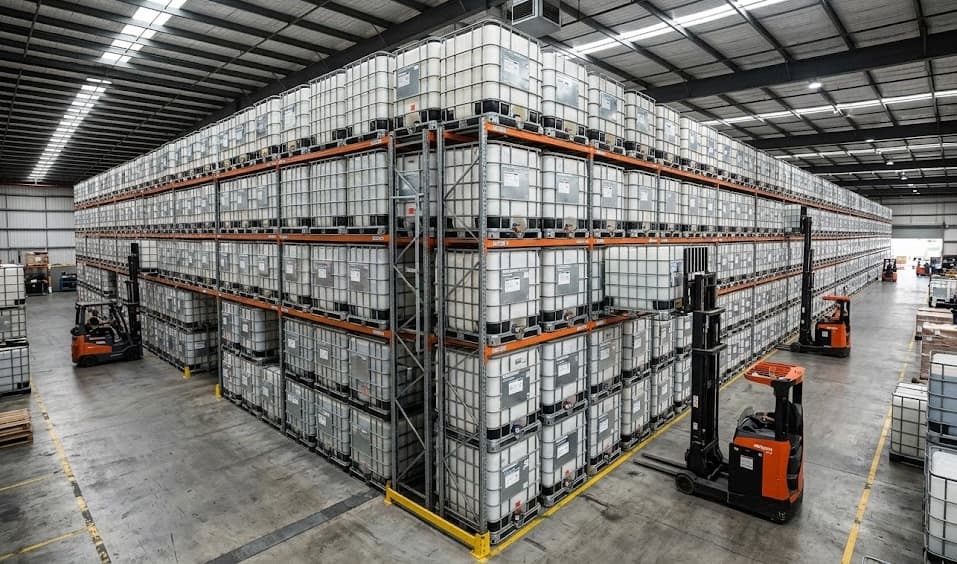
The History of Intermediate Bulk Containers: From Invention to Industry Standard
The intermediate bulk container, commonly known as the IBC tote, has become one of the most widely used vessels for storing and transporting liquids and granular materials in the industrial world. Yet few people know the story behind how these ubiquitous containers came to dominate global logistics. Understanding this history provides valuable context for anyone involved in the supply chain today.
The Origins: 1970s Innovation
The concept of the intermediate bulk container emerged in the early 1970s as industries searched for a packaging solution that bridged the gap between small drums (typically 55 gallons) and large tank trucks or rail cars. Manufacturers in Europe, particularly in Germany and the Netherlands, led the initial development. The chemical industry was the primary driver -- companies needed a way to ship moderate quantities of liquid chemicals efficiently without dedicating an entire tanker truck to a single delivery.
Early IBC designs were relatively simple: a plastic or metal inner container surrounded by a protective cage or frame. The first commercially successful models were rigid metal IBCs, essentially large square tanks made from stainless steel or carbon steel. These early containers typically held between 200 and 400 gallons and featured forklift pockets at the base for easy handling.
The Composite Revolution: 1980s
The 1980s brought the most significant advancement in IBC technology: the composite tote. Engineers developed a design combining a blow-molded high-density polyethylene (HDPE) inner bottle with a galvanized steel cage. This composite approach offered several advantages over the earlier all-metal designs. The HDPE bottle was chemically resistant to a wide range of substances, significantly lighter than steel, and could be produced at a fraction of the cost.
Schutz GmbH, a German company, is widely credited with commercializing the first composite IBC tote in 1982. Their design established many of the conventions still used today: the standard 275-gallon (1,000-liter) capacity, the pallet-integrated base, and the top-fill/bottom-discharge configuration. The 48-inch by 40-inch footprint was specifically chosen to match standard pallet dimensions used in North American and European logistics.
By the late 1980s, composite IBC totes had gained rapid adoption across Europe and were beginning to penetrate the North American market. Their stackability, ease of cleaning, and compatibility with existing warehouse infrastructure made them attractive to companies that had previously relied exclusively on drum-based logistics.
Standardization and Regulation: 1990s
The 1990s were defined by standardization efforts. As IBC totes became more common, the need for consistent safety and performance standards became apparent. The United Nations Committee of Experts on the Transport of Dangerous Goods developed the UN performance testing requirements that still govern IBC tote certification today.
These regulations established the familiar UN marking system -- the codes stamped on every certified IBC tote that indicate the container type, performance level, construction date, and approved contents. The introduction of these standards was critical for international trade, as it allowed shippers to verify that containers met minimum safety requirements regardless of where they were manufactured.
In the United States, the Department of Transportation (DOT) adopted UN standards for domestic transport, creating a unified regulatory framework. This period also saw the establishment of standard IBC tote sizes. While the 275-gallon tote remained the most popular, 330-gallon and 550-gallon variants emerged to serve specific market needs.
The Reconditioning Industry Emerges: Late 1990s to 2000s
As millions of IBC totes entered the market, a secondary industry emerged around reconditioning and reuse. Companies recognized that the steel cage of a composite IBC tote could last for decades, while the HDPE bottle could be replaced relatively easily. This led to the development of the rebottling process, where a used plastic bottle is removed from the cage and replaced with a new one.
The reconditioning industry grew rapidly in the 2000s, driven by both economic and environmental factors. A reconditioned IBC tote could be sold at 40 to 60 percent of the cost of a new unit, making it attractive to cost-conscious buyers. Simultaneously, the growing environmental movement pushed companies to consider the lifecycle impact of their packaging choices.
By 2005, the reconditioning sector had become a multi-billion-dollar global industry, with major operations on every continent. Companies like IBC West Coast emerged during this period, recognizing the West Coast's need for local reconditioning and recycling services to serve its dense concentration of agriculture, chemical, and food processing industries.
Modern Innovations: 2010s and Beyond
The past decade has brought continued innovation to the IBC tote industry. Material science advances have produced HDPE formulations with improved UV resistance, better chemical compatibility, and enhanced impact strength. Some manufacturers now offer multi-layer bottles with barrier properties that prevent oxygen permeation -- a critical feature for sensitive food and pharmaceutical products.
Design innovations have also continued. Folding IBC totes, which collapse when empty for more efficient return logistics, have gained traction in applications where container return rates are high. Smart IBC totes equipped with IoT sensors can now track location, temperature, fill level, and even chemical composition in real time.
Sustainability has become perhaps the most significant driver of change. Companies across the supply chain are increasingly focused on circular economy principles, seeking to maximize the useful life of every container and minimize waste. This has led to more sophisticated grading systems for used totes, better cleaning technologies, and improved recycling processes for end-of-life containers.
The Current Landscape
Today, the global IBC tote market is valued at over 3 billion dollars and continues to grow. The standard 275-gallon composite tote remains the workhorse of the industry, but specialized variants serve everything from hazardous chemical transport to food-grade olive oil storage. An estimated 25 million new IBC totes are produced annually, with millions more circulating in the secondary market through reconditioning programs.
The West Coast of the United States represents one of the most active IBC tote markets in the world. California alone accounts for a significant share of national IBC tote consumption, driven by the state's massive agricultural sector, thriving food and beverage industry, and extensive chemical manufacturing operations. The concentration of ports along the Pacific Coast also creates substantial demand for containers used in import and export logistics.
As we look to the future, the IBC tote industry is poised for continued evolution. Advances in materials, digitization, and sustainability practices will shape the next generation of intermediate bulk containers. But the fundamental value proposition -- efficient, safe, and cost-effective storage and transport of bulk materials -- remains as relevant as it was when the first IBC totes rolled off production lines more than five decades ago.
Need IBC Totes for Your Operation?
IBC West Coast offers new, used, and reconditioned IBC totes with West Coast delivery. Get a free quote today.
Get a Free Quote