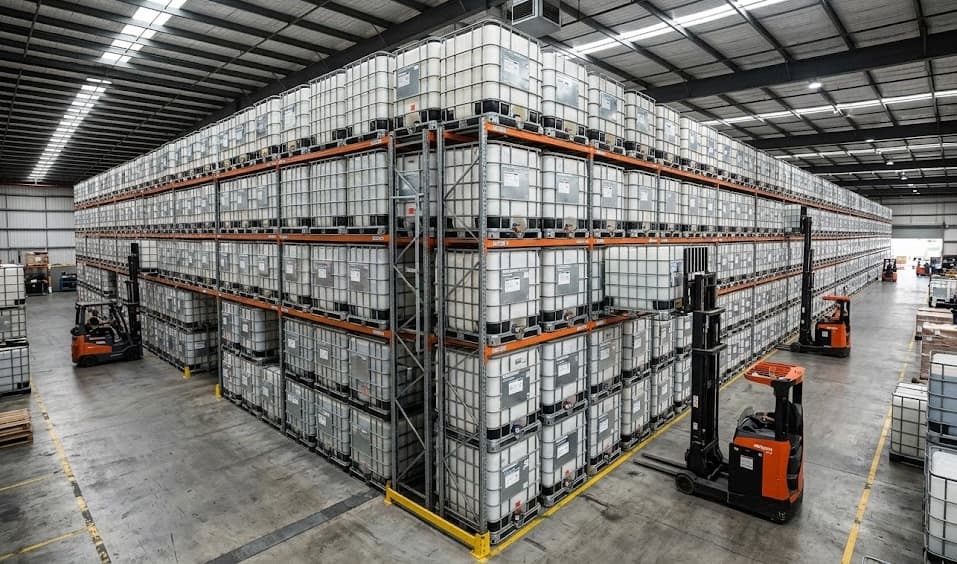
Stacking IBC Totes Safely: Best Practices for Warehouse Storage
Proper stacking of IBC totes is fundamental to warehouse safety and operational efficiency. While IBC totes are designed to be stacked, incorrect stacking practices can lead to structural failure, spills, injuries, and regulatory violations. This guide covers the principles and practices of safe IBC tote stacking.
Understanding Stacking Ratings
Every UN-certified IBC tote has a stacking rating that indicates the maximum load it can support from above. This rating is determined during the manufacturing testing process and is expressed in one of two ways: as a maximum stacking weight in kilograms, or as a maximum number of identical containers that can be stacked.
The stacking rating applies to a fully loaded container in new condition. As totes age and their structural components wear, the effective stacking capacity may decrease. This is particularly important for the steel cage, where corrosion at weld points can reduce structural integrity.
For standard composite IBC totes (275-gallon capacity), the typical stacking rating allows for two high (one container on top of another) when fully loaded. Some premium models are rated for three-high stacking, but this rating should be verified with the specific manufacturer and model.
Ground-Level Requirements
The foundation of safe stacking literally starts from the ground up. The surface on which the bottom tote rests must be flat, level, and capable of supporting the combined weight of all stacked containers.
A fully loaded 275-gallon IBC tote weighs approximately 2,300 to 2,500 pounds, depending on the specific gravity of the contents. A two-high stack therefore places approximately 5,000 pounds on a footprint of roughly 13 square feet, or about 385 pounds per square foot.
Most commercial warehouse floors can handle this load without issue, but older floors, outdoor surfaces, and areas with underground utilities should be verified. Uneven surfaces create point loads on the lower container's cage and pallet that can cause localized failure.
For outdoor storage on unpaved surfaces, use a level concrete pad or compacted gravel base. Soft ground, mud, or uneven terrain can cause the bottom container to settle unevenly, compromising the entire stack.
Alignment Is Critical
When stacking IBC totes, the upper container must be placed squarely on the lower one, with the pallet of the upper container sitting fully on the top frame of the lower container's cage. Misalignment creates uneven loading that can buckle cage bars or cause the upper container to slide off.
Proper alignment means the pallet feet of the upper container sit within the perimeter of the lower container's top frame. The upper container should not overhang the lower container in any direction. All four sides should be approximately flush when viewed from the side.
Even a few inches of misalignment can create significant leverage forces on the cage structure. In a worst-case scenario, a misaligned upper container can shift during transport or seismic activity, potentially falling from height and causing serious injury or environmental damage.
Same-Size Stacking Only
Only stack IBC totes of the same size and type on top of each other. Mixing different sizes (for example, stacking a 275-gallon tote on a 330-gallon tote) creates alignment issues and may exceed the structural limits of the lower container.
Similarly, do not stack IBC totes on top of drums, boxes, or other container types. The load distribution characteristics are different, and the result can be unpredictable structural failure.
Full vs Empty Stacking
The stacking rules differ for full and empty containers. Full containers are heavier and more stable due to their lower center of gravity. The liquid contents help distribute loads evenly across the base.
Empty containers can be stacked higher than full ones because they weigh much less (typically 100 to 150 pounds each). However, empty totes are more susceptible to wind loads in outdoor storage. High winds can topple empty IBC stacks, so secure them with strapping or store them in wind-protected areas.
A common mistake is stacking full containers on top of empty ones. This should never be done. The empty container below will not support the weight of the full container above, leading to cage collapse.
Temperature and Environmental Considerations
Extreme temperatures affect stacking safety. In cold weather, HDPE bottles become more rigid and brittle, making them more susceptible to impact damage during stacking operations. In hot weather, HDPE softens slightly, and the bottle may bulge or deform under the weight of stacked containers, especially if stored in direct sunlight.
For temperature-sensitive situations, limit stacking height when temperatures exceed 100 degrees Fahrenheit or drop below 20 degrees Fahrenheit. Monitor containers stored outdoors in extreme conditions for any signs of deformation or structural compromise.
UV exposure from prolonged outdoor storage degrades the HDPE bottle over time. While this does not immediately affect stacking, long-term outdoor storage without UV protection accelerates the aging process and eventually reduces the container's structural capacity.
Securing Stacked Containers
In seismically active areas (including much of the West Coast), stacked IBC totes should be secured to prevent shifting or toppling during an earthquake. Methods include rack systems with lateral supports designed for IBC storage, strapping stacks together using heavy-duty ratchet straps, and positioning stacks against walls or structural elements that provide lateral support.
In transport, stacked IBC totes must be secured in accordance with DOT load securement requirements (49 CFR Part 393). This typically involves chains, straps, or blocking and bracing to prevent any movement during transit.
Common Stacking Mistakes
Based on industry incident reports, the most common stacking errors include stacking beyond the rated height, stacking on uneven or soft surfaces, misaligning upper containers on lower ones, stacking containers with damaged cages, placing full containers on empty ones, failing to secure stacks in seismic zones or during transport, and ignoring environmental factors like temperature and UV exposure.
Each of these errors has resulted in documented incidents involving property damage, environmental contamination, or personal injury. Following proper stacking procedures is not just about compliance -- it is about protecting people and operations.
Inspection Before Stacking
Before placing a container in a stack, perform a quick visual inspection of the cage (all bars straight, no severe corrosion at welds), the pallet base (no cracks, structural members intact), the top frame (level, not bent or twisted), and the bottle (no visible bulging or deformation).
A container that passes individual inspection but fails as part of a stack often has a subtle issue -- a slightly bent cage bar, a weakened weld, or a warped base -- that only becomes apparent under the additional load of stacking.
By following these guidelines, you can stack IBC totes safely and efficiently, maximizing your storage capacity while protecting your personnel, products, and facility.
Need IBC Totes for Your Operation?
IBC West Coast offers new, used, and reconditioned IBC totes with West Coast delivery. Get a free quote today.
Get a Free Quote