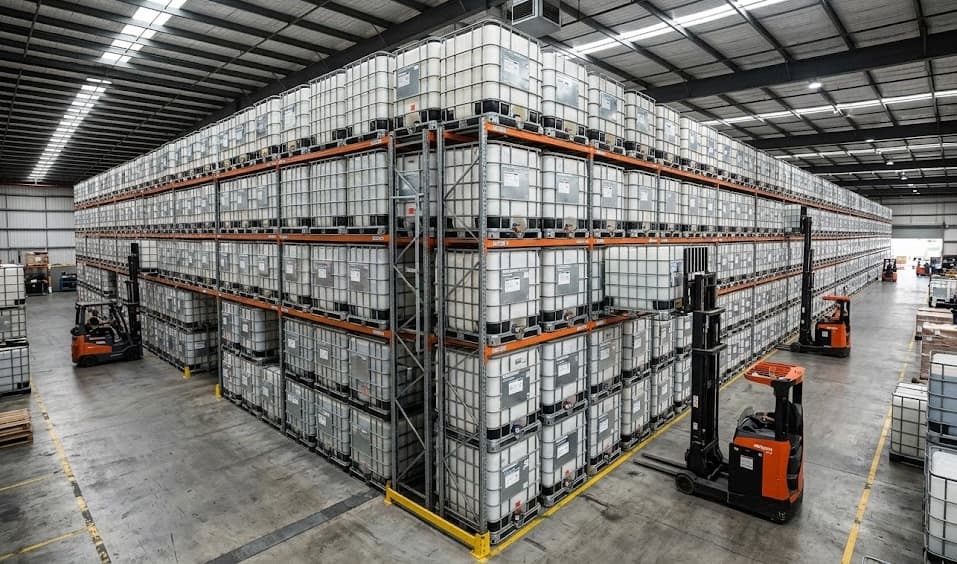
IBC Totes vs Steel Drums: A Comprehensive Comparison for Industrial Storage
The choice between IBC totes and 55-gallon steel drums is one of the most common decisions facing operations managers, procurement teams, and logistics professionals in industrial settings. Both container types have served industry for decades, and each has distinct advantages depending on the application. This comprehensive comparison covers every factor you need to consider.
Capacity and Space Efficiency
The most obvious difference between IBC totes and steel drums is capacity. A standard 275-gallon IBC tote holds exactly five times the volume of a 55-gallon drum. This simple math has profound implications for storage and logistics.
A single IBC tote occupies a floor footprint of approximately 48 inches by 40 inches and stands about 46 inches tall. To store the equivalent 275 gallons in drums, you would need five 55-gallon drums, which together occupy approximately 60 inches by 48 inches of floor space (arranged in a tight pattern). The IBC tote uses roughly 33 percent less floor space for the same volume of liquid.
The advantage extends to vertical space as well. IBC totes are designed to stack two or three high when filled, depending on the specific model and contents. While drums can also be stacked, they require palletizing first, and the typical drum stack takes up more cubic footage per gallon stored.
In warehouse settings where space is at a premium, the transition from drums to IBC totes can free up substantial floor area. Some facilities report recovering 25 to 40 percent of their storage footprint after converting from drum-based to IBC-based operations.
Cost Per Gallon
When evaluating costs, the per-gallon metric provides the most meaningful comparison. A new 55-gallon steel drum typically costs between 40 and 80 dollars, depending on specification and market conditions. That translates to roughly 0.73 to 1.45 dollars per gallon of capacity.
A new 275-gallon composite IBC tote typically costs between 200 and 350 dollars, or approximately 0.73 to 1.27 dollars per gallon. At the new-purchase level, the cost per gallon is roughly comparable.
However, the used and reconditioned market shifts this equation significantly. Used IBC totes in Grade B condition can be purchased for 75 to 150 dollars, bringing the cost per gallon down to 0.27 to 0.55 dollars. Used drums in comparable condition typically sell for 15 to 35 dollars, or 0.27 to 0.64 dollars per gallon. The secondary market maintains rough parity, though IBC totes often edge ahead at scale due to their greater volume-to-cost ratio.
Handling and Labor
This is where IBC totes pull decisively ahead. A single IBC tote can be moved with a standard forklift or pallet jack -- one operator, one movement, 275 gallons relocated. Moving the equivalent volume in drums requires five separate handling operations, even if the drums are palletized.
The labor savings compound quickly. Consider a scenario where you need to receive, store, and eventually dispense 10,000 gallons of a liquid product. With IBC totes, that requires handling approximately 36 containers. With drums, the same volume requires 182 individual containers. The reduction in handling time translates directly to lower labor costs and faster throughput.
Dispensing from IBC totes is also more efficient. The standard bottom-discharge valve allows gravity-fed dispensing without pumps in many applications. Drums typically require a pump or siphon for dispensing, adding equipment cost and setup time.
Material Compatibility
Steel drums offer broader chemical compatibility out of the box. Carbon steel and stainless steel can safely contain many aggressive chemicals, solvents, and materials at elevated temperatures. Lined steel drums (with epoxy or phenolic coatings) extend this range further.
Composite IBC totes, with their HDPE bottles, are compatible with a wide range of chemicals but are not suitable for all substances. Strong oxidizers, certain solvents (such as some chlorinated hydrocarbons), and materials that require elevated storage temperatures above the HDPE rating can degrade the bottle. However, for the vast majority of water-based solutions, mild chemicals, food products, and agricultural chemicals, HDPE provides excellent compatibility.
For operations that handle multiple product types, a mixed fleet of both IBC totes and steel drums may be the optimal approach -- using IBC totes for compatible products and drums for materials that require steel containment.
Safety Considerations
Both container types, when properly maintained and used within their rated parameters, provide safe storage and transport. However, the risk profiles differ.
IBC totes have a lower center of gravity when filled, making them less prone to tipping during transport. Their integrated pallet base means they do not require separate palletizing, eliminating one common source of handling accidents. The enclosed valve system reduces spill risk during dispensing.
Steel drums have the advantage of being more robust against physical impacts. A forklift collision that might crack an HDPE bottle would likely only dent a steel drum. Drums also provide better fire resistance, which matters in applications involving flammable materials.
For hazardous material transport, both container types can be certified to UN/DOT standards. The specific certification requirements depend on the contents, and not all IBC totes or drums are rated for all hazmat classifications. Always verify the UN marking and certification before using any container for regulated materials.
Environmental Impact
From a sustainability perspective, IBC totes generally have a more favorable environmental profile. The reconditioning process for an IBC tote (replacing the bottle while retaining the cage) consumes less material and energy than manufacturing a new drum. The rebottling process typically uses about 40 percent less raw material than producing a complete new tote.
IBC totes are also more efficient in transport, which reduces the carbon footprint per gallon shipped. Fewer containers mean fewer truck movements, less fuel consumed, and lower emissions. A truck loaded with IBC totes will carry more product than the same truck loaded with drums.
At end of life, both containers are recyclable. Steel drums can be melted and reformed indefinitely. IBC tote components are recycled separately -- the steel cage is recycled as scrap metal, and the HDPE bottle is ground into pellets for reuse in manufacturing plastic lumber, drainage pipe, and other products.
When to Choose IBC Totes
IBC totes are the clear choice when you need to store or transport large volumes (1,000 gallons or more at a time), when labor efficiency and handling speed matter, when floor space is limited, when you are moving water-based or HDPE-compatible liquids, or when sustainability is a business priority.
When to Choose Steel Drums
Steel drums remain the better option for smaller volume needs (under 500 gallons at a time), for materials incompatible with HDPE, for high-temperature storage, when dealing with aggressive solvents or oxidizers, or when the material requires steel containment for regulatory compliance.
The Hybrid Approach
Many sophisticated operations use both container types strategically. IBC totes serve as the primary storage and transport vessel for high-volume, compatible materials. Steel drums handle specialty chemicals, smaller-volume products, or materials that require steel containment.
This hybrid approach maximizes the advantages of each container type while compensating for their respective limitations. The key is matching the right container to each specific material and application rather than applying a one-size-fits-all approach.
Understanding the strengths and limitations of each option empowers you to make decisions that optimize cost, efficiency, safety, and environmental impact across your operation.
Need IBC Totes for Your Operation?
IBC West Coast offers new, used, and reconditioned IBC totes with West Coast delivery. Get a free quote today.
Get a Free Quote